As Mali transitions from the shadow of Wagner to the formation of Africa Corps, a critical question looms: has this shift truly broken the cycle of violence against civilians, or does it merely mask the same old patterns of abuse and unchecked power? Reports indicate that despite structural changes, the lives of innocent Malians remain at risk in regions where military operations continue unabated.
Human rights under scrutiny: the persistence of abuse in Mali’s security landscape
Recent findings reveal a troubling continuity in human rights violations in Mali, even as Africa Corps takes over the mantle from Wagner. Civilians continue to face arbitrary killings, torture, and enforced disappearances, with little recourse to justice. The international community’s focus on accountability has yet to translate into meaningful action on the ground.
The transition from one security force to another has not stemmed the tide of abuse. Investigations point to persistent violations in key regions such as Ségou, Mopti, and Tombouctou, where civilians are caught in the crossfire of counterterrorism operations. The absence of robust judicial oversight and the failure to hold perpetrators accountable have allowed these practices to endure.
Civilian casualties: a pattern of violence in military operations
Amidst claims of improved security, evidence suggests that Africa Corps operations have resulted in significant civilian harm. Between June 2023 and December 2025, at least 34 civilians were killed in seven localities along the Mali-Mauritania border during joint operations involving Malian forces and Wagner personnel. Eyewitness accounts describe extrajudicial executions, where individuals were shot after arrest or while fleeing, and others subjected to horrific acts such as throat-cutting and burning.
Drone strikes have also contributed to civilian fatalities. On March 16, 2025, an attack on a market in Ejdeir reportedly killed 16 people. In November 2025, a strike on a residential area in Tangata resulted in seven deaths. Investigators found no evidence of military targets at these sites, raising serious concerns about the precautions taken and the accountability mechanisms in place.
Targeted communities: the human cost of suspicion and collective punishment
The most vulnerable groups—Fulani, Arab, and Tuareg communities—have borne the brunt of these abuses. Allegations of collaboration with armed groups have led to collective punishment, including looting of livestock, money, and personal belongings, as well as the destruction of homes and farmland. These actions exacerbate the humanitarian crisis, displacing families and disrupting livelihoods.
It is imperative to distinguish between combatants and civilians, as international humanitarian law demands. The use of collective reprisals and violence based on ethnic or community affiliation cannot be justified under any circumstances.
Torture and arbitrary detentions: the hidden scars of conflict
Beyond the battlefield, reports detail systematic torture and degrading treatment in detention centers, particularly in Léré and Nampala. Survivors describe harrowing methods, including suspension by the arms, waterboarding, electrocution, and beatings with rods, iron bars, or rifle butts. Sexual violence has also been documented.
At least five detainees are believed to have died from torture or harsh conditions. Many others remain detained without access to legal counsel or communication with family members. Disturbingly, some interrogations involved Wagner personnel working alongside Malian soldiers, with the latter failing to intervene despite the violence.
The role of Africa Corps: continuity or reform?
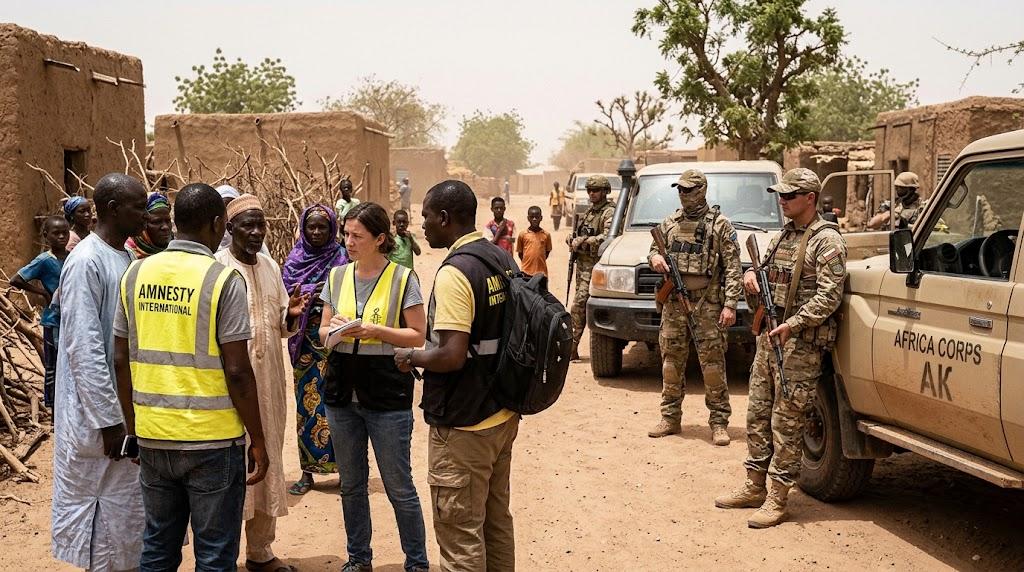
Africa Corps, established under Russian oversight, officially replaced Wagner in June 2025 after beginning deployments in January. However, new allegations in Bombori, a Fulani neighborhood, suggest that the shift has not mitigated the risks for civilians. On July 10, 2026, approximately 80 men were reportedly rounded up, beaten, and interrogated about armed group activities. Six individuals attempting to escape were shot, and three others executed.
These incidents raise questions about the true nature of Bamako’s cooperation with Moscow, the scope of Africa Corps’ mandate, and the adequacy of oversight mechanisms. The lack of transparent accountability processes only deepens concerns about the protection of civilians.
Impunity’s grip: why justice remains elusive for victims
Despite mounting evidence, no judicial proceedings have been initiated against government forces for civilian abuses since 2023. This systemic failure to investigate and prosecute violations fosters a climate of fear, deterring victims and witnesses from coming forward. Limited access to conflict zones further complicates efforts to document abuses and deliver justice.
The authorities must prioritize independent investigations, hold individuals accountable for proven crimes, and ensure victims have unimpeded access to legal recourse. Transparency regarding agreements with Africa Corps and the oversight of military operations is equally critical.
The shift from Wagner to Africa Corps was meant to signal a new chapter in Mali’s security strategy. Yet, for the civilians caught in the middle, the reality is one of enduring violence and unaddressed suffering. The fight against armed groups cannot come at the expense of human dignity. Every allegation of abuse demands thorough, impartial scrutiny—and every perpetrator must be held to account.