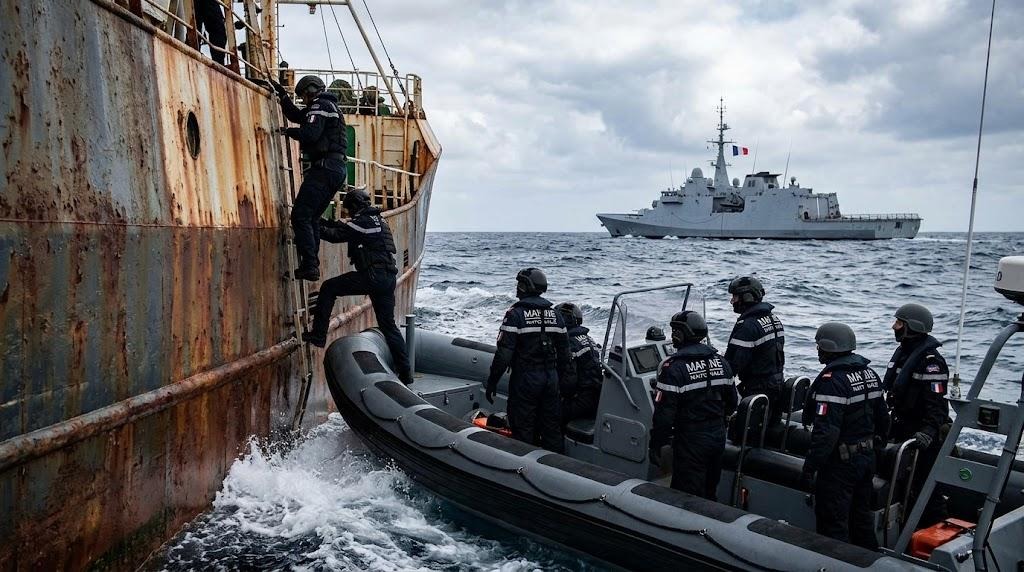
Is the Benin flag becoming a loophole for sanctions-busting vessels? The interception of the Russian-flagged DF Peak in the Indian Ocean has thrust Cotonou into a delicate maritime dispute—one that tests the credibility of West African ship registries and the effectiveness of Western sanctions on Russian oil.
Behind the interception: a high-stakes maritime operation
On October 12, 2026, over 450 nautical miles south of Réunion Island, the French Navy intercepted the 244-meter DF Peak, a crude oil tanker suspected of sailing under a fraudulent Benin flag. The operation, later confirmed by Paris, marks a rare but critical strike against Moscow’s “ghost fleet”—a shadowy network of vessels designed to evade sanctions imposed by the EU, US, and UK since 2024.
During the at-sea inspection, French naval forces discovered serious irregularities regarding the vessel’s claimed Beninese registration. Under judicial oversight, the ship was rerouted under escort to a holding area near Réunion for comprehensive checks on its paperwork, cargo, and beneficial ownership.
The DF Peak’s shifting identities: a textbook ghost fleet case
The vessel, with a deadweight tonnage of 110,000, had previously operated under multiple aliases. Originally commissioned as NS Captain, it was reflagged to Russia as Kaliningrad in April 2024 before adopting the name DF Peak and displaying a Beninese flag in 2025. Its recent voyage from Venezuela to the western Indian Ocean raised red flags, according to maritime tracking data.
Such tactics—frequent identity changes, opaque ownership structures, and flag-state hopping—are hallmarks of the ghost fleet. These vessels often rely on shell companies, inadequate insurance, and ship-to-ship transfers to obscure cargo origins and destinations.
Legal stakes: can Benin protect its maritime sovereignty?
The case exposes vulnerabilities in Benin’s Flag State Control, governed by its maritime code. Under Ivorian law, granting a ship Beninese nationality requires a verifiable economic link: permanent residency of the owner, a registered local company, or strict operational control from Cotonou.
If investigations confirm the DF Peak was flying a false flag, it would constitute a direct violation of Benin’s sovereignty and a criminal offense. Authorities could be compelled to remove the vessel from the national registry for breaching safety norms and misusing the flag. As a signatory to the UN Convention on the Law of the Sea, Benin is legally bound to enforce effective control over vessels flying its flag.
Internationally, France acted within its rights under the Montego Bay Convention (Article 110) to board the vessel due to reasonable suspicion of false nationality or lack of registration. Meanwhile, Benin may formally request judicial assistance from France to investigate potential breaches of Beninese registration laws by intermediaries or maritime entities.
The ghost fleet dilemma: why sanctions enforcement at sea keeps failing
The DF Peak interception underscores a growing gap between sanctions policy and enforcement. Despite robust administrative measures, opaque financial networks, unregulated transfers, and phantom registries allow sanctioned oil to reach global markets. The Russian ghost fleet thrives on these weaknesses—exploiting weak oversight in African, Middle Eastern, and Caribbean ports.
Beyond the immediate case, Benin faces a pressing challenge: auditing its maritime registry to prevent its flag from being weaponized by illicit trade networks. The integrity of Cotonou’s maritime administration is now on trial—not only in West Africa, but in the corridors of global sanctions policy.