
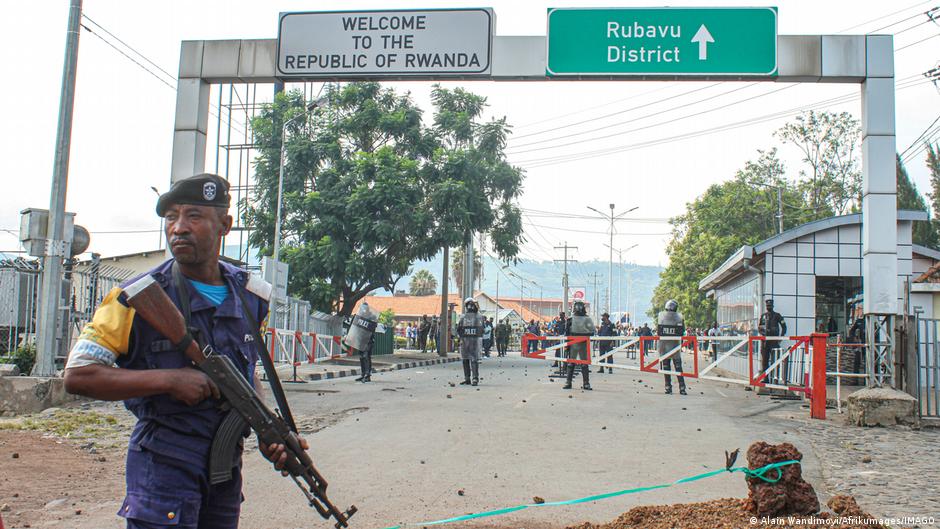
Goma’s commercial heartbeat—once fueled by vibrant cross-border trade with Rwanda—has slowed to a near standstill. The closure of key border crossings with Gisenyi has sent ripples through the eastern Democratic Republic of the Congo’s economy, leaving traders and residents grappling with mounting hardships.
Rwanda’s decision to seal its borders with Goma, primarily to curb the spread of Ebola, has triggered a cascade of economic disruptions. Stringent health controls at every entry point have further choked the flow of goods and people, exacerbating the challenges faced by local businesses and households alike.
Street vendors bear the brunt of lost livelihoods
For years, Jacques Safari, a street vendor selling eggs near the Goma border, relied on a steady stream of travelers crossing into Rwanda. Now, his daily routine has been upended. “Before, I could sell up to five trays of eggs every day,” he explains. “Today, I’m lucky if I sell two.” The sharp decline in foot traffic has slashed his earnings, mirroring the struggles of countless others who depended on the border’s lively commerce.
The closure has severed a critical lifeline for small-scale traders like Jacques. Many of his former customers were travelers and commuters who regularly traversed the frontier, their journeys now halted by the restrictions. “Most of our clients were travelers,” he says. “Without them, our businesses are suffocating.”
Wholesalers face supply chain breakdowns
The impact extends far beyond street vendors. At Birere Market, wholesalers are scrambling to adapt to a new reality where supplies are scarce and demand has plummeted. Hamuli Kasilembo, a longtime wholesaler in the market, describes a once-reliable system now in disarray. “Before, we could restock quickly and efficiently from Rwanda,” he says. “Now, logistics are a nightmare, and money moves like molasses.” The slowdown in transactions has left many businesses teetering on the edge of survival.
Economists warn of deeper consequences
Economic experts had foreseen the fallout from the border closure. Alphonse Muanda, an economist monitoring the region, emphasizes that daily trade between Goma and Gisenyi is the backbone of local economies on both sides of the border. “Small traders depend entirely on cross-border commerce for their daily survival,” he notes. “Many traveled to Gisenyi to buy essential goods like rice, soap, and other wholesale items.”
With the border still sealed, Muanda warns of a looming social and economic crisis. “When authorities close the border, it’s the smallest traders who pay the highest price,” he explains. “These are people who live hand-to-mouth, relying on every transaction to put food on the table. The closure doesn’t just hurt businesses—it threatens livelihoods.”
The border’s closure, driven by health concerns, has left Goma’s residents bracing for harder times ahead. As the weeks pass, the fear of worsening poverty and economic instability grows, casting a shadow over a city already struggling to recover.
You may also like
Bénin et Émirats arabes unis renforcent leur coopération militaire et sécuritaire
At the un, Togo’s 2 million dollar African map gamble sparks outrage at home
In Cameroon questions arise over whether billions have vanished from the safes of the Special Criminal Court
At the Ouaga 2000 arena, Benin’s Amazones etch their names in handball history
Niger’s state narrative masks internal fractures after Niamey mutiny