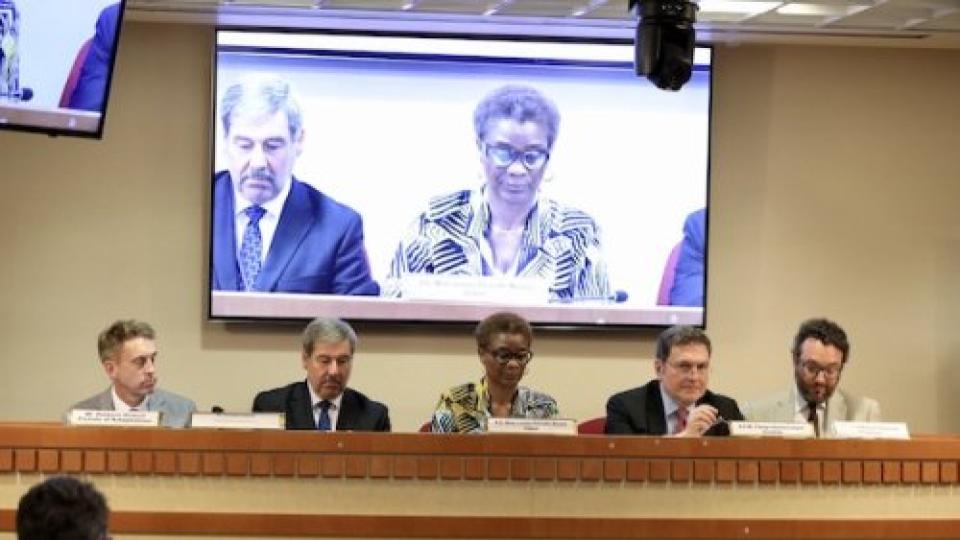
During the High-Level Political Forum (HLPF) in New York, the African Union’s Permanent Mission hosted the unveiling of a joint OECD-OIF/IFDD report on green financing accessibility. Addressing an international audience, Louise Pierrette Mvono, Gabon’s Minister of Planning and Prospective, passionately advocated for her nation, demanding a fundamental overhaul of global international aid structures.
With an impressive 88% of its land covered by forests and a longstanding designation as a net carbon sink, Gabon stands as a crucial contributor to global climate regulation. However, this esteemed position as a conservation leader is paradoxically hindered by intricate procedural and linguistic obstacles that impede its access to essential climate funds.
While commending the scientific precision of the presented report, Minister Mvono underscored this glaring contradiction. She asserted that Gabon’s immense commitment to preservation necessitates, in return, predictable, equitable, and proportionate international financial solidarity, free from the current bureaucratic delays.
A proactive national strategy unfolding
Far from passively awaiting a shift in global paradigms, Libreville is actively forging its path. Ahead of presenting the nation’s second Voluntary National Review to the United Nations, the Minister emphasized the well-structured framework guiding Gabon’s ecological transition.
The National Growth and Development Plan 2026-2030 already incorporates sophisticated instruments such as green bonds and carbon credits. The accreditation of Gabon’s Caisse des Dépôts et Consignations (CDC) by the Green Climate Fund further exemplifies this commitment to financial self-reliance. Furthermore, in terms of innovation, the $60 million « Country Package » partnership finalized at COP16 in Cali signifies an integrated approach, seamlessly blending climate action, biodiversity conservation, and local development initiatives.
Three key levers to unlock the future
To effectively translate global pledges into tangible local impacts, the Minister presented three critical directives to international donors. These include bolstering local engagement by prioritizing direct accreditation for national institutions, thereby lessening reliance on international intermediaries; fostering sustained expertise through funding continuous training programs to enable the local design of bankable ecological projects; and ultimately, monetizing natural capital by establishing robust payment mechanisms for ecosystem services and transparent carbon markets, which are essential for acknowledging the systemic value of tropical forests.
Through this pragmatic appeal, Gabon reiterates that the preservation of our planet hinges on the capacity of affluent nations to streamline and expedite financial support for countries at the forefront of conservation efforts.