Gabon has adopted a firmer stance regarding its infrastructure commitments. Facing persistent delays in several initiatives funded by the African Development Bank (AfDB), the government is now insisting on concrete outcomes.
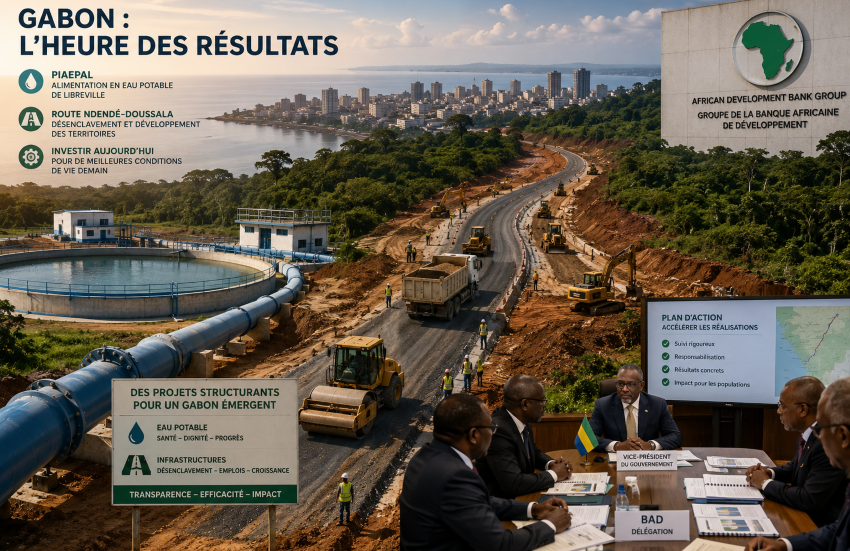
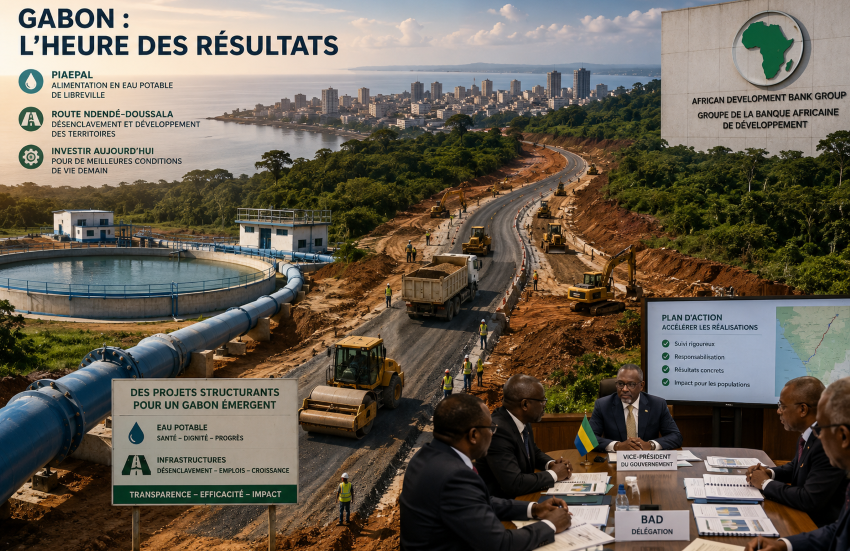
A high-level meeting recently took place in Libreville between Vice President Hermann Immongault and an AfDB delegation led by Country Manager Mamour Ousmane Ba. The discussions centered on a vital priority for the authorities: ensuring that mobilized funds are transformed into visible achievements for the population.
Strategic priorities under scrutiny
Two major projects are at the heart of this new demand for efficiency. First is the Integrated Program for Drinking Water Supply and Sanitation in Libreville (PIAEPAL), designed to provide a sustainable solution to water access in the capital. Second is the Ndendé-Doussala road, a strategic infrastructure project intended to boost regional integration and economic trade with neighboring countries. Both sites are considered essential, yet their slow progress continues to spark public impatience.
For years, Gabon has secured significant financing from international institutions to modernize its infrastructure. However, many projects have struggled to meet their original deadlines, leading to growing frustration among citizens. The recent dialogue with the AfDB signals a shift in the executive branch’s approach toward performance and accountability.
The end of tolerance for delays
The government is moving toward a results-oriented strategy where every cent of debt must have a measurable impact on daily life. This requirement is particularly critical as budget constraints tighten. For the authorities, the goal is no longer just about securing resources, but guaranteeing their effective use. The public now judges the state based on finished projects rather than the amounts invested.
The PIAEPAL project is a prime example of these high stakes. With recurring water shortages in several Libreville neighborhoods, expectations are immense. Every delay erodes the credibility of public programs. Similarly, the Ndendé-Doussala road, long promised as a catalyst for development, faces bottlenecks that postpone the economic benefits intended for local operators and residents.
Addressing internal and external bottlenecks
A significant takeaway from the recent discussions is the admission of shared responsibility for these setbacks. Hermann Immongault emphasized the need to clarify the roles of all stakeholders and pinpoint the exact obstacles stalling execution. This transparent approach moves away from the habit of blaming external contractors or lenders exclusively.
By acknowledging internal administrative dysfunctions, the government recognizes that delays often stem from a complex mix of factors. Heavy administrative procedures, poor institutional coordination, and slow decision-making processes can combine to paralyze construction sites. This honesty is a crucial signal, as chronic delays in large-scale projects often reflect systemic governance challenges rather than isolated failures.
A test for national credibility
The AfDB remains supportive but cautious. Mamour Ousmane Ba reaffirmed the bank’s commitment to Gabon’s priorities while noting that the effectiveness of financing depends heavily on the country’s internal capacity to execute projects. This highlights the reality of modern development: the most attractive nations are those that can turn debt into operational infrastructure.
The message delivered in Libreville is unequivocal. Gabon wants every funded project to become a tangible reality. The success of the PIAEPAL water program and the completion of the Ndendé-Doussala road will serve as the ultimate indicators of whether this new political will can finally break the cycle of delays that has hindered national development for too long.