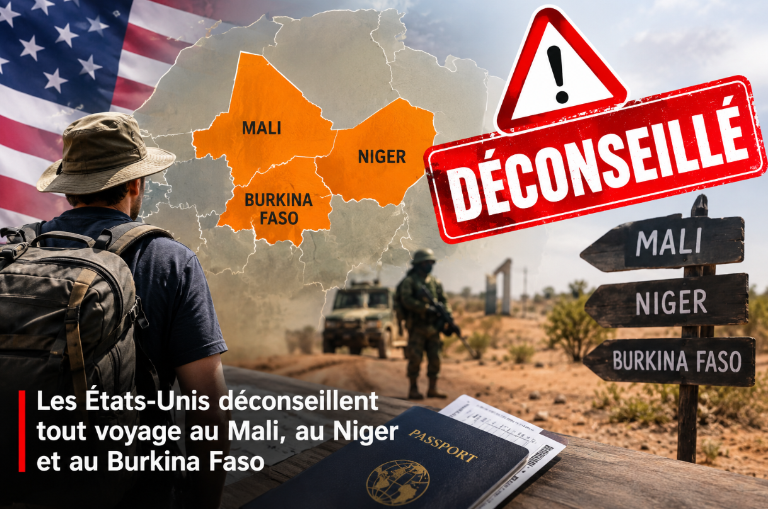
The United States has issued its sternest travel advisory for three Sahel nations in 2026, but the decision didn’t come in a vacuum. Behind the ‘do not travel’ warning lies a complex interplay of evolving threats, systemic instability, and operational constraints that have reshaped the security landscape across Mali, Niger, and Burkina Faso. This isn’t just another seasonal alert—it reflects a fundamental shift in how Washington assesses risk in one of Africa’s most volatile regions.
Why the US raised the alarm to the highest level
The State Department’s decision to place Mali, Niger, and Burkina Faso at Level 4—its most severe classification—was not made lightly. Official advisories released in 2026 cite a convergence of threats: escalating terrorist activity, a surge in kidnappings, pervasive criminal networks, and deteriorating public health conditions. Unlike previous warnings, this one underscores a sustained inability to stabilize key areas, even in urban centers once considered relatively safe.
What’s changed is not just the frequency of attacks, but their unpredictability. Armed groups linked to Al-Qaeda and the Islamic State have expanded their reach, targeting not only military outposts and border crossings but also civilian infrastructure, transportation hubs, and economic assets. The result is a region where movement—once a symbol of resilience—now carries grave personal and professional consequences.
The hidden forces fueling instability in Mali
In Mali, the roots of the crisis run deep. Years of political instability, compounded by the presence of multiple jihadist factions, have eroded state control in vast swaths of the country. The State Department’s June 2026 advisory highlights not only the threat of armed attacks but also the collapse of law enforcement in rural areas, leaving communities vulnerable to banditry and extremist recruitment.
Even Bamako, the capital, is no longer considered a safe haven. U.S. government personnel are restricted from traveling outside the city, a policy shift that signals a broader retreat from engagement. The advisory also warns of kidnapping rings targeting foreign nationals, with ransom demands increasingly used to fund militant operations. For travelers, this means that assistance—whether from embassies or private security firms—can be delayed or denied in high-risk zones.
Niger’s fragile security: when borders become battlefields
Niger’s geographic position makes it a critical corridor, but also a flashpoint. The July 2026 advisory paints a stark picture: terrorist groups operating near the borders with Mali and Burkina Faso have turned transit routes into ambush zones. The risk isn’t confined to remote areas—Niamey itself faces sporadic threats, including armed robberies and vehicle-borne improvised explosive devices.
Humanitarian organizations and businesses operating in Niger now face a Catch-22. While essential aid must continue, the ability to move staff safely is severely limited. The U.S. Embassy’s restrictions on off-capital travel reflect a lack of viable evacuation routes, forcing organizations to reevaluate their presence in the country altogether. The advisory doesn’t just caution against tourism—it signals a near-total withdrawal of non-essential personnel.
Burkina Faso: the jihadist surge reshaping travel norms
Burkina Faso’s descent into crisis has been rapid. Once a stable democracy, the country now faces daily attacks by Islamist militants in the north and east. The May 2026 advisory emphasizes the indiscriminate nature of these assaults, which have struck hotels, markets, and mining sites—sectors critical to the economy. Kidnappings, often targeting foreign workers, have become a lucrative tactic for armed groups.
Even Ouagadougou, the capital, is under strain. U.S. officials are barred from traveling beyond the city limits, mirroring the restrictions seen in Bamako and Niamey. The advisory warns that attacks can occur without warning, making even routine activities—like dining out or shopping—potentially hazardous. For businesses, this means suspending operations in high-risk regions and relocating staff to safer hubs.
Beyond the headlines: how other African nations are affected
While Mali, Niger, and Burkina Faso dominate the headlines, they are not alone. The U.S. has issued Level 4 warnings for the Central African Republic and Chad, and Level 3 advisories for Nigeria, Cameroon, and Mozambique—each citing terrorism, kidnapping, or regional instability. The pattern is clear: the Sahel’s crisis is spilling across borders, creating a contiguous zone of high-risk travel.
What distinguishes the Sahel trio is the scale and persistence of the threats. Unlike isolated incidents in other countries, the violence in Mali, Niger, and Burkina Faso has become institutionalized, with armed groups embedding themselves in local economies and governance structures. This makes recovery—and a return to normal travel—far more distant than in regions facing episodic unrest.
What this means for travelers and businesses in 2026
The U.S. travel ban isn’t a suggestion—it’s a directive rooted in real-time intelligence and operational reality. For travelers, the implications are immediate: insurance policies may be voided, evacuation plans may fail, and consular support may be unavailable. The advisory doesn’t just recommend caution—it advises against travel entirely, a stance that aligns with the experiences of NGOs, journalists, and corporate teams already on the ground.
For businesses, the message is equally stark. Supply chains are at risk, project timelines are collapsing, and the cost of security is rising. The advisory serves as a wake-up call: in 2026, the Sahel is not a destination for the unprepared. It demands a level of risk management that few organizations—or individuals—can sustain.
The bottom line: a region at a crossroads
The U.S. Level 4 advisory for Mali, Niger, and Burkina Faso is more than a travel warning—it’s a reflection of a region in turmoil. The threats driving this decision are not temporary; they are structural, deep-rooted, and resistant to quick fixes. Until governance improves, armed groups are contained, and civilian protection is restored, the Sahel will remain a no-go zone for all but the most critical missions. For now, the message from Washington is clear: stay away.