From rhetorical sovereignty to tangible hunger
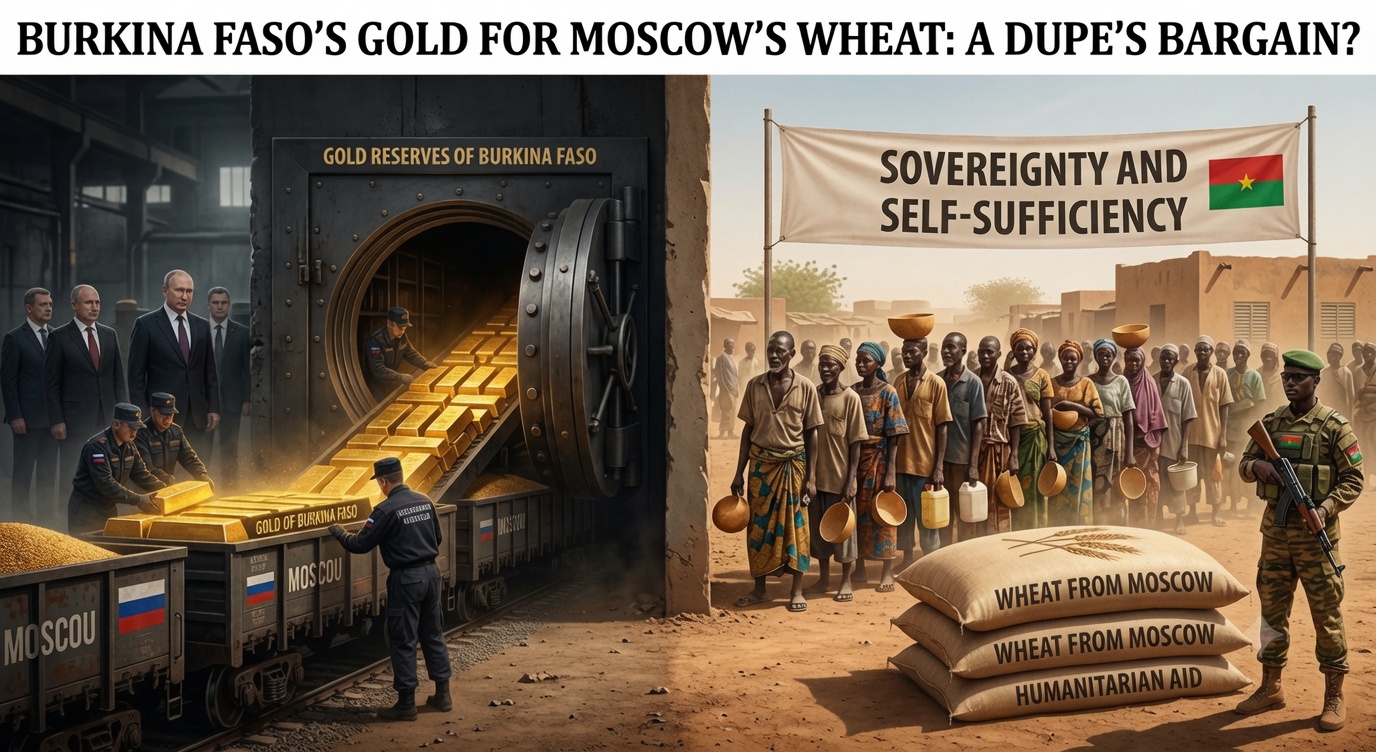
The contrast could not be more stark. On one side, a government touts its “reclaimed sovereignty” with absolute intransigence toward local solidarity. On the other, a humiliating dependence on foreign aid to feed its own people. By barring grassroots initiatives and NGOs from assisting Burkina Faso’s most vulnerable under the pretext of controlling humanitarian aid, Captain Ibrahim Traoré has taken a step of rare political cruelty. Yet the cynicism deepens when, simultaneously, authorities in Ouagadougou extend their hands to Moscow, begging for sacks of wheat.
A symbolic surrender of wealth
The recent visit of Russia’s foreign minister laid bare the mechanics of this lopsided “cooperation.” With iron diplomacy clad in velvet gloves, the Kremlin’s envoy praised Burkina Faso’s decision to transfer and store its national gold reserves directly at the Bank of Moscow. An announcement that rings like an admission of economic surrender. For a regime that built its legitimacy on severing ties with neocolonialism and pledging total independence, entrusting the nation’s treasure to Russia borders on a fool’s bargain.
The contradictions of self-sufficiency
The official narrative has long championed economic autonomy and self-sufficiency. Yet this ambition crumbles when basic food needs cannot be met without external assistance. A sovereignty that relies on imported grain shipments is an unfinished one—one that fails to guarantee either production autonomy or the food security of its citizens.
The equation is brutally simple: Burkina Faso is mortgaging its sovereign wealth—its gold—in exchange for security promises and, above all, emergency food aid. Receiving Russian wheat shipments to feed a population choked by insecurity is no geopolitical victory. It is the emblem of failure. How can a nation claim pride when its nutritional survival hinges on the goodwill of an external patron to whom it has handed the keys to its own vaults?
Where has Burkina Faso’s gold gone?
Burkina Faso stands among West Africa’s top gold producers. Theoretically, this wealth should fund agricultural policies, storage infrastructure, irrigation systems, and sustainable support for local producers. Yet when the country still depends on foreign food aid, observers question how national riches are being mobilized—and whether they truly improve living conditions.
The suppression of local solidarity
The most intolerable aspect remains the internal mismanagement of this crisis. While a government struggles to feed its people amid asymmetric conflict is a grim reality, actively sabotaging national solidarity by threatening or banning Burkinabè from aiding fellow citizens reveals an absolute strategy of social control. By monopolizing aid, the Traoré regime appears determined to ensure every grain of rice or wheat received by the hungry is seen as a gift from power—not an act of human brotherhood.
This centralization carries a major political risk. In many crises, humanitarian groups, local associations, and citizen initiatives play a complementary role to the state, especially where authorities are absent or constrained by security threats. Restricting their action slows assistance to vulnerable populations and increases reliance on state-controlled mechanisms, fueling suspicions of political manipulation of aid.
A sovereignty measured in empty plates
Citizens are repeatedly called upon to make sacrifices in the name of national sovereignty, the fight against terrorism, and state reform. But these sacrifices lose meaning when daily hardships persist, insecurity remains, and the country continues to beg abroad for something as fundamental as food. True sovereignty is also measured by a state’s ability to protect and nourish its people sustainably.
While Burkina Faso’s gold heads to Russian vaults to shore up the political survival of its leadership, the people are left with hollow sovereignty and very real hunger. By confusing independence with merely swapping one guardian for another, Captain Traoré has not liberated Burkina Faso—he has merely renegotiated dependence at a bargain price.
The true question is not which partner Burkina Faso cooperates with, but whether these partnerships genuinely strengthen the country’s autonomy and improve the lives of Burkinabè. A sovereignty policy cannot be judged by diplomatic rhetoric alone; it must be measured by its capacity to secure safety, prosperity, and dignity for its citizens. When these goals are unmet, the gap between political promise and daily reality becomes impossible to ignore.