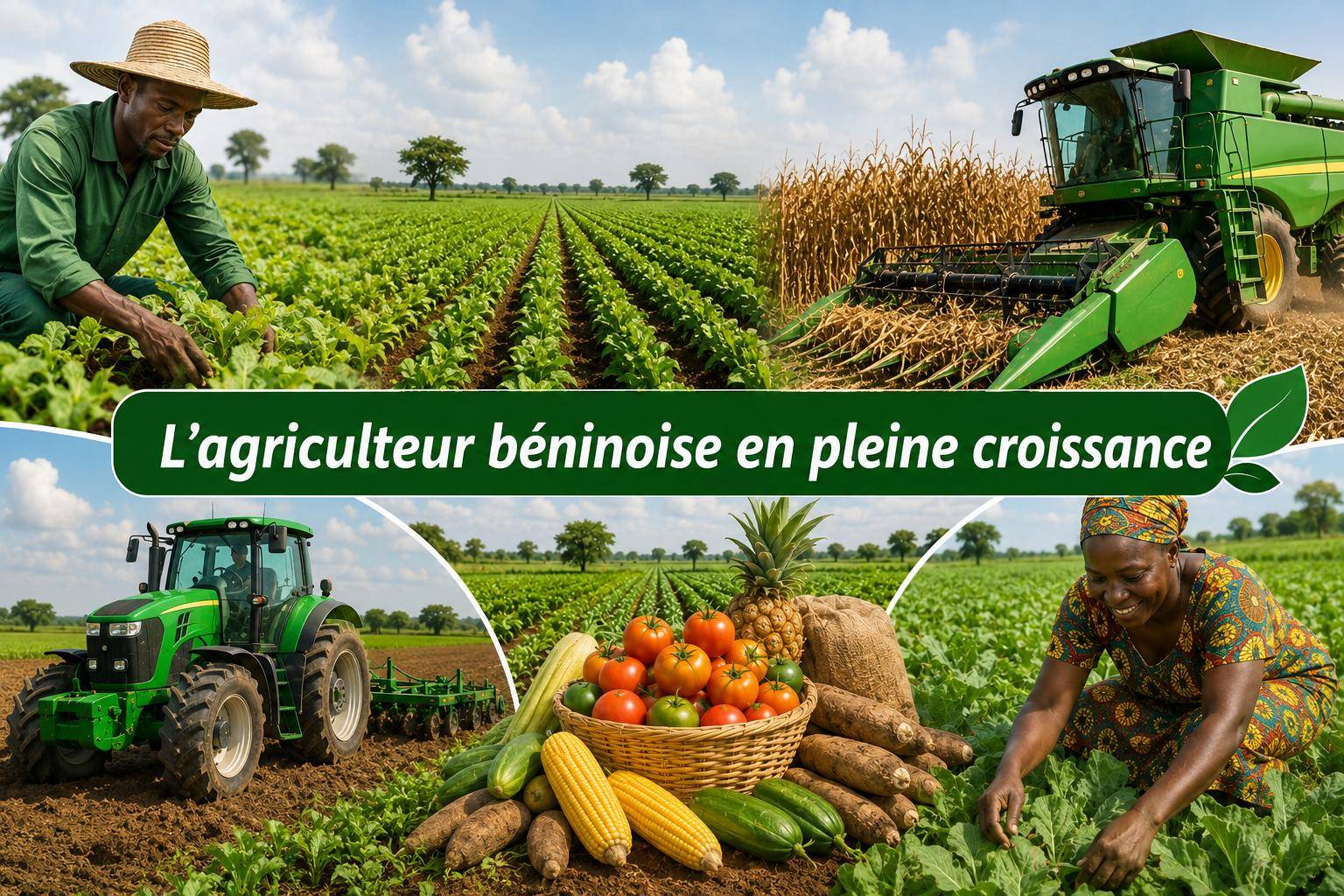
The Bénin agricultural renaissance: a decade of record-breaking growth
Since President Patrice Talon took office in 2016, the Bénin agricultural sector has undergone a spectacular transformation. Through a bold reform agenda centered on heavy subsidies, rapid mechanization, and strategic land development, the country has shattered production records across key crops. From cotton to pineapples, maize to soybeans, agriculture has become the backbone of national growth and a pillar of food security.
Breaking records: the rise of high-performance agricultural value chains
The implementation of ambitious national development plans has propelled Bénin’s agriculture to unprecedented levels. The results are visible in every major crop category, with production volumes far exceeding previous benchmarks.
Maize: Once limited to under 1.3 million tonnes annually before 2016, maize production soared to 2.5 million tonnes by 2025—well above domestic consumption needs of approximately 1 million tonnes. While this surplus strengthens food security, it also introduces new challenges in managing cross-border trade to stabilize local market prices.
Soybeans: A true symbol of industrialization, soybean output skyrocketed from a mere 140,000 tonnes in 2016 to over 606,000 tonnes in the 2024–2025 season—a more than fourfold increase. This surge fuels the modern processing facilities at the Glo-Djigbé Industrial Zone (GDIZ), while also enabling significant export opportunities.
Rice: Paddy rice production followed a similar upward trend, rising from 204,000 tonnes pre-2016 to 1 million tonnes by 2025, marking a dramatic shift toward self-sufficiency.
Cotton: Known as “white gold,” Bénin’s cotton industry has long dominated West African production. Annual output now consistently exceeds 640,000 tonnes, with a record 766,273 tonnes harvested in 2021. The nation remains Africa’s top cotton producer, with ambitions to reach the million-tonne milestone in the coming years.
Pineapple: This tropical fruit has seen a 93 % production increase, growing from 244,000 tonnes before 2016 to 470,000 tonnes in 2022, with projections nearing 600,000 tonnes. The cashew sector has also flourished, doubling its output from 91,000 to 187,000 tonnes between 2016 and 2023—a 105 % rise—while improving yields by 34 %. Producers benefit from government subsidies covering up to 83 % of the cost of certified planting materials.
Subsidies as a shield: investing 110 billion FCFA to protect farmers
The agricultural boom was made possible by a robust financial shield against rising global input costs. Faced with soaring prices for fertilizers and agrochemicals, the government allocated a historic 110 billion FCFA in subsidies across the 2022–2025 farming seasons. This intervention stabilized production costs, prevented yield declines, and shielded the nation from food insecurity risks.
Water management and mechanization: ending dependence on unpredictable weather
Modernizing infrastructure has been central to the sector’s transformation. Prior to 2016, only 6,200 hectares of land were equipped with irrigation systems—just 2 % of the national potential. Today, 25,440 hectares have been developed across 67 municipalities, quadrupling the previous coverage. With plans to expand to 50,000 hectares, the government aims to build long-term resilience and boost farmer incomes.
Mechanization has also revolutionized labor practices. Tractor use—covering less than 8 % of cultivated land in 2016—now spans over 400,000 hectares. This progress stems from the distribution of 5,000 tractor kits, subsidized at 50 %, along with training for 6,000 tractor operators and 300 mechanics. The government is committed to further expansion, targeting a 30 % mechanization rate by 2026 through the deployment of 8,000 active units.
A new era of financing and ecological responsibility
Financial tools have been completely overhauled to support sustainable growth. The restructured National Agricultural Development Fund (FNDA) has financed over 3,000 projects totaling 19 billion FCFA, while the Municipal Development Support Fund (FADeC-Agriculture) has driven 330 communal investments worth 68 billion FCFA. These reforms aim to enhance governance and unlock thousands more opportunities for rural entrepreneurs.
Environmental stewardship has become a cornerstone of the new agricultural model. Before 2016, 80 % of Bénin’s farmland suffered from poor fertility. Today, sustainable land management practices have restored over 3 million hectares, improving soil health and preventing degradation. Revitalized water systems and stricter pollution controls have also revitalized fisheries, with total fish production increasing by 79 %. High-quality shrimp from Bénin are once again making their way to European markets, while livestock production has surged by 53 % for meat and 43 % for eggs—moving the country closer to covering 75 % of domestic demand.
Building a market-driven agricultural future
The Bénin government’s strategy has redefined rural development by strengthening state functions and fostering targeted value chains. Enhanced market access and strategic partnerships are reshaping the sector’s role in the national economy. Agriculture is no longer seen as a subsistence activity, but as a modern, competitive engine of growth.
The challenge ahead lies in sustaining this momentum through strong governance and equitable wealth distribution. By continuing to invest in innovation, training, and infrastructure, Bénin is not only securing its food future but also positioning itself as a leader in sustainable, high-value agriculture across West Africa.