- Bénin
- Politique
Bénin transition: Talon and Wadagni’s strategic handover through a religious dossier
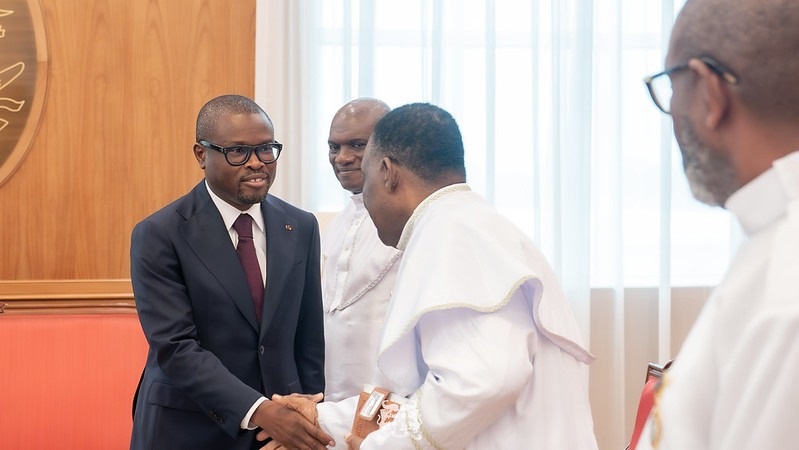
A June 4, 2026 meeting between President-elect Romuald Wadagni and the delegation of the Celestial Christianity Church offers a revealing glimpse into the Bénin’s political transition—a process marked by deliberate role-sharing between outgoing and incoming leadership.
Not all governance files carry the same weight. The reunification process of the Celestial Christianity Church stands out as a litmus test for institutional continuity. While the matter unfolds through internal theological consultations and committee deliberations, its success hinges on the state’s unwavering commitment. Any perceived hesitation in this area could signal fragility to the Church’s factions, particularly as electoral timelines approach. The outgoing administration appears to have anticipated this risk entirely.
The opening act: two presidents, one mission
The narrative begins with the handover ceremony of the Superior Council of Labor’s (CST) findings and recommendations. On that day, Patrice Talon and Romuald Wadagni stood side by side—one still in office, the other elected but not yet sworn in. Their joint presence was far from ceremonial; it was a deliberate political statement. It underscored an explicit transfer of responsibility, a tacit agreement that continuity in this dossier was non-negotiable.
“It’s uncommon to see an outgoing president involve his successor so early in such a sensitive matter. This speaks volumes about how deeply they’ve managed the transition,” noted a diplomat stationed in Cotonou, requesting anonymity.
June 4, 2026, delivered another layer to this carefully choreographed sequence. In the morning, Patrice Talon officially inaugurated the High Council tasked with implementing the CST’s recommendations. By evening, Romuald Wadagni was receiving the Council’s delegation in his capacity as president. The precision of the timing was almost theatrical: one installed the framework, the other embraced it; one provided legitimacy, the other breathed life into it.
Strategic division of roles: a governance masterclass
What unfolded was no accident but a meticulously designed governance architecture. Patrice Talon assumed the role of facilitator—a term borrowed from mediation vocabulary, denoting one who creates dialogue conditions without imposing decisions. His historical legitimacy on this file stems from its origins under his administration, its structural development, and the CST’s final report. To the Church’s stakeholders, he is the guarantor of the process.
Romuald Wadagni, meanwhile, embodied active republican continuity. By reaffirming his support for the delegation, he signaled that the state wasn’t merely passing the baton—it was wholeheartedly adopting the dossier. The distinction is critical. A perfunctory handover would have sufficed to ensure transition; Wadagni went further, demonstrating personal engagement, offering reassurance, and asking incisive questions that revealed his deep familiarity with the file.
“He didn’t just listen—he engaged. You could tell he’d been thoroughly briefed; he knew the dossier inside out. This wasn’t a courtesy call,” shared a delegation member after the meeting.
A high-stakes test of top-level cohesion
Beyond the Celestial Christianity Church, this dossier serves as a litmus test for the relationship between the two presidents. In many African transitions, files inherited from predecessors often languish in institutional limbo—neither abandoned nor fully embraced by the new administration. The temptation to start afresh or let momentum fade is ever-present.
Here, the opposite is evident. By actively engaging with a dossier initiated by his predecessor within weeks of taking office, Wadagni established a governance principle: state continuity supersedes agenda disruption. If this principle holds across other sectors, it could become a defining feature of his presidency.
“What we’re witnessing with the Celestial Church, we hope to see replicated across other major initiatives. This is the true test of a transition,” observed a Bénin governance analyst.
A dossier with continental implications
Reducing this matter to Bénin’s borders would be a mistake. The Celestial Christianity Church is a global organization with followers across continents. Its reunification process, if successful, will be an international milestone—and Bénin, as its founding nation, will be at its epicenter.
The dual engagement of Bénin’s presidents elevates this dossier beyond national significance. It positions the country as the epicenter of resolving a global religious schism, with its leaders emerging as responsible actors in a peace process touching millions of believers worldwide. In a departure from traditional diplomacy, this represents a form of soft power: the ability to wield influence through mediation rather than coercion.
In essence, the June 4 meeting was not a footnote in religious news—it was a foreign policy statement and a testament to national unity. For skeptics, it served as irrefutable proof that Patrice Talon and Romuald Wadagni’s power transition was executed with depth, not merely form.