Romuald Wadagni takes office in Cotonou with 94% victory as opposition faces exclusion
Romuald Wadagni was sworn in as Bénin’s new president on May 24, inheriting a nation where economic progress meets a tightly controlled political landscape. His predecessor’s protégé secured a landslide victory in April, but the absence of key opposition figures raises questions about governance and pluralism.

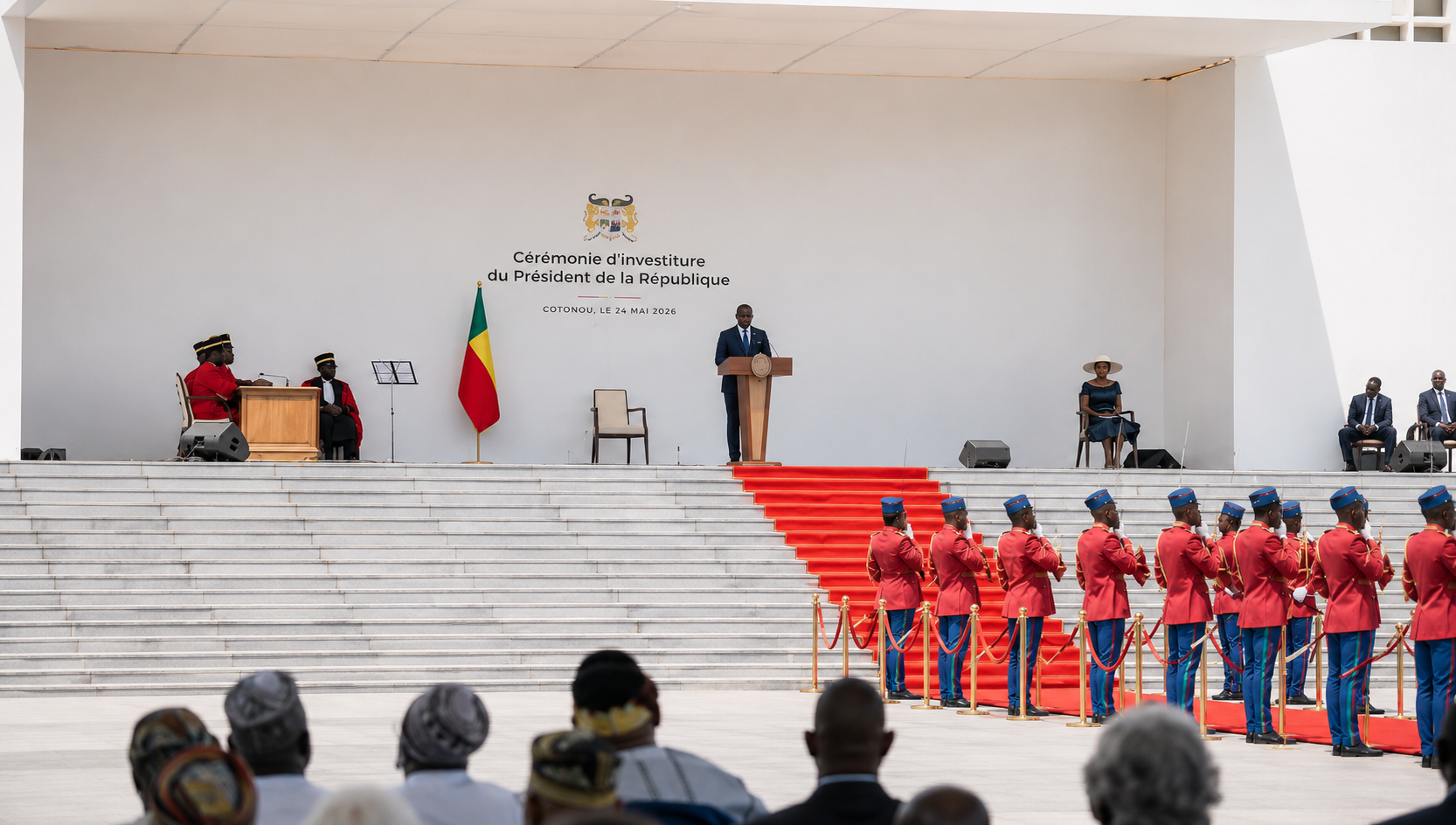
In a ceremony that unfolded with military precision, Romuald Wadagni assumed the presidency of Bénin on Sunday, May 24, at the Palais des Congrès in Cotonou. The former Finance Minister, who secured 94% of the vote in the April 12 election, now leads a nation at a crossroads—where economic resilience contrasts with a shrinking democratic space.
At 49, Wadagni becomes the fifth head of state since Bénin restored multi-party democracy in 1990. His rise follows a decade marked by Patrice Talon’s presidency, during which the country maintained fiscal stability through strategic debt issuances and maintained its sovereign credit rating. The incoming president’s victory was virtually assured from the outset, given the disqualification of the main opposition coalition, Les Démocrates, whose candidate ticket was invalidated in October 2025 due to technicalities in parliamentary endorsements.
A technocrat’s transition: continuity in economic policy
Born in Lokossa, Wadagni brings a technocratic profile to the presidency. After 17 years at Deloitte, he joined the government in April 2016 as Finance Minister, where he played a pivotal role in managing the country’s finances. His tenure saw Bénin successfully access international capital markets while sustaining its sovereign ratings—a legacy he now inherits.
The April election was contested by only one opponent, Paul Hounkpè of the Forces cauris pour un Bénin émergent (FCBE), who garnered a fraction of the votes. With the vice-presidency secured by Mariam Chabi Talata—President Talon’s former deputy—the new administration begins with a mandate extended to seven years, following a 2025 constitutional amendment that decoupled presidential and legislative elections.
A tightly scripted ceremony in a constrained political climate
The inauguration proceedings, meticulously timed from 9:30 AM to noon, reflected the formality of the occasion. Patrice Talon formally handed over presidential insignia in a private meeting at the Palais de la Marina before the constitutional court convened for the swearing-in. The event drew over 6,000 guests, including former presidents Nicéphore Soglo and Thomas Boni Yayi, who were publicly acknowledged by Wadagni. Observers noted the flawless organization, though the absence of genuine political competition cast a long shadow over the proceedings.
The exclusion of Les Démocrates—founded by former president Thomas Boni Yayi—stemmed from procedural hurdles. The electoral commission invalidated their candidacy after a parliamentary sponsor withdrew support, leaving the ticket with only 27 of the required 28 endorsements. The constitutional court upheld the decision in late October, effectively silencing the largest opposition force. Critics point to additional barriers, including exorbitant registration fees, restrictive compliance certificates, and a 2025 electoral threshold requiring parties to secure at least 20% of votes per district to retain parliamentary seats—measures that have marginalized opposition representation.
The judicial system has also been weaponized against dissent. Figures like Reckya Madougou, sentenced to 20 years in 2021 on terrorism charges, and academic Joël Aïvo, handed a 10-year term for conspiracy, remain incarcerated. Many opposition figures have fled into exile, while the Court of Repression of Economic and Terrorist Offenses (CRIET), established in 2016, continues to draw condemnation from human rights organizations for its perceived misuse against political opponents.
Regional overtures and domestic priorities
Wadagni’s inaugural address outlined two central themes: consolidating economic gains for Bénin’s citizens—particularly youth, women, rural populations, and the middle class—and reinforcing security in the north, where armed groups have operated since 2022. Yet it was his diplomatic outreach that signaled the most significant shift. For the first time in years, high-level representatives from the Alliance of Sahel States (AES)—including Mali’s Foreign Minister, Burkina Faso’s counterpart, and Niger’s Prime Minister—were in attendance, alongside Nigeria’s vice president as a special envoy of Bola Tinubu.
The presence of Niger’s Prime Minister, Ali Mahaman Lamine Zeine, drew spontaneous applause—a stark contrast to the frosty relations between Cotonou and Niamey since the 2023 coup in Niger. The two nations have clashed repeatedly over border closures affecting oil pipeline transit, yet Wadagni’s conciliatory tone suggests a willingness to reset ties. His address also included a symbolic nod to the African diaspora, emphasizing Bénin’s identity as a