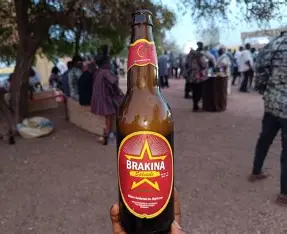
Residents of Ouagadougou are facing an unprecedented challenge in their daily routines: securing a simple bottle of beer after work has become a logistical hurdle. Over recent months, beverage shortages have intensified, stock levels have dwindled, and prices have surged, leaving both consumers and businesses grappling with the consequences.
Consumers bear the brunt of rising costs and scarcity
Emmanuel Somda, a regular patron of a local maquis, recently found himself unable to purchase his preferred beverage, Brakina. With shelves increasingly empty, he has been forced to turn to alternatives like Sobbra, only to discover those are also frequently unavailable. “Previously, a beer cost between 600 and 650 West African CFA francs. Now, some bottles are priced at 750 francs,” he laments.
The frustration extends beyond Somda’s circle. Across multiple districts in Ouagadougou, the beer shortage has become a recurring frustration. The dual pressures of escalating living expenses and economic instability—exacerbated by persistent regional insecurity—have compounded the issue, placing an additional strain on household budgets.
Maquis owners face declining revenues
Small business owners, particularly those running maquis and drink stalls, are the first to feel the impact. Reduced sales and disgruntled customers have led to declining footfall in many establishments.
Nathalie Zongo, who manages a beverage outlet, has witnessed a sharp decline in her business. “Securing beer supplies has become a daily struggle,” she explains. “Castel, which we sold for 900 francs, now costs 1,000. Sobbra has jumped from 600 to 750 francs. Customers are unhappy, and many leave without making a purchase.”
For a country where informal drinking establishments serve as vital economic lifelines, the drop in sales directly translates to diminished earnings and heightened financial vulnerability for countless operators.
Distribution bottlenecks fuel market disruptions
The scarcity has also strained relationships between maquis owners and beverage distributors. Daily delivery quotas have plummeted, leaving many establishments struggling to meet demand.
According to industry stakeholders, some outlets that previously received up to 15 crates per day now receive as few as four or five. Warehouses and distribution centers are rationing available stock to stretch supplies as far as possible.
A senior executive at a major capital-based distribution hub shared insights into the daily challenges: “Each morning, we allocate one or two crates per establishment. The next day, owners return hoping for more. Conversations are often tense, and misunderstandings are common.”
This imbalance between constrained supply and steady demand has triggered automatic price increases, even when producers deny adjusting their official rates.
Brakina denies production cuts amid rising demand
Brakina, Burkina Faso’s leading brewery, has addressed concerns about supply shortages. In an official statement, the company refuted claims of reduced production, attributing current market challenges to a significant surge in demand over the year’s first half. It also denied implementing any price increases at the wholesale level.
Yet, despite these assertions, the reality on the ground remains unchanged: shelves are bare, and retail prices have risen noticeably. Industry analysts point out that when demand outpaces production and distribution capabilities, shortages become inevitable—especially when a dominant market player like Brakina accounts for a substantial share of national consumption.
Long-term solutions remain distant
The brewery has announced plans to expand production capacity, though it cautions that the benefits of such measures will not be felt for several years.
Until then, consumers must contend with irregular stock replenishments and continually climbing prices. This shortage underscores the limitations of the current production framework in meeting growing demand, as well as the precarious position of a sector that sustains thousands of livelihoods.
For now, enjoying a favorite beer in Ouagadougou remains a luxury. Until supply stabilizes and demand aligns with production capabilities, the burden on consumers and businesses alike will persist.
You may also like
Can Air Sénégal survive the Interpol smuggling probe? The stakes for crew, passengers and the airline’s future
Senegal’s December 2, 2026: will Diomaye Faye dissolve parliament or play the long game?
Senegal’s 2026 budget revision: can Dakar still rescue its growth and investment agenda?
Senegal’s 2026 revised budget: a trap vote for Pastef or a necessary evil?
As donor fatigue spreads, can Benin’s €544,042 UNAIDS pledge keep the HIV response on track?