In May 2026, the delicate balance of purchasing power across West Africa faces a renewed challenge. As households strive to safeguard their savings amidst persistent inflationary pressures, a striking disparity has emerged at fuel stations: a significant divergence in pricing between Côte d’Ivoire and Bénin.
Côte d’Ivoire: the burden on a producing nation
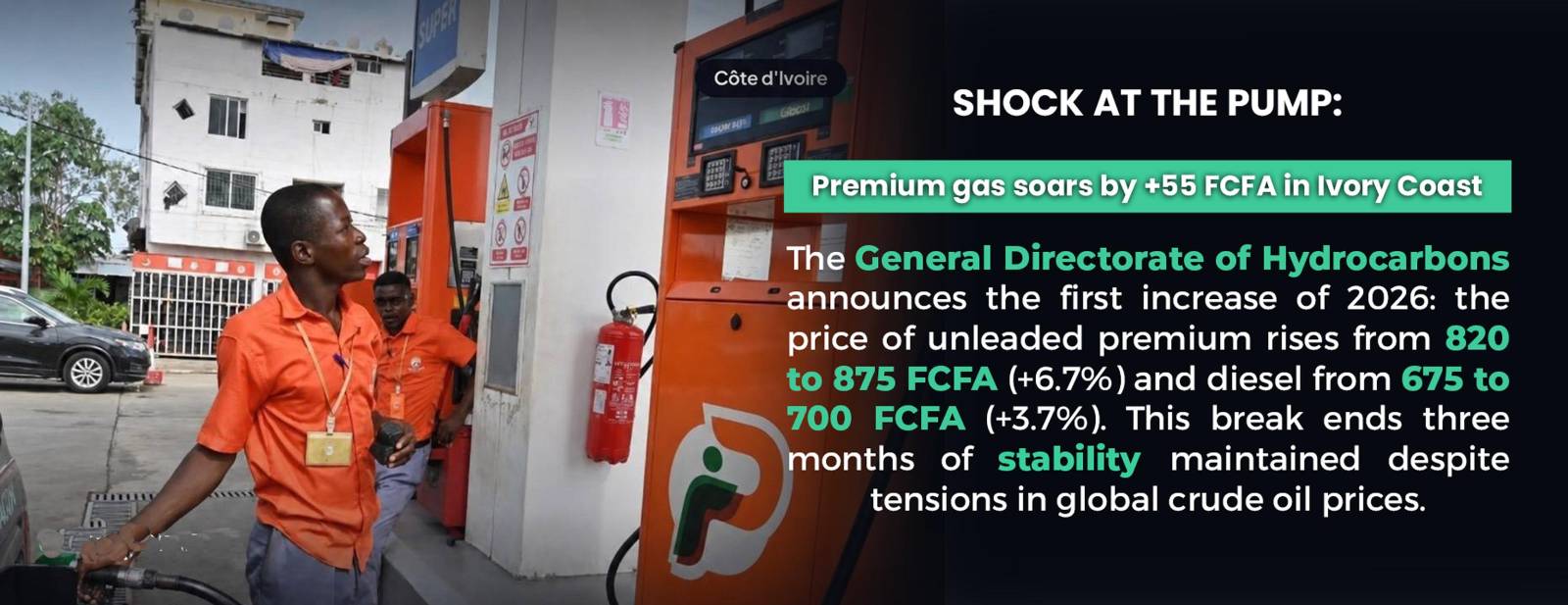
Following a quarter of relative stability, the Directorate General of Hydrocarbons in Côte d’Ivoire officially announced the year’s initial price increase. For consumers, the impact is substantial: Super unleaded fuel has escalated from 820 to 875 FCFA/L, marking a 6.7% rise, while diesel has surpassed the 700 FCFA/L threshold.
This revised pricing structure has understandably generated public bewilderment. The paradox is stark: how can a petroleum-producing nation, whose reserves should ideally offer a natural buffer, exhibit higher fuel costs than its non-producing neighbors? Beyond the numerical values, this adjustment initiates a cascading economic effect: every additional franc on a liter of diesel invariably translates into increased transportation expenses and, consequently, higher prices for essential commodities.
The Béninese ‘shield’: a pragmatic approach
Conversely, Bénin appears to have prioritized social resilience. Despite the country not yet having large-scale oil exploitation, the government in Cotonou has implemented a strategy to contain inflation. Even with geopolitical tensions in the Middle East driving global crude prices upwards, the fuel rates effective since May 1, 2026, remain remarkably competitive:
- Petrol: 725 FCFA/L
- Diesel: 750 FCFA/L
The conclusion is unequivocal: petrol is 150 FCFA less per liter in Bénin compared to Côte d’Ivoire.
“Our lack of production necessitates stringent management, but the paramount concern remains safeguarding household budgets,” stated a source close to the Béninese executive.
Through judicious taxation adjustments or targeted subsidies, Bénin successfully invigorates its local economy, a stark contrast to nations where similar economic conditions appear to stifle growth.
Petroleum wealth: whose ultimate benefit?
This pricing asymmetry prompts a fundamental discourse on resource distribution within the sub-region. For the Ivorian citizen, this increase is perceived as an ‘invisible tax,’ a direct deduction from their future aspirations and daily sustenance.
While Côte d’Ivoire possesses the strategic advantage of oil extraction, it struggles to convert this inherent wealth into a tangible benefit for the end consumer. Bénin, conversely, demonstrates that a proactive policy framework can effectively compensate for the absence of natural resources.
A persistent question lingers: what is the true value of energy sovereignty if it fails to shield its citizens amidst economic turbulence?