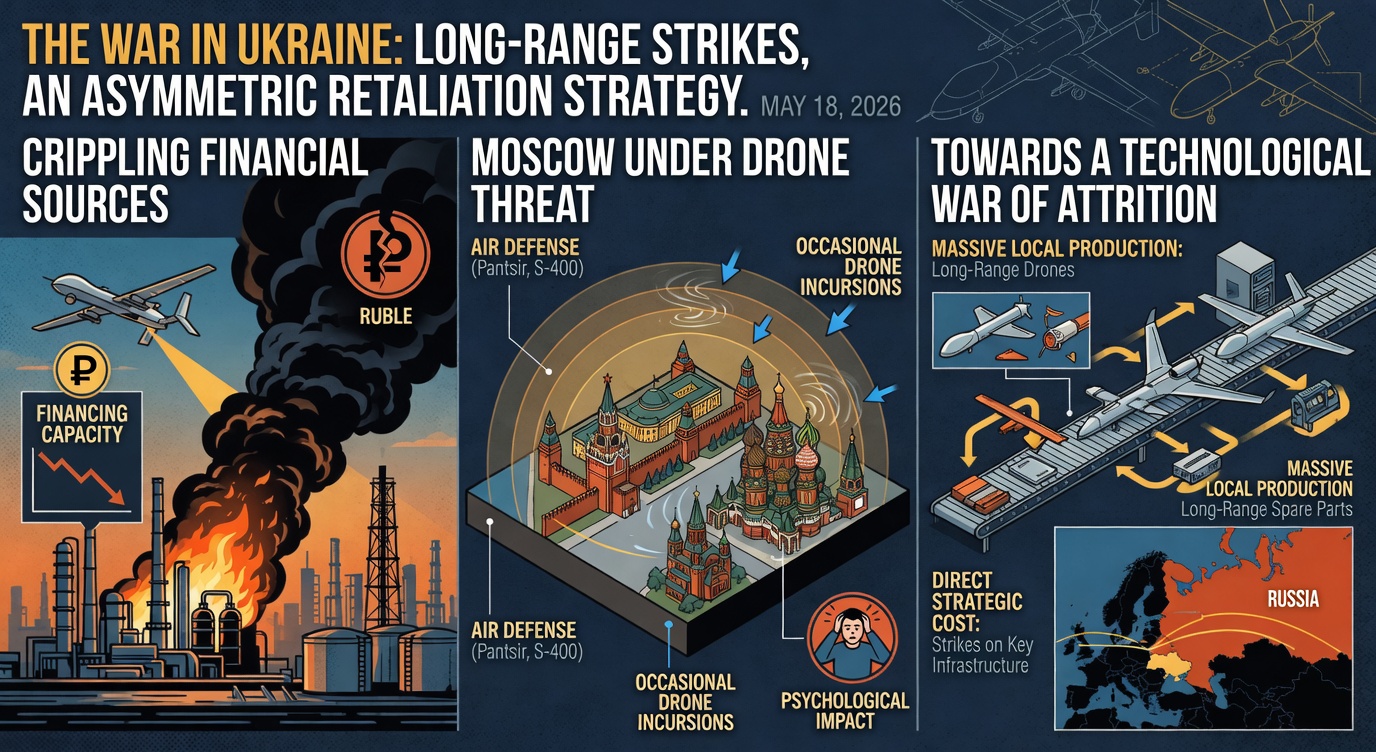
After more than four years of intense conflict, marked by relentless daily bombardments from the Russian army across Ukrainian territory, the front lines have steadily expanded beyond Ukraine’s borders. In a strategic response to the widespread destruction inflicted upon its population and economy, Kyiv has meticulously developed a campaign of targeted strikes deep within the Russian Federation, fundamentally altering the aerial and naval balance of this protracted war.
Disrupting the russian war machine’s financial lifeline
Ukraine’s military doctrine is unequivocally clear: to effectively weaken the adversary’s offensive capabilities, its logistical backbone must be paralyzed. Kyiv’s forces are systematically targeting not only military complexes but also crucial energy infrastructure, including Russian oil refineries and fuel depots.
The objectives behind these operations are twofold. Firstly, they aim to disrupt the direct supply lines supporting Russian troops engaged on the front. Secondly, Kyiv seeks to drastically reduce Moscow’s capacity to finance its long-term war effort, recognizing that the Russian economy remains heavily reliant on the export and processing of its hydrocarbons.
Moscow under drone threat: psychological and strategic ramifications
While the region surrounding the Russian capital frequently experiences drone alerts and attacks, the city of Moscow itself remains a less common target. Situated over 400 kilometers from the Ukrainian border, the metropolis benefits from an exceptionally dense air defense network.
Nevertheless, the occasional incursions of Ukrainian drones into the heart of the capital carry profound strategic importance. Beyond the often limited material damage, these strikes shatter the sense of security among urban Russian populations and compel Moscow’s military command to redeploy critical surface-to-air defense systems, such as Pantsir or S-400, away from the Ukrainian front to safeguard the nation’s vital centers of power.
Shifting towards technological attrition
This campaign of long-range strikes exemplifies Ukraine’s strategic pivot towards a technological war of attrition, bolstered by a significant domestic production of long-range drones. By extending the conflict onto Russian soil, Kyiv delivers a clear message to both the international community and its own populace: in the face of continuous Russian bombardments, Ukraine now possesses the means to impose a direct and strategic cost on its adversary, far beyond traditional combat zones.