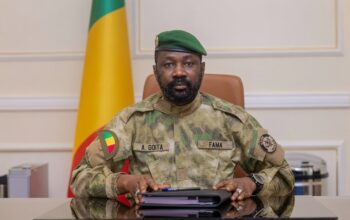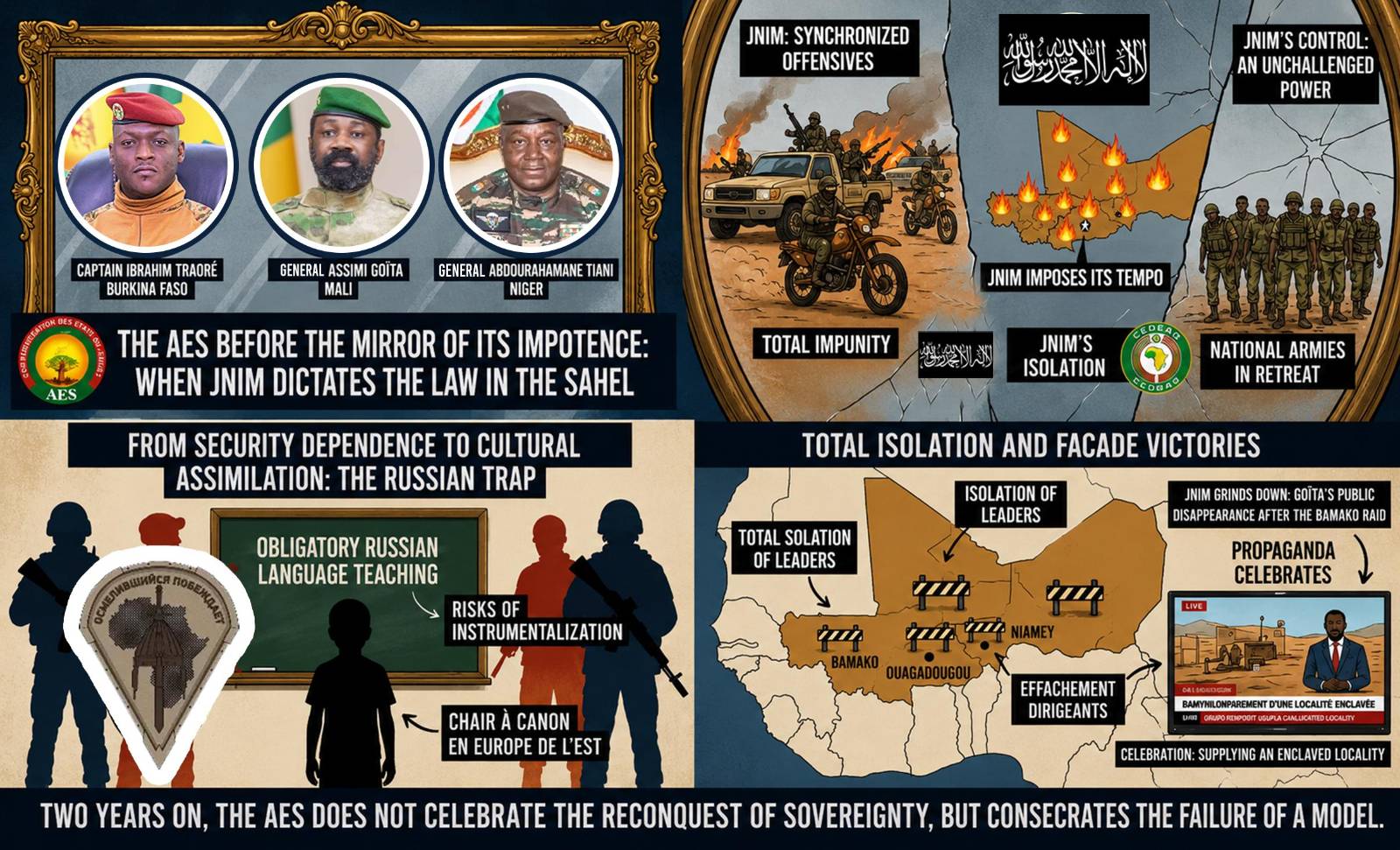
Two years after the Alliance of Sahel States (AES) was formed with great fanfare, its once-imposing facade is now showing dangerous cracks. Behind the bold declarations of sovereignty from the military juntas in Bamako, Ouagadougou, and Niamey, a harsh reality persists: the only truly coordinated armed force capable of dictating the pace of conflict and striking at will remains the Group for the Support of Islam and Muslims (JNIM).
Military incompetence and the hollow rhetoric of self-proclaimed leaders have collided head-on with the relentless efficiency of this terrorist network. JNIM orchestrates large-scale, synchronized offensives that simultaneously target multiple strategic regions, overwhelming even well-equipped national armies. Neither the theoretical intelligence-sharing agreements within the AES nor the full geopolitical alignment with Moscow have succeeded in stemming the tide of losses.
From security dependence to cultural assimilation: the Russian trap
The Burkinabè Captain Ibrahim Traoré and his counterparts have sought to fill their nations’ security void by forging a deep alliance with Russia. Yet this partnership has evolved far beyond mere military cooperation or the presence of Wagner Group mercenaries—now rebranded as Africa Corps. A particularly ominous development is the decision to introduce Russian language instruction in Burkinabè school curricula starting next term. Marketed as an act of cultural decolonization, this move is nothing short of a calculated psychological and structural indoctrination of the nation’s youth.
The implications of this linguistic shift go beyond mere curriculum reform. By embedding Russian early in education, the regime is laying the groundwork for deeper ideological integration. The long-term risk is stark: Burkinabè students, sent to Russia ostensibly for education or training, could be exploited in Moscow’s broader geopolitical agenda. As global tensions escalate, fears grow that Sahelian youth—unprepared and far from home—may be deployed as cannon fodder or human shields in conflicts in Eastern Europe that have nothing to do with their own region.
Total isolation and hollow victories
As cultural realignment takes shape, JNIM continues to dismantle the three juntas from within. By systematically crippling their adversaries, the armed group has forced the AES leadership into a near-total state of isolation. In Mali, the prolonged absence of Assimi Goïta from public life—following a deadly raid in Bamako that reportedly claimed the life of the Defense Minister—stands as the most glaring symbol of this strategic paralysis.
The contrast is damning: while terror groups steadily expand their territorial control, the juntas’ military command structures are sinking into political absurdity. Official propaganda now celebrates the mere delivery of supplies to a remote town or a routine defensive counterattack as major triumphs. This desperate glorification exposes the depth of their impotence.
At the two-year mark, the AES is not celebrating sovereignty regained; it is mourning the failure of a flawed model. By confusing war propaganda with genuine military strategy and swapping one foreign dependency for another—this time, cultural and military submission to Moscow—the juntas have allowed JNIM to set the agenda. The Sahel has not been liberated; it has merely exchanged one master for another, with its own youth bearing the heaviest burden.