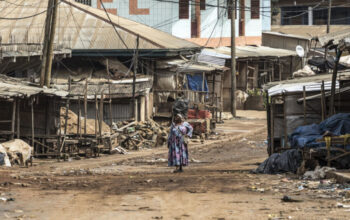
In the remote town of Obo, Haut-Mbomou, a striking incident unfolded last week when Russian mercenaries from the Wagner Group launched a surface-to-surface missile toward the Democratic Republic of Congo. The projectile, fired from a makeshift position in the heart of Obo, underscored tensions in a region already grappling with instability.
From US military outpost to Wagner stronghold
The origins of the missile trace back to a chapter of Central African history few remember. Between 2011 and 2017, elite American soldiers, including Green Berets, were deployed to Obo as part of Operation Observant Compass. Their mission: to dismantle the Lord’s Resistance Army (LRA) and capture its infamous leader, Joseph Kony, whose insurgency had terrorized parts of Uganda, South Sudan, and the Central African Republic for decades.
The Americans established a fortified base in Obo, equipped with surveillance systems and perimeter defenses. Their presence was part of a broader multinational effort to neutralize the LRA, which had been responsible for widespread atrocities, including the abduction of children and large-scale civilian massacres.
By April 2017, the operation concluded with the withdrawal of US forces. Though Joseph Kony remained at large, the Americans left behind more than just memories. According to local reports, military equipment—including vehicles, communications gear, and at least one surface-to-surface missile—was stored in containers and abandoned on-site.
Wagner takes control and uncovers hidden arsenal
In recent months, the Wagner Group—Russian mercenaries deployed to bolster Central African security forces—arrived in Obo at the invitation of local authorities. Their arrival marked a turning point. After evicting Central African military personnel from the former American base, the mercenaries began a thorough search of the abandoned facilities.
Local officials had previously announced that Wagner would conduct test firings of recovered weapons. The process: retain functioning arms, discard faulty ones. It was during one of these drills that the fateful launch occurred on the evening of February 26.
The mercenaries assembled a heavy-caliber weapon on Obo’s soccer field, in full view of residents. The projectile ignited, soaring into the night sky, visible across multiple neighborhoods. It passed over nearby towns such as Mboki and Zemio before crossing into Congolese territory.
The missile landed five kilometers from the village of Zapay in the DRC, with no immediate reports of casualties. Authorities believe the target zone was deliberately chosen to avoid populated areas in the Central African Republic, particularly Bambouti, located just 125 kilometers away. The dense Congolese forest served as a controlled impact zone.
Fear and uncertainty in Zapay
The impact sent shockwaves through Zapay, a Congolese village that hosts refugees fleeing violence linked to Wagner’s operations in the Central African Republic. Many residents, already traumatized by past abuses, now question whether the strike was a calculated message—one that suggests no border can shield them from the mercenaries’ reach.
Witnesses in Obo confirmed seeing the mercenaries load, aim, and fire the weapon. No other armed group in the area possesses the capability to launch a long-range projectile that crosses an international border and lands hundreds of kilometers away. The act was deliberate, visible, and unmistakably attributed to Wagner forces.
In Zapay, families spent the night scanning the sky, unsure if another projectile would follow. The incident has left locals in a state of heightened anxiety, with many fearing further escalation.
Questions of accountability and regional security
The use of a US-made missile by Russian mercenaries raises serious questions about the management of military stockpiles in post-conflict zones. It also highlights the growing influence of external armed groups in Central Africa and the risks they pose to regional stability. With Wagner’s presence expanding and control over former military sites tightening, the implications for neighboring countries like the DRC remain deeply concerning.