
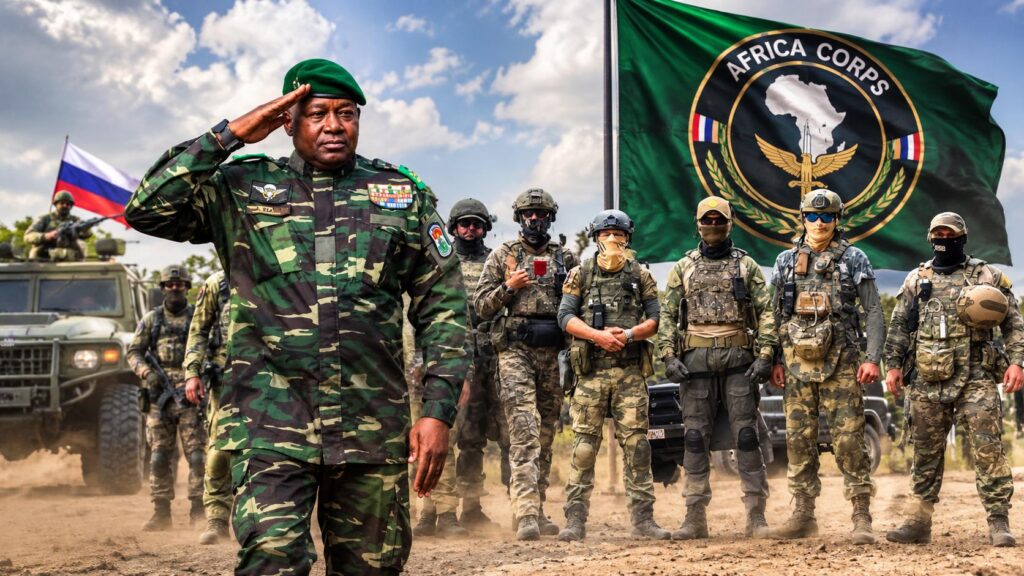
The military government led by General Abdourahamane Tiani is confronting an escalating wave of dissent from within its own barracks. Massive desertions toward armed groups, chronic shortages of basic equipment, and deadly confrontations with Russian Africa Corps operatives have turned the rank and file against the very leadership they once helped install.
A patriotic facade hiding deep fractures
More than eighteen months after the July 2023 coup, the nationalist image projected by Niger’s military rulers is cracking under the weight of battlefield realities. Behind the sovereignist speeches and military parades staged by the National Council for the Safeguard of the Homeland (CNSP), a far grimmer picture emerges. Niger’s armed forces are not merely buckling under relentless security pressure along their borders — they are disintegrating from within. The wave of defections sweeping through the ranks has become the clearest signal that General Tiani has lost the loyalty of a substantial portion of his own troops.
From uniform to insurgency: the widening exodus
What began as scattered acts of insubordination has morphed into a steady stream of soldiers abandoning their posts. Dozens of troops, stripped of their illusions and left to fend for themselves in remote garrisons, are choosing to flee. More troubling for Niamey: these deserters are no longer simply returning to civilian life. They are taking their tactical expertise — and sometimes their weapons — to join armed opposition movements or terrorist organizations.
Joining the FPL: a tactical windfall for rebels
A significant number of experienced fighters have enlisted with the Patriotic Liberation Front (FPL), the rebel movement led by Mahmoud Sadi that demands a return to constitutional order and the release of deposed president Mohamed Bazoum. By aligning with the FPL, these former soldiers lend the movement a dangerous tactical credibility, transforming a political rebellion into a structured paramilitary threat capable of targeting strategic infrastructure such as the oil pipeline linking Niger to Benin.
Crossing the red line into jihadist ranks
Even more alarming for regional stability, some soldiers have gone as far as joining Jama’at Nusrat al-Islam wal-Muslimin (JNIM), al-Qaeda’s Sahel branch. Driven by despair, a sense of abandonment, or material incentives, these former regular army members provide jihadists with intimate knowledge of local security networks, leaving military bases in western Niger more exposed than ever before.
Chronic under-equipment against a heavily armed enemy
How did things reach this point? On the ground, the bitterness of enlisted personnel is rooted in living and combat conditions that have become unbearable. Despite the regime’s warlike rhetoric, supplies simply do not follow. Troops deployed to the volatile fronts of Tillabéri or Diffa face a dramatic shortage of basic resources.
Spare parts for armored vehicle fleets are scarce, fuel is rationed, and reserve ammunition runs out quickly during firefights. Soldiers confront mobile armed groups equipped with light drones and modern assault rifles, while they themselves often lack basic personal protective equipment or secure communication systems. On top of these material hardships, risk bonuses are paid late and wounded soldiers receive inadequate care. The perceived gap between the comfort of senior junta officials in Niamey and the misery of soldiers in the field fuels a deep-seated resentment.
Bloodshed with Africa Corps: the August 28-29 incident
The military’s distrust of the political leadership reached a point of no return in late summer. During the night of August 28-29, a gravely serious event laid bare the gaping rift between troops and the high command: an attempted insurrection crushed in blood, involving the regime’s Russian allies.
Faced with growing unrest in several Nigerien army units, the junta called on Russian Africa Corps operatives to secure critical points and suppress mutinous stirrings. During those nighttime clashes, Russian mercenaries opened fire directly on Nigerien soldiers. This tragic episode, in which several national troops lost their lives to foreign bullets on their own soil, sent shockwaves and indescribable outrage through the barracks.
For non-commissioned officers, watching a self-proclaimed “sovereignist” regime deploy foreign mercenary forces against its own troops represents the ultimate betrayal. General Tiani’s moral authority among enlisted personnel collapsed that night.
A regime trapped by its own armed forces
Far from the image of a united and unshakeable military power, Niger’s junta now appears weakened by the very base of the institution that brought it to power. By addressing neither the logistical needs of its troops nor the population’s desire for stability, General Tiani finds himself increasingly isolated. Mass desertion and the flight of skilled personnel toward rebellion or jihadism demonstrate that Niger’s army refuses to serve as cannon fodder for a regime whose objectives it no longer shares. If the fracture continues to widen at its current pace, the greatest threat to the CNSP will not come from outside — but from within its own barracks.
You may also like
Sahel alliance’s 7,727 billion CFA franc debt burden on the regional market
Benin’s schools reopen nationwide on 14 September as security improves and fees stay free
Niger’s fuel subsidy burden pushes SONIDEP toward 28 billion FCFA loss in 2026
Burkina Faso’s textile gamble: how retirees’ pensions became collateral for TEXFORCES-BF
Niger’s external liabilities hit 12,900 billion FCFA as dependence persists