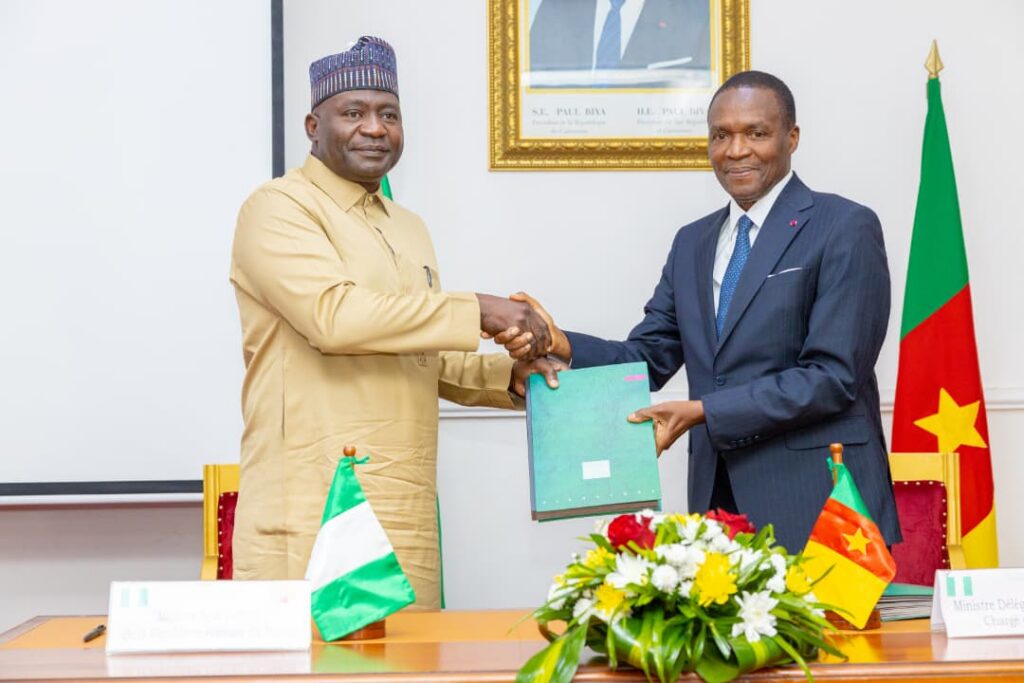
Nigeria Cameroon defense cooperation: new security pact
Nigeria and Cameroon have formalized a new military cooperation agreement in Yaoundé, aiming to significantly bolster security along their shared southern border. This pivotal accord outlines provisions for enhanced operational coordination, more robust intelligence sharing, and closer collaboration across military training initiatives and the defense industry sector.

The memorandum of understanding, designed to deepen military cooperation and fortify the security of their common southern frontier, was officially signed in Yaoundé. The signatories were Nigeria’s Minister of Defense, General Christopher Gwabin Musa (retired), and Cameroon’s Minister Delegate to the Presidency in charge of Defense, Joseph Beti Assomo.
This signing ceremony marked the culmination of two days of intensive discussions involving military and security officials from both nations. The adopted document establishes an updated framework for cooperation, directly addressing ongoing security challenges encountered on both land and within the shared maritime domain. Specifically, the memorandum mandates a reinforcement of operational coordination, intelligence exchange, logistical support, joint military training exercises, and personnel exchange programs. Both parties additionally committed to refining their response mechanisms to effectively counter the various security threats they face.
Following the signing, General Christopher Musa articulated that the agreement would now provide a “structured framework for military cooperation and operations” between Nigeria and Cameroon, thereby institutionalizing their collaborative efforts in tackling shared security concerns. Discussions also encompassed the recently established Combined Maritime Task Force. Officials from both countries underscored the imperative of achieving full operationalization for this crucial structure, recognizing its potential as a vital instrument for enhancing maritime security across the Gulf of Guinea and safeguarding the region’s economic and security interests.
Cooperation within the defense industrial sector featured prominently during the deliberations. The Nigerian minister reiterated his nation’s commitment to forging partnerships in defense technologies and innovation. He observed that “one of the persistent challenges hindering the development of African defense capabilities remains the limited local production of military equipment,” emphasizing the critical need for closer regional industrial cooperation.
General Musa further highlighted the capabilities offered by Nigeria’s Defence Industries Corporation, affirming his country’s readiness for joint ventures in military equipment manufacturing, technology transfer, research, innovation, and skill development. In response, Joseph Beti Assomo conveyed Cameroon’s keen interest in deepening bilateral cooperation in innovation and defense technologies. He indicated that a formal framework for proposals was nearing completion, aimed at concretizing future joint projects within this critical sector.
You may also like
Thali oil permit: can Prime Global Energies’ $15 million rescue finally unlock Cameroon’s stalled Njom-3 well?
Can West Africa’s peace hold without the Entente Council and UNOWAS pact?
Can Lomé’s quiet diplomacy finally deliver peace to eastern DRC?
Can Nigeria’s security forces ever shut down the kidnapping economy in the north?
Can Benin’s defense strategy survive on diversification alone?