In a West African landscape increasingly strained by geopolitical tensions, Niger’s transitional authorities have recently implemented commercial measures that have left regional economists and traders perplexed.
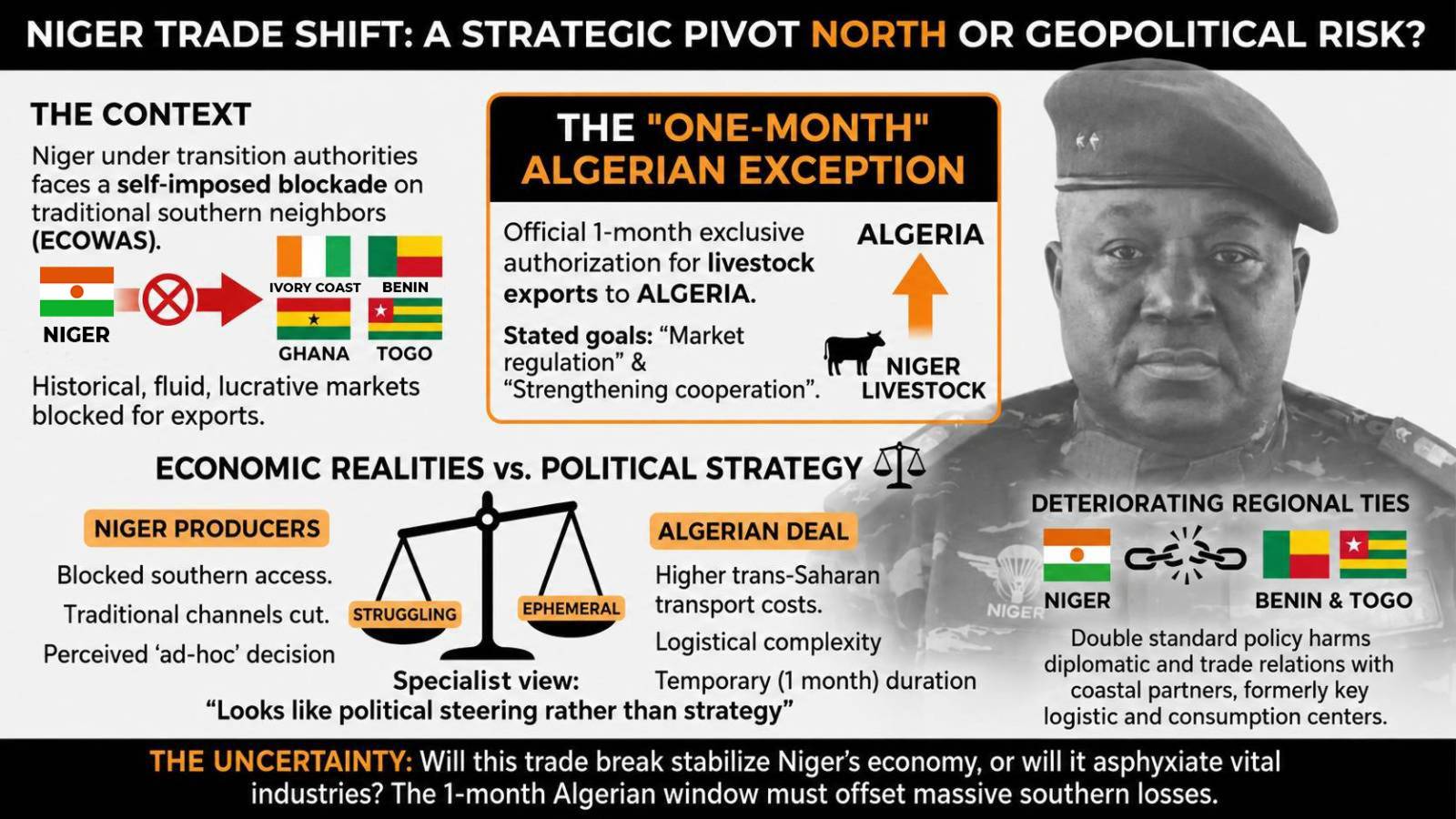
While trade routes toward the Gulf of Guinea—particularly Côte d’Ivoire, Benin, Ghana, and Togo—remain either locked or severely restricted, Niamey has unexpectedly carved out a temporary passage toward the North.
An exceptional concession for Algiers
The government of Niger has granted Algeria a one-month exceptional authorization to import livestock. Official channels describe this move as part of an effort to “regulate the domestic market” and “strengthen economic cooperation” between Niger and Algeria.
Yet beneath the stated objectives lies a far more intricate economic reality for local producers. Historically, the Gulf of Guinea has served as Niger’s most natural, fluid, and lucrative outlet for its pastoral sector.
Economic actors voice growing concerns
Analysts specializing in Sahelian cross-border trade question the long-term logic behind such asymmetric policies. Blocking access to traditional southern markets while opening a fleeting northern window for just 30 days appears less like a calculated economic strategy and more like a politically driven maneuver.
« Prioritizing Algeria over neighboring Economic Community of West African States (ECOWAS) members risks undermining a pastoral sector already battered by recurring crises, » notes an expert on Sahelian trade flows.
Regional relations strain under divergent trade policies
The apparent double standard in trade policy is deepening diplomatic rifts with coastal West African nations. Benin and Togo, long-standing logistical hubs and key markets for Niger, are now sidelined in favor of a more complex Saharan trade axis.
With decisions perceived by some as hasty or poorly thought out, local herders find themselves hostage to shifting political winds. Can a single month of exports to Algeria truly offset the losses from blocked markets in Côte d’Ivoire, Benin, or Ghana? The answer remains uncertain, especially as trans-Saharan transport costs threaten to absorb a significant portion of potential profits.
The coming weeks will reveal whether this abrupt shift in economic diplomacy stabilizes Niger’s economy or further suffocates its vital livestock sectors.