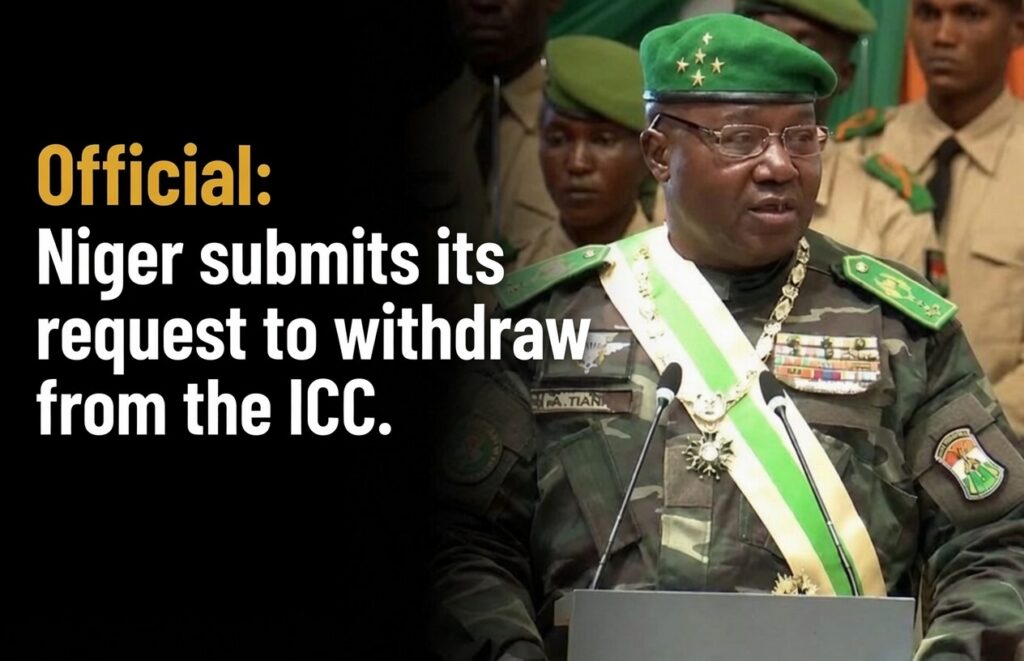
The Republic of Niger has formally commenced its procedure for withdrawing from the International Criminal Court (ICC). This pivotal decision aligns with a broader reorientation initiated by the military authorities since their assumption of power in July 2023. Through this action, Niamey unequivocally asserts its commitment to upholding national sovereignty and challenging the operational framework of an institution that has frequently faced criticism across the African continent.
A primary contention raised by the Nigerien authorities pertains to the ICC’s perceived disproportionate focus on African nations in its prosecutorial efforts. Indeed, since its establishment in 2002, the bulk of investigations and individuals pursued by the Hague-based tribunal have originated from states within the continent. This persistent imbalance has, for several years, fueled allegations of «selective justice» articulated by various African leaders.
This development also unfolds amidst a significant geopolitical recalibration within Niger. Following a discernible shift away from several Western partners, the Nigerien administration is now prioritizing enhanced collaboration with member states of the Alliance of Sahel States (AES), which comprises Mali, Burkina Faso, and Niger. These three nations have collectively pursued numerous joint ventures aimed at bolstering their political and security autonomy, reflecting a new era in Sahel politics today.
Consequently, the withdrawal from the ICC represents another in a series of policy decisions underscoring the authorities’ determination to curtail the influence of international institutions perceived as inimical to national interests. Proponents of the current administration interpret this trajectory as a robust assertion of the nation’s sovereignty. Conversely, critics contend that disengaging from international justice mechanisms could potentially undermine efforts to combat impunity and deny victims of egregious crimes an additional avenue for redress.
From a legal standpoint, this disengagement is not immediate. In accordance with the provisions of the Rome Statute, the foundational treaty of the International Criminal Court, the withdrawal procedure will only become effective one year subsequent to the formal notification being submitted to the United Nations. Furthermore, any investigations already initiated prior to the official withdrawal date will remain under the jurisdiction of the Court.
By opting to withdraw from the ICC, Niger thus contributes to the broader discourse concerning Africa’s position within global institutions and the delicate equilibrium between national sovereignty and the imperatives of international criminal justice.
You may also like
Will the UK’s new transit visa rules isolate Senegal from its key global routes?
Will the AES ever launch its own currency? The question Traoré keeps leaving unanswered
South Africa’s mass shooting crisis: can Johannesburg and Cape Town ever feel safe again?
Can Ibrahim Traoré’s 300 armored vehicles claim survive scrutiny? Inside Faso Armored’s made-in-Burkina Faso gamble
Can Washington force third-country deportations? Ivory Coast’s refusal raises the stakes