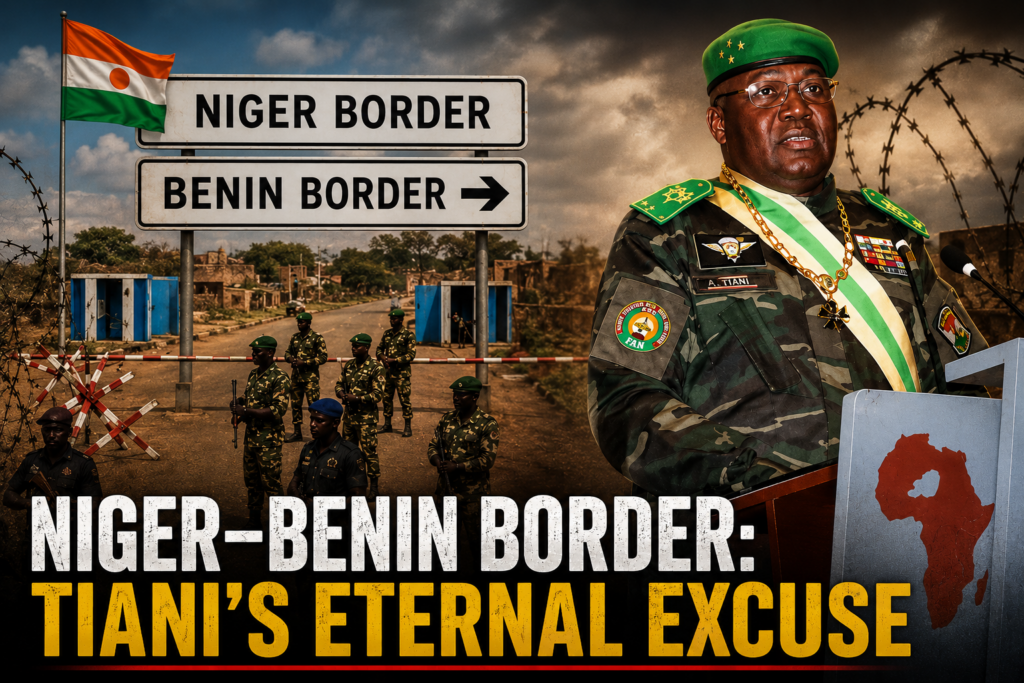
The Niger-Bénin border dispute: a dialogue that never materializes
Eight weeks after Beninese President Romuald Wadagni’s visit to Niamey and five weeks following the resumption of technical discussions between the two nations, expectations ran high for a swift resolution to the Niger-Bénin border crisis. The negotiations had appeared promising, suggesting a phased reopening of exchanges between the neighboring countries.
Yet, on July 26, during a national address marking the first anniversary of his rise to power, General Abdourahamane Tiani dashed those hopes. In a televised statement broadcast on ORTN, he declared: ‘Certain prerequisites must be addressed before any irreversible decision on border reopening can be made.’
This pronouncement reinforced a pattern observed over the past three years: the border has evolved from a mere transit point into a political tool, wielded to fuel nationalist narratives and sustain pressure on Cotonou.
The ambiguity of prerequisites
The crux of the issue lies in the lack of concrete details. What exactly constitutes these so-called ‘prerequisites’? Which criteria would signal their fulfillment? Is there a timeline for resolution? None of these questions have received clear answers.
This deliberate vagueness grants the military leadership a strategic advantage: it enables the indefinite postponement of reopening without requiring tangible justification. Each new condition can be replaced by another, rendering the border dispute an open-ended issue with no clear resolution in sight.
A security narrative that no longer holds
Since the July 2023 coup, the regime has consistently cited security as its primary justification for maintaining the closure. Niamey alleges that Benin’s territory serves as a rear base for armed groups or foreign actors threatening Niger’s stability. However, these claims have never been substantiated with verifiable evidence.
Meanwhile, terrorist attacks persist across Niger’s most vulnerable regions—Tillabéri, Tahoua, and Diffa—demonstrating that border closure has not translated into tangible security improvements. This contradiction raises a critical question: if the measure were intended to bolster national security, why do internal threats continue unabated?
Technical discussions sidelined by political calculations
Just weeks before Tiani’s announcement, Beninese and Nigerien experts had reconvened to explore technical frameworks for a gradual resumption of trade. These meetings aimed to reconcile security concerns with the restoration of commercial flows.
By dismissing these efforts, the general’s stance underscores a clear message: the final decision rests solely on political grounds. In essence, these discussions now appear to serve as a delaying tactic rather than a pathway to resolution.
Economic fallout: a burden shared unequally
The prolonged closure has inflicted severe economic repercussions on both nations. Benin, a transit hub, has seen a decline in port traffic, customs revenue, and transportation sector activity. However, the impact on Niger—already landlocked—has been far more devastating.
The diversion of trade routes through alternative corridors has driven up logistical costs, with cascading effects on consumer prices:
- Agricultural product inflation;
- Rising construction material costs;
- Increased prices for imported medicines and goods;
- Supply chain disruptions for local businesses;
- Eroded competitiveness for Nigerien enterprises.
Small-scale traders along the border bear the brunt of this crisis. Many have seen their incomes plummet, while once-thriving border communities now grapple with economic stagnation.
Regional cooperation at risk
The closure extends beyond economics, undermining broader regional collaboration. Academic exchanges, cross-border governance initiatives, joint development projects, and anti-trafficking efforts have all grown increasingly difficult to sustain.
Ironically, a formally closed border does not deter illicit networks—in fact, it often exacerbates them. The vacuum left by legal trade fuels informal commerce, complicating authorities’ efforts to monitor and regulate border activities.
Sovereignty as a political shield
By framing the border closure as an ‘irreversible’ decision, Tiani invokes sovereignty as a symbolic gesture. The narrative frames the measure as defiance against external pressures. Yet, this raises a fundamental question: does sovereignty lie in isolating an economy or in safeguarding the welfare of its people?
For many analysts, the prolonged closure now appears driven more by political messaging than by measurable security objectives. It reinforces a narrative of perpetual resistance, bolstering the junta’s domestic legitimacy among a segment of the population.
The human toll of a political standoff
The official discourse obscures the human cost borne by ordinary citizens. Transport workers deprived of livelihoods, merchants facing ruin, students barred from travel, separated families, and entrepreneurs navigating uncertainty—these impacts remain largely unaddressed. Each passing week deepens these hardships and delays the return to normalcy.
An impasse with no end in sight
Three years into the crisis, the Niger-Bénin border has become less a security issue and more a political lever. By invoking vaguely defined prerequisites, the Nigerien leadership retains full control over the timeline, perpetuating the status quo indefinitely.
As time passes, the populations of both nations continue to endure the economic, social, and humanitarian consequences of a decision whose tangible benefits remain elusive. A lasting resolution may ultimately hinge on when political imperatives yield to the urgent need for dialogue, trust, and pragmatic regional cooperation.
You may also like
Niger’s defense money: inside the 1.8 billion FCFA monthly question over the CFPD
Mali balances Russia ties with renewed US security talks
Mali drone war: 731 civilians killed in 199 strikes, investigation reveals
Benin and Reims launch master’s in sustainable engineering design at Sèmè City
Nigeria police vow secure and neutral presidential election