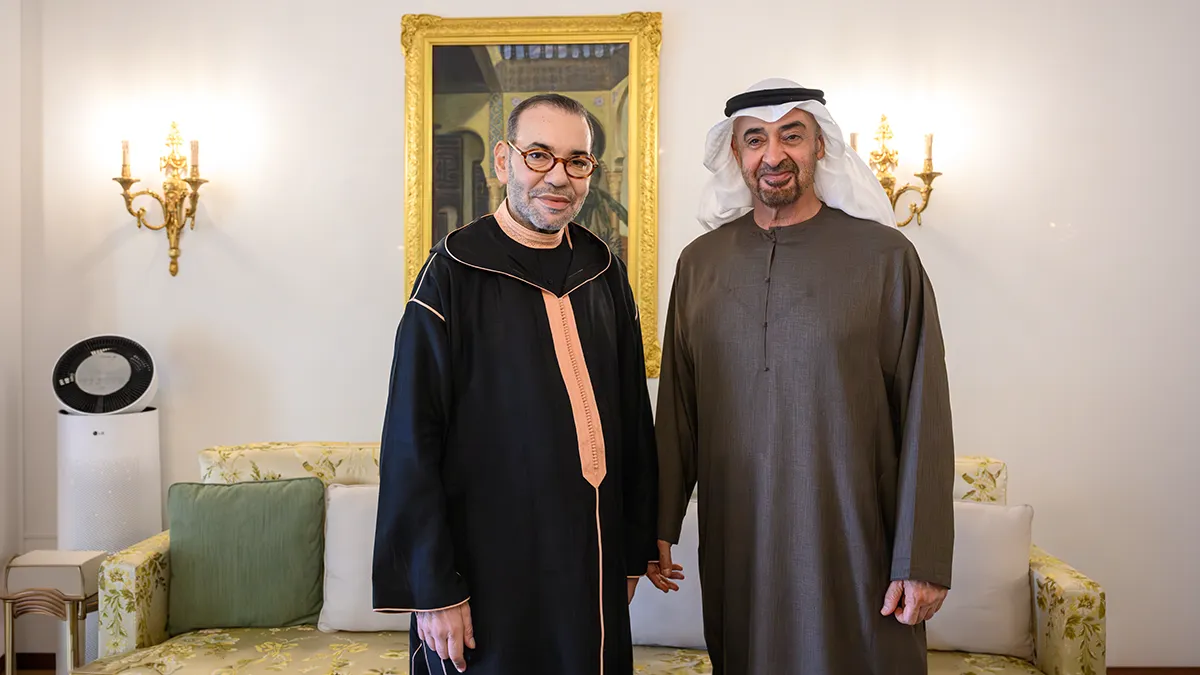
Morocco and UAE leaders unite in Rabat to reinforce Atlantic-Gulf axis amid Middle East turbulence
King Mohammed VI of Morocco and Sheikh Mohamed bin Zayed Al Nahyan of the United Arab Emirates solidified a strategic partnership built on massive infrastructure investments and shared maritime security interests.
- Economic investments and infrastructure modernization
- Geopolitical trade-offs: Sahara and Gulf security
- Diplomatic anticipation and regional stability
The Royal Palace in Rabat has once again become the focal point of strategic diplomacy bridging North Africa and the Gulf. This wasn’t merely a ceremonial meeting; the gathering between Morocco’s King Mohammed VI and UAE’s Sheikh Mohamed bin Zayed Al Nahyan occurred as tensions in the Middle East threaten to disrupt global trade and energy corridors.
As the standoff between Iran, Israel, and the United States escalates, threatening vital commercial and energy arteries worldwide, both capitals have chosen to act in unison. Rabat and Abu Dhabi have long fostered a robust political and intelligence partnership, and this meeting confirms that North Africa is no longer insulated from the Gulf’s security crises.
The diplomatic teams from both nations had one clear priority: to coordinate a unified response to prevent military escalation from paralyzing critical maritime trade and energy routes. For Morocco, Gulf stability is non-negotiable, extending beyond symbolic gestures.
The Moroccan monarch has privately assured regional leaders of his active solidarity in defending these strategic waters. From Abu Dhabi’s perspective, Morocco’s geopolitical weight in Africa and its direct access to the Atlantic and Mediterranean make it an indispensable partner requiring absolute alignment.
Economic investments and infrastructure modernization
This political harmony is not empty rhetoric; it’s anchored in substantial financial and industrial commitments. The UAE has emerged as Morocco’s top Arab investor, with over $30 billion deployed across key sectors.
The economic roadmap gained momentum following the Comprehensive Economic Partnership Agreement (CEPA). Energy projects are already underway, with the UAE committing financial backing to the Africa-Atlantic Gas Pipeline (AAGP), a $25 billion initiative designed to transport Nigerian gas to European markets via a 5,600-kilometer route.
UAE’s investment footprint extends to modernizing Morocco’s transportation infrastructure. New funding agreements target the expansion of the Al Boraq high-speed rail, operated by ONCF, extending its current Tangier-Casablanca line to Marrakech. Simultaneously, institutional partnerships with ONDA (National Airports Authority) include investments in strategic terminals such as Casablanca, Nador, and the new logistics hub in Dakhla, emphasizing the Atlantic coast’s importance to the Gulf.
Geopolitical trade-offs: Sahara and Gulf security
The bilateral relationship operates on clear geopolitical reciprocity. Abu Dhabi was among the first capitals to openly support Morocco’s stance on the Western Sahara conflict by opening a consulate in Laayoune, a crucial diplomatic backing reciprocated by Rabat through military and institutional support on the eastern flank.
Abu Dhabi requires influential Arab allies with modern militaries and influential diplomacy to counter Iran’s regional ambitions and its proxy militias.
Discussions in Rabat revealed complete alignment on defending territorial integrity and rejecting external interference destabilizing legitimate governments. However, this mutual shield has sparked concerns in neighboring Algeria, which views the Gulf monarchies’ financial and political presence on its western border with suspicion.
Moroccan diplomacy is skillfully leveraging UAE investment not only to modernize critical infrastructure but also to consolidate its strategic position in North Africa.
Diplomatic anticipation and regional stability
International observers agree that the true value of this meeting lies in its proactive nature. Rather than reacting to fait accompli, Mohammed VI and Mohamed bin Zayed are defining a common position before the Levant or Red Sea crisis reaches a point of no return.
Both delegations publicly emphasize dialogue to curb military escalation, but behind-the-scenes discussions focus on pragmatic cooperation: direct collaboration between intelligence services to monitor extremist group movements and security in conflict zones.
Official communiqués from Morocco’s Ministry of Foreign Affairs and UAE’s WAM agency underscore that security is no longer viewed regionally or in isolation. The interconnected nature of current crises demands rethinking traditional alliances, with the Rabat-Abu Dhabi axis emerging as one of the Arab world’s most stable partnerships.
In a global context where Western powers appear distracted or divided, consolidating a stability pole along the Atlantic-Gulf axis grants both countries crucial strategic autonomy for the coming years.