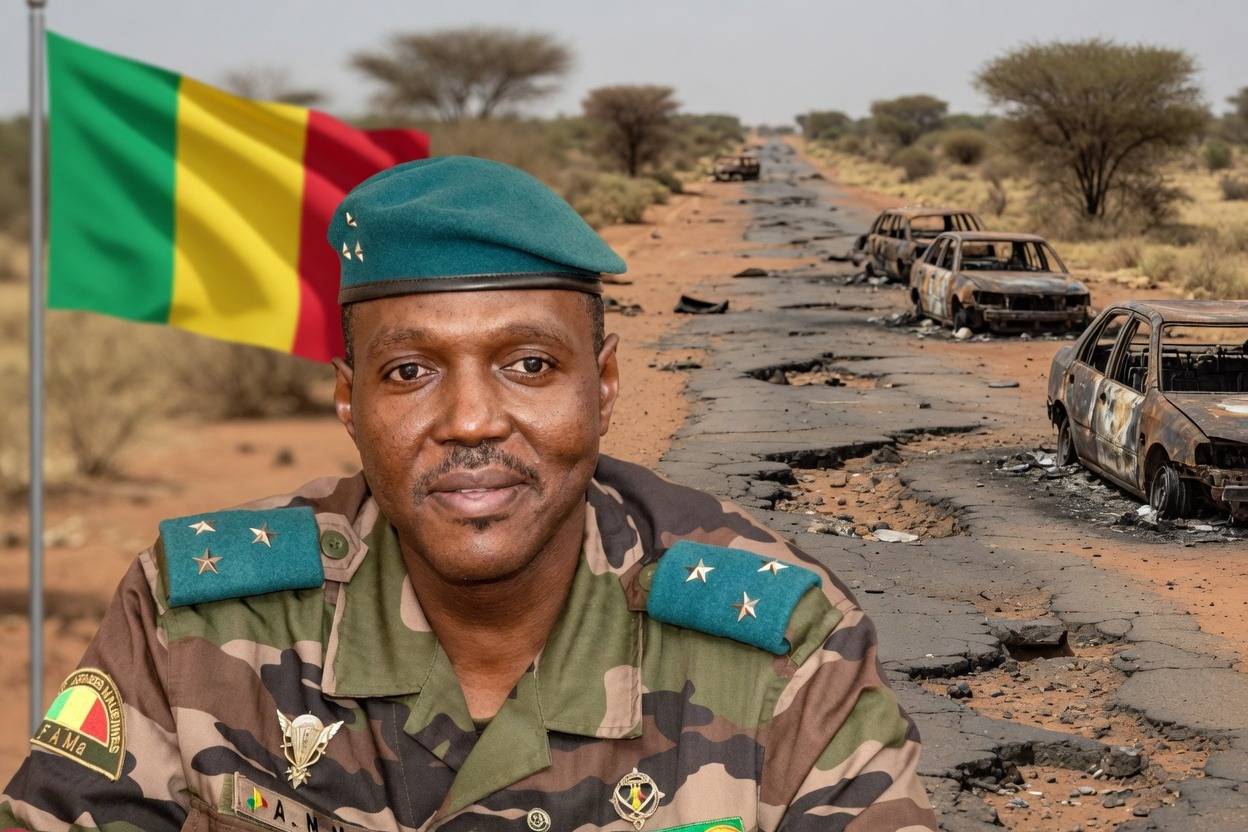
Charred vehicle wrecks, decaying food supplies, and lifeless bodies abandoned along the roadside paint a grim picture of the crucial supply routes traversing northern Mali. A pervasive scent of death hangs heavy in the air, a stark reminder of the escalating violence gripping the nation. Yet, despite this profound humanitarian and security crisis, transitional authorities in Bamako appear detached, operating within a parallel reality. Prime Minister Abdoulaye Maïga’s assertion, « there is no blockade on the roads. Everyone moves freely in Mali, » serves as a desperate attempt to verbally conceal the state’s severe operational collapse.
This rhetoric of denial highlights an ever-widening chasm between the military government and the lived experiences of civilian populations. While Bamako frequently issues pronouncements of victory, the vital corridors connecting the country’s south to its northern regions have tragically transformed into open-air cemeteries. The current regime seems to have traded genuine territorial protection for an aggressive communication strategy, where any acknowledgment of Malian suffering is branded as an act of sedition. By prioritizing a narrative of restored sovereignty over the physical survival of its citizens, the ruling junta isolates itself in an ivory tower, with human lives paying the ultimate price.
Strategically, the government’s failures are equally pronounced. The abrupt decision to sever ties with traditional international partners in favor of new alliances has, thus far, failed to deliver the promised security improvements. On the contrary, the withdrawal of international forces created a dangerous vacuum that armed terrorist groups swiftly exploited, imposing brutal sieges on communities across northern and central Mali. The regime, seemingly unable to secure essential supply convoys, appears to have lost the tactical initiative on the ground. Its response often consists of sporadic airstrikes, a stark contrast to the sustained territorial presence required to break the economic stranglehold on these beleaguered regions.
Finally, political stagnation and severe restrictions on individual liberties further undermine the nation’s stability. By stifling the voices of journalists, opposition figures, and civil society members who dare to shed light on the crisis, the government deprives itself of critical mechanisms for fostering true national resilience. The absence of a clear electoral timeline and the regime’s increasing authoritarianism suggest that the primary focus is no longer on resolving the security crisis, but rather on perpetuating a power structure that, in the absence of tangible battlefield successes, relies on a superficial nationalism. While fervent speeches echo through the halls of Bamako, the real Mali, far from the capital, continues to suffer and decay along its desolate roads.