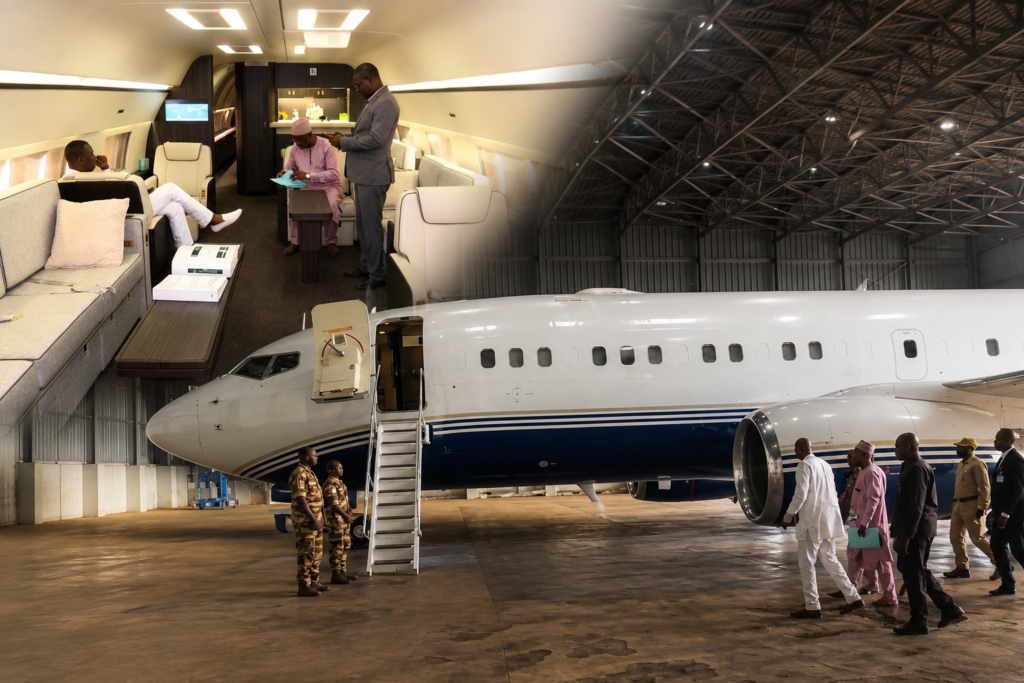
The unveiling of Mali’s new Boeing 737 presidential aircraft on national television this Wednesday evening has intensified public scrutiny of the military-led Transition government’s spending priorities. Authorities justify the acquisition as a financially sound decision, citing a net cost of 6 billion West African CFA francs after accounting for insurance compensations and the resale of parts from the previous aircraft.
While the government emphasizes the transaction’s economic rationality, the timing and context of this investment have sparked broader discussions. With Mali grappling with persistent insecurity, economic strain, and strained public finances, the purchase raises pressing questions about whether the Transition’s priorities align with the nation’s most urgent needs.
An announcement out of touch with ground realities
The timing of the presentation could not have been more ill-timed. As authorities repeatedly urge citizens to embrace sacrifice, resilience, and national unity, the unveiling of a state-of-the-art presidential jet sends a conflicting message one that suggests a preoccupation with prestige over the immediate welfare of the Malian people.
Across vast regions of the country, security remains a daily crisis. Military outposts continue to come under attack, roadside ambushes persist, and civilians face persistent violence. Many areas remain inaccessible, while the state struggles to restore its presence and authority in contested territories.
Unresolved security challenges overshadow symbolic investments
Three years into the Transition’s pledge to prioritize territorial restoration, Mali’s security landscape remains fraught with unresolved threats.
In the northern regions, coalitions such as the Permanent Strategic Framework and the Azawad Liberation Front maintain significant operational capacity, contesting control over key zones. Meanwhile, in central and southern Mali, the Group for the Support of Islam and Muslims (JNIM) continues to expand its influence, intensifying attacks on military forces, state infrastructure, and public officials. Critical roadways remain high-risk corridors, disrupting trade, transportation, and economic activity.
This stark reality stands in sharp contrast to the image of strength and capability that the regime aims to project.
Budgetary choices under scrutiny
Even if the government asserts that the final cost of the aircraft is significantly lower than the headline figure, critics argue that billions of CFA francs could have been allocated to more pressing needs, including:
Enhancing the operational readiness of the Malian Armed Forces;
Procuring armored vehicles, secure communications systems, and protective equipment;
Upgrading intelligence and aerial surveillance capabilities;
Supporting wounded soldiers and the families of fallen servicemen;
Assisting internally displaced persons and funding the reconstruction of war-damaged infrastructure.
Beyond financial figures, the controversy centers on the hierarchy of national priorities.
A diluted message of sobriety and patriotism
Since assuming power, the Transition leadership has cultivated its legitimacy in part through a narrative of austerity, patriotism, and dedication to national interests one that promised a break from the perceived excesses of previous regimes.
The acquisition of a large-capacity presidential jet risks undermining this message. To many citizens, it signals a return to the very culture of elite entitlement and symbolic spending that the Transition vowed to leave behind. This perception is further compounded by ongoing economic hardships: rising living costs, fiscal pressures, unmet social needs, and stagnation across key economic sectors.
Diplomatic symbolism at what cost?
Government officials may contend that a modern presidential aircraft enhances Mali’s ability to conduct high-level diplomatic engagements and represent the nation on the international stage.
Yet, this argument fails to resonate with those who argue that a state’s credibility is rooted first and foremost in its internal stability, its capacity to safeguard its people, and the proper functioning of its institutions.
For many Malians, true sovereignty is not measured by the modernity of a presidential fleet, but by the effective control of national territory and the protection of its citizens.
A source of growing criticism
In opposition circles and among critical voices, the purchase has taken on deeper political significance.
Some interpret it as evidence of a government more invested in the mobility of its leaders than in the functioning of the state. Others suggest that a long-haul aircraft, permanently available, serves not only as a symbol of prestige but albeit unproven as a potential escape route for top officials in the event of a major security deterioration.
Regardless of intent, the perception reflects a broader climate of distrust toward the government’s decision-making processes.
Questioning the Transition’s strategic direction
The arrival of the Boeing 737 transcends a simple procurement decision. It reopens a fundamental debate about the Transition’s strategic choices.
As security threats persist, attacks continue, and economic hardships deepen, every expenditure perceived as symbolic is increasingly met with skepticism. For many Malians, genuine sovereignty is not demonstrated through the modernization of the presidential fleet, but through the state’s ability to protect its people, restore its authority across all regions, and improve the daily lives of its citizens. Until these goals are met, investments in prestige risk appearing increasingly disconnected from the realities on the ground.
You may also like
Kidal: 43 dead as strikes wipe out desert water wells in northern Mali
Benin’s rating leap to AA-: the moment regional capital started taking Cotonou seriously
Brigitte Tchede’s Cairo surge: Benin’s discus medal breakthrough that changes everything
Burkina Faso’s armored vehicles: the moment of truth arrives on the battlefield
Bénin’s Senate takes decisive step with 2027 budget adoption