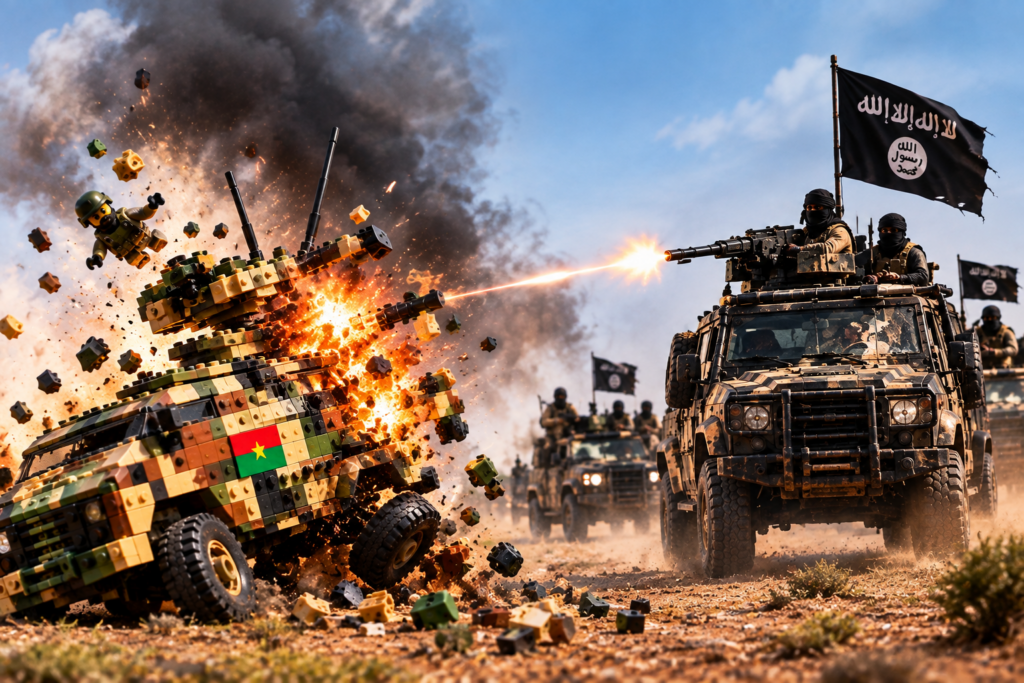
From assembly lines to frontlines: The critical test for Burkina Faso’s homegrown armor
For years, Burkina Faso has wagered on industrializing its military capabilities, aiming to reduce dependency on foreign procurement. The push for locally assembled or produced armored vehicles has been framed as a cornerstone of national sovereignty. But when the rubber meets the road or when ordnance meets metal the true measure of these investments begins.
On September 16, 2026, the Group for the Support of Islam and Muslims (JNIM) claimed control of two strategic positions manned by the Volunteers for the Defense of the Homeland (VDP) in Mahlou and Winten, located in Bam Province. The announcement, while unconfirmed by independent verification, thrust Burkina Faso’s armored ambitions into a stark spotlight. These vehicles, once celebrated as symbols of industrial progress, now face their first real combat trial.
The limits of production: When hardware meets the heat of war
The government of Captain Ibrahim Traoré has championed local military production as a transformative leap for national defense. The narrative is compelling: reduced reliance on imports, enhanced self-sufficiency, and a tangible display of technological autonomy. Yet, in the volatile Sahel, such aspirations are tested not in manufacturing halls or promotional videos, but in the crucible of combat.
While the specifics of Burkina Faso’s armored production remain undisclosed, the vehicles in question have been widely described as modular, akin to Lego pieces, easy to assemble, but potentially challenging to maintain under sustained pressure. The analogy underscores a critical question: Can these vehicles withstand the operational realities of Burkina Faso’s northern battlefields?
The litmus test at Mahlou and Winten
The loss of these positions, if confirmed, would mark more than a tactical setback. It would signal the arrival of a pivotal moment for Burkina Faso’s military narrative. The JNIM’s advances in Bam Province, including earlier claims over positions near Séguénéga and Bourzanga in August 2026, reveal a troubling pattern: terrain regained is often terrain lost. The question now is whether Burkina Faso’s armored vehicles can reverse that trend.
Critics argue that the government’s focus on quantity how many vehicles are produced and showcased has overshadowed the more critical issue of quality. Durability, firepower, and survivability in harsh conditions are the benchmarks that matter. A vehicle that cannot operate after a single engagement is little more than a liability, regardless of its origin.
Sovereignty at stake: Beyond buzzwords and blueprints
The stakes extend beyond military hardware. National sovereignty, as defined by tangible control over territory, is on trial. Burkina Faso’s ability to hold ground, protect civilians, and project force depends not on the number of armored vehicles paraded in Ouagadougou, but on their performance in engagements like Mahlou and Winten.
If the JNIM’s claims are substantiated, the narrative of a burgeoning local defense industry will face its most severe challenge yet. The terrain has already spoken and its verdict is not yet final, but it is increasingly urgent.
A reality check for aspirations
The coming weeks will determine whether Burkina Faso’s armored vehicles are a solution or a symbol. For the soldiers manning them, the factories assembling them, and the communities relying on their protection, the difference is existential. Claims of industrial prowess are meaningless if they cannot translate into battlefield dominance.
As analysts assess the fallout from Mahlou and Winten, one truth becomes undeniable: the era of untested promises has ended. The era of accountability and potentially, of breakthroughs has begun.
You may also like
Benin’s rating leap to AA-: the moment regional capital started taking Cotonou seriously
Brigitte Tchede’s Cairo surge: Benin’s discus medal breakthrough that changes everything
Brigitte Tchede turns the tide for Benin with a Cairo breakthrough
Togo presses pause on press freedom as a reporter’s sidelining marks a decisive shift
Benin-Rwanda breakthrough: Wadagni’s Kigali mission redefines strategic partnership