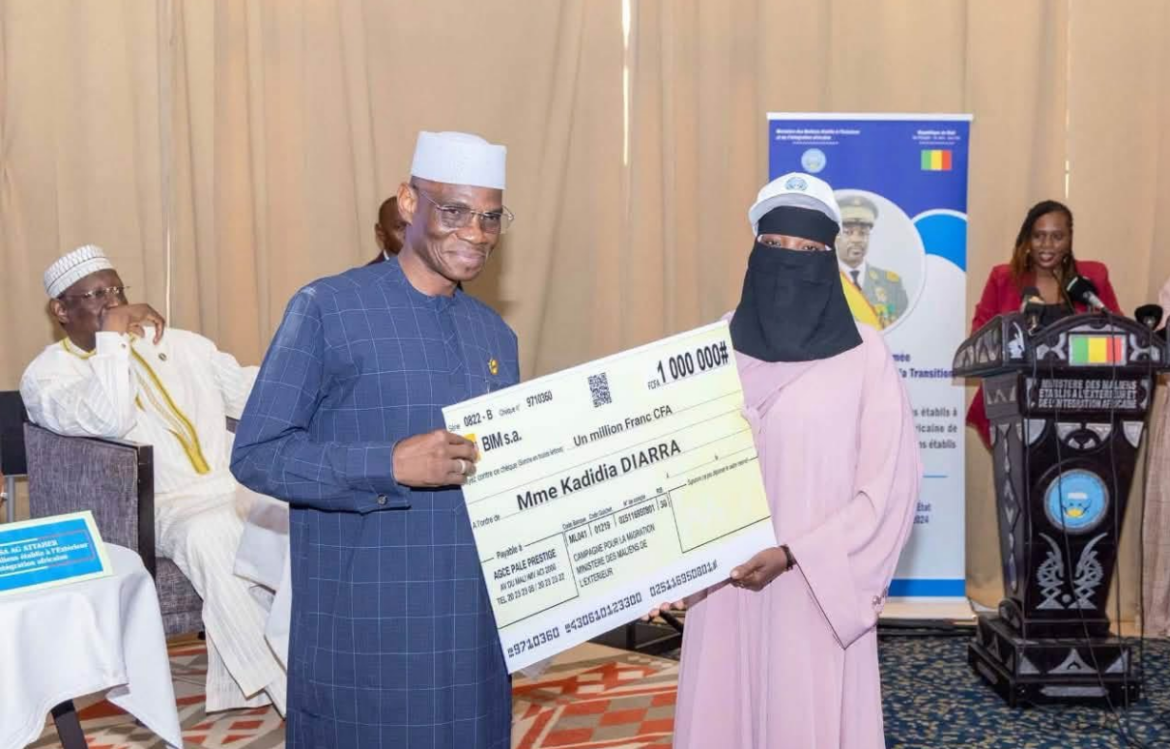
On Monday, October 12, Mali’s Minister of Malians Abroad and African Integration, Mossa Ag Attaher, presided over a ceremony to hand out financing for 90 socio-economic reintegration projects run by returning migrants. The total envelope announced: 121 million CFA francs, averaging between 1 and 2 million per project. Out of 206 applications received, 90 were selected. The state is fully funding the operation through the Special Investment Budget. The sectors highlighted are familiar ones: livestock, market gardening, agriculture, trade, handicrafts, and services. Beneficiaries are spread across Bamako and a handful of localities (Gao, Timbuktu, Nioro, Kita, San).
On paper, the announcement looks clean, national, and sovereign. It fits the current rhetoric of celebrating the diaspora and turning return into opportunity. The minister called for “rigor,” “exemplary management,” and promised “territorial follow-up.” He even mentioned special attention to deportees from Saudi Arabia, who often fall off the IOM’s radar.
Yet behind the round figures and giant check photos, several gray areas remain and invite scrutiny.
An opaque selection process
No public criteria grid has been released. It remains unclear on what basis the 90 files were chosen from 206. Who sat on the selection committee? What factors were prioritized: real economic viability, level of vulnerability, how long ago the person returned, the presence of a serious business plan, or other, less admissible considerations? Previous rounds (75 projects for 100 million in 2025, 40 projects led by civil society organizations in 2024) also failed to publish detailed criteria. The opacity of the process leaves open the question of possible favoritism, clientelism, or selection by network rather than by merit and potential impact.
No names, no details
The list of the 90 beneficiaries has not been made public. Neither the exact amounts allocated to each person nor the precise nature of the selected projects is disclosed. In a country where trust in the management of public funds remains fragile, this lack of transparency is problematic. How can anyone verify that the funds actually reach the intended recipients and don’t dissolve along the way? How can anyone ensure that relatives, political activists, or intermediaries aren’t capturing part of the envelope?
A promised follow-up that has never been demonstrated
The minister promises “territorial follow-up” to guarantee the sustainability of the activities. Yet no public evaluation of previous rounds has been published. How many of the 2024 and 2025 projects still exist today? How many actually generate stable income and create jobs? How many have simply vanished after the subsidy ran out? Without performance indicators, independent audits, and published results, the mechanism looks more like a series of one-off operations than an evaluable public policy.
The scale of the problem
Since 2022, the MPRR-SSA program alone (funded mainly by the European Union and implemented with the IOM) has facilitated the return of more than 27,800 Malians and supported over 14,000 reintegration projects. Against those volumes, 90 projects for 121 million CFA francs look like a drop in the ocean. The national effort is real, but it remains symbolic. And that is precisely where the risk of a gap between communication and reality is greatest: presenting a limited operation as a “concrete commitment” and a “lever for local development” can create the illusion of massive action while the vast majority of returning migrants remain without structured support.
What is not being said
The program is financed through the Special Investment Budget. In a tight budgetary context, it is unclear exactly where these 121 million come from, or whether they come at the expense of other priorities. It is also unknown whether beneficiaries are only recent returnees or include people who came back years ago. Finally, nothing indicates how the mechanism dovetails (or doesn’t) with existing IOM and technical partner mechanisms, which could lead to duplication or, conversely, gaps in coverage.
The stated intention—helping compatriots rebuild an economic activity after an often traumatic migration journey—is legitimate. But a public policy worthy of the name is judged by its transparency, traceability, and measurable results. For now, the mechanism remains largely a black box: applications received, projects selected, funds disbursed… and silence about what happens next.
As long as the beneficiary list, selection criteria, and impact assessments from previous years are not made public, doubt will remain permissible. And in an area as sensitive as the reintegration of returning migrants, doubt is never neutral.