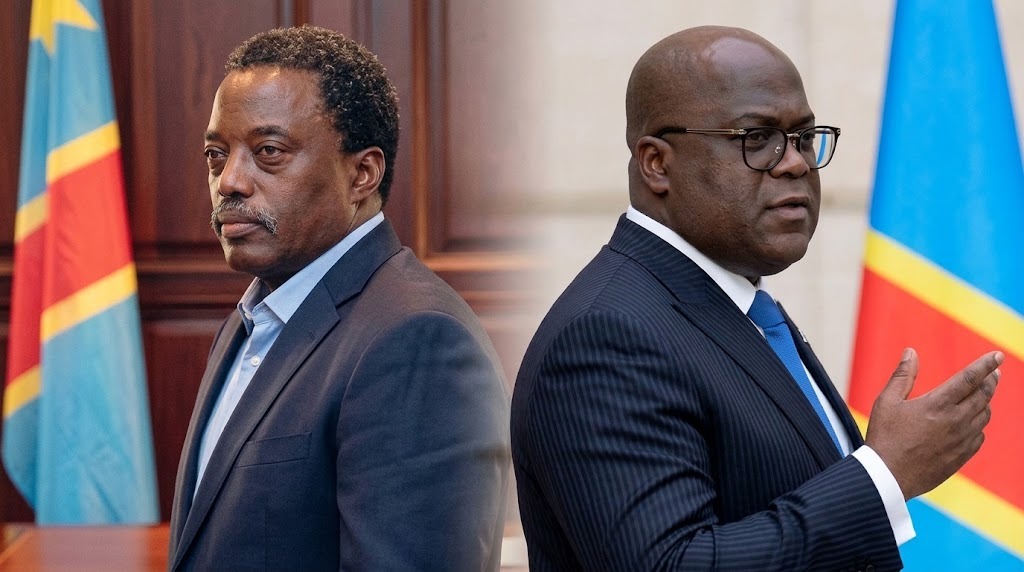
When Joseph Kabila stepped into the leadership of the Front for the Refoundation of the Nation (FRN), a newly unveiled political-military platform announced in Goma, he did more than claim a title. The former Congolese president placed himself at the center of a restructured rebellion that could either fracture further or force a new phase in eastern Democratic Republic of Congo’s long-running conflict. The critical question now is whether this gamble consolidates the armed opposition or pushes the region toward yet another cycle of violence.
A new command structure takes shape in Goma
The announcement, made on Monday, October 12, in Goma — a North Kivu city under M23 control since January 2025 — formalized what had been building for months. Kabila now leads the FRN, a movement that brings together key figures from the Alliance Fleuve Congo (AFC) and the March 23 Movement (M23). Among those standing alongside him are Corneille Nangaa, Bertrand Bisimwa, and Sultani Makenga, all presented as senior figures in the new organization.
This configuration is unprecedented: a man who governed Congo from 2001 to 2019 is now aligned with commanders directly engaged in fighting government forces. The symbolic weight alone reshapes how the conflict is perceived, both inside the country and abroad.
From AFC-M23 to FRN: what actually changed?
The creation of the FRN is not merely a rebranding exercise. According to the declaration issued in Goma, the new front replaces the Alliance Fleuve Congo and openly signals a strategy of confrontation with the central government, including the possible use of force. The exact institutional fate of the M23 within this broader platform remains unclear.
This shift did not emerge from nowhere. In its final report dated June 11, 2026, the United Nations Group of Experts on the DRC had already flagged a potential restructuring of the AFC-M23 and an expanded role for Kabila. The experts also documented repeated contacts between the former head of state and movement leaders.
The FRN announcement thus gives official form to a rapprochement that international observers had been tracking. Yet it raises a fundamental question: will this new leadership unify the rebellion’s various components, or will it ignite fresh internal rivalries?
Rwanda’s role remains the elephant in the room
The regional dimension cannot be overlooked. The M23 is widely considered by the United Nations and multiple international partners to receive military backing from Rwanda. Kigali denies these accusations and frames its security concerns in eastern DRC as a central issue in its relations with Kinshasa.
Kabila’s presence at the helm of the FRN adds a political layer to an already complex equation. By pairing a figure who led the country for nearly two decades with rebellion commanders, the platform may aim to broaden its appeal beyond its military base. It could also blur the lines of the conflict further, intertwining national political opposition, territorial grievances, and regional alliances.
For Kinshasa, the challenge is no longer simply containing an armed insurgency. It now involves responding to an organization that seeks to challenge its authority under a wider political banner. For Kigali, the movement’s consolidation comes as its role in the conflict remains at the heart of diplomatic tensions with the DRC.
Peace talks face a new complication
The FRN’s emergence coincides with ongoing diplomatic efforts to end the fighting. Discussions between Congolese parties and international mediators aim to reduce clashes, restore security, and create conditions for a lasting settlement.
The arrival of a new political-military structure led by a former president could complicate these efforts. It raises pressing questions about who is authorized to negotiate, how armed groups’ chains of command actually function, and whether leaders can enforce any commitments on the ground.
Kabila’s legal situation adds another layer of tension. Sentenced to death in absentia in September 2025 for treason, he rejects the charges and denounces the proceedings as politically motivated.
Eastern Congo’s civilians remain in the crosshairs
Beyond announcements and power struggles, the populations of North Kivu and South Kivu continue to bear the brunt of the conflict: forced displacement, persistent insecurity, and disrupted economic activity.
The FRN’s creation opens a new chapter whose effects will depend on its ability to unify its components, its relationship with Rwanda, and how Congolese authorities respond.
One thing is certain: the crisis in eastern DRC is no longer just a confrontation between the Congolese army and the M23. With Kabila’s formal entry into this political-military architecture, the political, military, and regional dimensions of the conflict are more entangled than ever. Whether this realignment leads to further escalation or, eventually, opens a broader space for negotiation remains the defining question.