- Home
- Opinions
- Mali under rebel and jihadist pressure: what’s next for Bamako?
Mali under rebel and jihadist pressure: what’s next for Bamako?


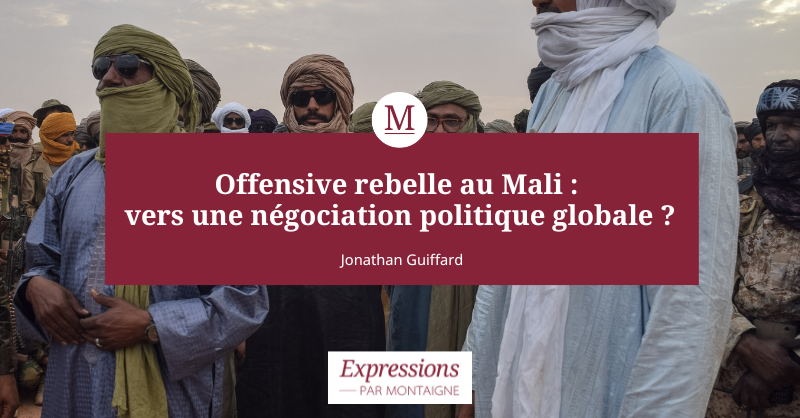
The Malian junta led by Assimi Goïta, closely allied with Russia, has been severely weakened since the April 25 rebel offensive by Al-Qaeda-affiliated jihadists of the JNIM and independentists from the Azawad Liberation Front (FLA). Northern Mali could fall, as it did in 2012—though the contexts differ markedly. Western military intervention seems unlikely this time. What are the rebels’ objectives? How might Russia respond? How should Europe prepare for the emergence of a new jihadist proto-state in Mali? These are the critical questions shaping the immediate future of the Sahel’s most fragile nation.
On April 25, 2026, coordinated attacks were launched across Mali by the Jama’at Nusrat al-Islam wal-Muslimin (JNIM—Al-Qaeda’s Sahelian branch) and the Azawad Liberation Front (FLA) against Malian Armed Forces (FAMa) and their Russian partners in the so-called Afrika Korps. The offensive has intensified pressure on the Malian government, reviving memories of the March 2012 takeover of northern Mali—though the political landscape today is far from identical.
What separates 2012 from 2026? And what short-term consequences can be expected from this latest offensive?
The current context: the boldest offensive in years
On April 25, 2026, rebel and jihadist forces launched a sweeping assault targeting five key Malian cities: Bamako, Kidal, Gao, Sévaré, and Mopti. This marks the first time since March 2012 that the two groups have coordinated such a large-scale operation: a tactical shift from sporadic cooperation since 2024 to a full-fledged alliance. Across these cities, the attacks focused on FAMa positions and Russian outposts. In Bamako, symbolic targets included the Kati military district and the international airport.
A partial assessment of the offensive reveals:
- Northern towns have fallen under rebel and jihadist control. Kidal, along with nearby Tessalit and Anéfis, has been captured. Cities like Ber, Bourem, Gourma-Rharous, Léré, Intahaka, and Tessit have also been taken, effectively encircling Tombouctou and Gao. Some Russian-backed Malian bases in the north, however, remain under government control, including in Gao, Tombouctou, and Aguelhok.
- Junta leaders have been directly hit. Defense Minister General Sadio Camara was killed, while senior officials including General Modibo Koné, head of Mali’s State Security Agency (ANSE), were wounded. Meanwhile, President Assimi Goïta, the military leader, was reportedly evacuated to Turkey’s embassy before reappearing publicly on April 28 alongside Russian officials.
- Rumors of a potential junta power grab by General Malick Diaw, a key figure in the regime, circulated briefly but remain unconfirmed. One thing is certain: the military leadership has been severely shaken by this assault.
While this offensive echoes 2012, key differences stand out:
- The JNIM and FLA are now coordinating openly, with JNIM leaders allowing FLA representatives to take a public role. Unlike Elghabass Ag Intallah and Bilal Ag Cherif of the FLA, JNIM figures like Iyad ag Ghali and Hamadoun Kouffa have remained out of sight; only senior JNIM member Sidan Ag Hitta was spotted in Tessalit.
- Instead of executing captured soldiers as in 2012, both groups are prioritizing negotiation and disarmament, offering FAMa fighters safe passage and urging others to lay down arms. They present themselves as defenders of both civilians and military personnel against Bamako’s junta.
- Negotiations with Russian mercenaries secured their withdrawal from key northern bases in Kidal and elsewhere, mirroring tactics used in Syria. Algeria likely facilitated these talks, possibly in coordination with the FLA.
- The northern advance was made possible by a strategy tying down FAMa forces in central Mali and Bamako. The prolonged assault on Bamako itself is unprecedented.
Negotiations with Russian mercenaries secured their withdrawal from key northern bases in Kidal and elsewhere, mirroring tactics used in Syria.
This offensive underscores a shift in strategy by both armed groups, learning from past failures and victories since 2012. Rather than aiming for visible territorial control, they appear to be escalating a strategy of strangling cities and the junta that began in 2020. By April 28, the JNIM had announced a full blockade of Bamako, burning transport trucks to underscore its resolve while the junta organizes limited supply convoys.
Unlike the collapse of 2012–2013, the Malian regime, FAMa, and their Russian partners have not been completely overwhelmed. They have attempted to regain momentum through sweeping counteroffensives. The situation remains dire for Bamako—but not yet catastrophic. In response, civil society voices have renewed calls for negotiations with armed groups, criticizing the junta’s reliance on military force alone. Political figures like Oumar Mariko, former minister Mamadou Ismaïla Konaté, imam Mahmoud Dicko, and the Brussels-based Alliance of Sahel Democrats (ADS) have been vocal.
Amid this upheaval, the Islamic State’s Sahel Province (EIWS) launched an attack on Ménaka, but was repelled by Russian-Malian forces. Though not part of the JNIM/FLA offensive, the EIWS remains a persistent threat in northeastern Mali.
A predictable crisis
As early as September 15, 2022, analysis warned that Russian military support was an illusion that would fail to address Mali’s security challenges. Far from stabilizing the country, Moscow’s involvement was counterproductive: alienating civilians through repression and failing to curb JNIM expansion.
- In January 2023, a forward-looking assessment anticipated the unfolding scenario, including:
The escalation of tensions between the CMA and FAMa/Wagner forces, leading to renewed clashes in the north, with the CMA aligning with the JNIM to regain control over the Niger River loop and potentially half the country - The fragmentation of central Mali into recurring violence between Macina Katibat and community defense militias, which are unlikely to prevail, leading to gradual JNIM control
- The encirclement of Bamako in its outskirts… Unless the army collapses entirely, it is unlikely the city will fall like it did in 2012
- The loss of control over Mali will trigger political unrest and ultimately force a political dialogue with the JNIM to establish a lasting truce, potentially amputating parts of the country’s territory or imposing major constitutional changes. Pressure from Malian religious institutions will be decisive in pushing the government toward negotiations.
By November 2023, after FAMa and Russian forces retook Kidal, we warned that this victory was a mirage. The CMA had chosen strategic retreat to prepare a future counteroffensive rather than suffer heavy losses. The short-lived FAMa control over the area was confirmed by the July 2024 battle of Tinzawatene, culminating in the recent rebel gains.
These developments confirm the crisis was foreseeable. Against this backdrop, what are the likely short-term evolutions?
Short-term outlook
Militarily, the JNIM/FLA alliance will likely secure the withdrawal of Russian forces from the north before targeting Gao and Tombouctou, effectively re-establishing the de facto partition seen in March 2012. That year, the takeover unfolded in stages: Kidal fell first, followed by separate advances on Gao and Tombouctou. Massive soldier defections hastened the collapse—and today’s dual pressure (military and negotiation) risks triggering similar desertions, compounded by the junta’s fractured command and political turmoil in Bamako. If Russian forces withdraw from Gao and Tombouctou, the conquest of the entire Niger River loop appears inevitable.
The only factor that could slow this advance is the threat posed by Malian and Burkinabe TB2 drones. While the JNIM and FLA may destroy Malian drones and target airfields with kamikaze drones, striking Burkinabe or Nigerien drones would be far more challenging.
The north of Mali is poised to fall under complete FLA and JNIM control. Both groups have adjusted their ambitions: the FLA seeks de facto autonomy for the region without pursuing full political independence, while the JNIM appears content with a less stringent application of Islamic law. This reduces the likelihood of a repeat of the 2012 scenario, where jihadists violently seized cities and imposed extreme governance. Recall that after AQMI’s defeat in 2013, its leaders advocated for a softer expansion strategy focused on preaching and limited sharia enforcement.
Control over northern Mali will position the armed groups favorably—but with two new fronts that could drain resources and fighters: confronting the Islamic State in the Ménaka region and countering aerial incursions by Malian and Burkinabe forces.
Unlike in 2012, JNIM fighters are also active in central Mali, and this northern offensive may be accompanied by fresh attacks on Malian garrisons in locations like Gossi, Boni, Hombori, Niafunké, Konna, Mopti, and Sévaré. Given that the FLA is unlikely to support operations in this region, these attacks will likely aim to disrupt FAMa operations rather than seize cities. Recent retaliatory attacks against civilians in villages like Kori-Kori and Gomossogou reflect this violent strategy—a tactic at odds with the groups’ broader political narrative positioning them as protectors against junta violence. The challenge of controlling all factions within the JNIM remains a known vulnerability.
The fate of central and southern Mali is harder to predict for two reasons: first, the JNIM has controlled rural areas for years, besieging cities and negotiating local agreements with communities in exchange for limited sharia enforcement—a strategy reminiscent of the Viet Cong or Taliban. Second, unlike the Taliban, the JNIM lacks sufficient manpower to sustain broad territorial control.
Yet the 2012–2013 takeover of Kidal, Gao, and Tombouctou enabled jihadist groups to recruit heavily in central Mali. A repeat of this strategy could significantly strengthen the JNIM.
The siege of Bamako is a strategy of suffocation and forced regime change or negotiation.
The siege of Bamako is a strategy of suffocation and forced regime change or negotiation. Despite official propaganda, the scale of this offensive—just months after the first successful siege of the capital—exposes the junta’s inability to manage the crisis. Assimi Goïta is trapped in Bamako, much like Bashar al-Assad in Damascus. Growing mistrust between junta leaders, particularly Goïta’s increasing skepticism toward Russia, threatens to destabilize the regime. With key architects of the Russia partnership—Sadio Camara and Modibo Koné—temporarily or permanently sidelined, renegotiating this alliance becomes more feasible. The Russian partnership may crumble, accelerating the loss of northern and central Mali. Ongoing negotiations and months of tensions between FAMa and Russian mercenaries—who have criticized national forces since the Tinzawatene defeat—further weaken Moscow’s position.
Unless forced into negotiations, the junta has little incentive to abandon its Russian partnership if it hopes to survive, which could help secure the capital. If Bamako continues paying, Russian protection in the region may persist—but any hope of territorial recovery seems remote. If Russia withdraws support, Mali can only count on limited help from Burkina Faso and Niger, both embroiled in their own jihadist conflicts. Senegal may mobilize along its border but is unlikely to deploy troops inside Mali, given the JNIM’s growing presence on its frontier. Algeria, Mauritania, Guinea, and Côte d’Ivoire are likely to remain observers, privately welcoming the junta’s humiliation while pushing for negotiations.
Looking ahead:
- The long-term dynamics since 2022 indicate the north’s fall and central Mali’s loss of control are inevitable. While the timeline is unclear, the balance of power is not.
- The medium-term dynamics show the Russian partnership and Bamako’s military strategy are fragile and doomed to fail, as recent events have demonstrated.
- Two potential triggers could shift the trajectory:
o The onset of negotiations, driven by the junta’s collapse or external diplomatic pressure.
o An external military intervention to reverse the balance of power and alter long- and medium-term trends.
What equation for Mali and the international community?
In this context, several scenarios are likely unfolding, though none are mutually exclusive.
Scenario 1: The prospect of external military intervention
What happens when the JNIM raises its black flag over a major Malian city?
This crisis raises a critical question: what should be done when the JNIM raises its black flag over a major Malian city? Before 2022, such a move would have triggered Western military intervention to dismantle the jihadist group—much like in Afghanistan, Iraq, Syria, or Mali. However, the withdrawals from Afghanistan and the Sahel have forced a reassessment of this approach, given their proven inability to resolve the security crisis. Is regional or international military intervention desirable, feasible, or realistic? Regionally, only Algeria has the capacity to reverse the balance of power—but it is unlikely to intervene given its doctrine of non-interference beyond its borders. Mauritania has maintained a non-aggression pact with AQMI and the JNIM since 2010. Other regional armies have already clashed with jihadists and shown their limitations, suggesting they will prioritize defensive positions. In this context, only international intervention could reverse the tide, temporarily, as Operation Barkhane once did. France is unlikely to return to the Sahel, and neither the UN nor Europe will act alone. The U.S. is focused on other theaters. All factors point toward prioritizing negotiations.
Scenario 2: The prospect of large-scale political negotiations
The JNIM’s leadership has sought since 2025 to replicate the Syrian HTC’s victory, implying a willingness to nationalize their struggle, implement a ‘moderate’ Islamic governance model, and engage in dialogue with the international community. To achieve this, the group has sought a sponsor since 2024, possibly Turkey’s role for the HTC. Algeria or Mauritania could fill this role, given their proximity to FLA leaders, close ties with JNIM cadres, and opposition to Bamako’s junta. However, neither country has confirmed readiness to play this part.
This suggests a strategy of conquest through junta collapse, followed by negotiations with a political force willing to accept their demands: implementation of sharia across Mali; greater autonomy for the north and center; integration of the JNIM and FLA into local governance.
A major obstacle remains: unlike the HTC, the JNIM has not severed its allegiance to Al-Qaeda, nor has it abandoned its intent to export its Islamist project beyond Mali’s borders. Additionally, the group has not engaged in official dialogue with the international community, complicating its normalization. It remains unclear whether the JNIM could be an acceptable negotiating partner for regional powers or European actors. The political framework is not yet conducive to such talks.
A comprehensive negotiation would require engaging both the FLA—building on the Algiers Accords—and the JNIM, aligning with local agreements negotiated with the High Islamic Council of Mali.
Progress will hinge on pressure from Russia, Turkey, or African partners (including Togo and Ghana) against the junta. Without such pressure, it is difficult to envision a Malian political or military force regaining control through force. The blockade of Bamako may increase the likelihood of civil society mobilization or a counter-coup, but systematic repression of opposition since 2020 has largely neutralized this risk. Until negotiations begin, the strategy of strangulation will persist, and captured cities will serve as springboards for further attacks on FAMa.
Long-term, France and Europe must recognize that the strategic landscape has shifted. Even with their relative normalization, the emergence of a jihadist proto-state will necessitate vigilance akin to Syria or Afghanistan, given the potential for terrorist threats to project beyond Mali’s borders. For this reason, Arab and African partners must be mobilized and supported to help contain and normalize these new actors on the international stage.