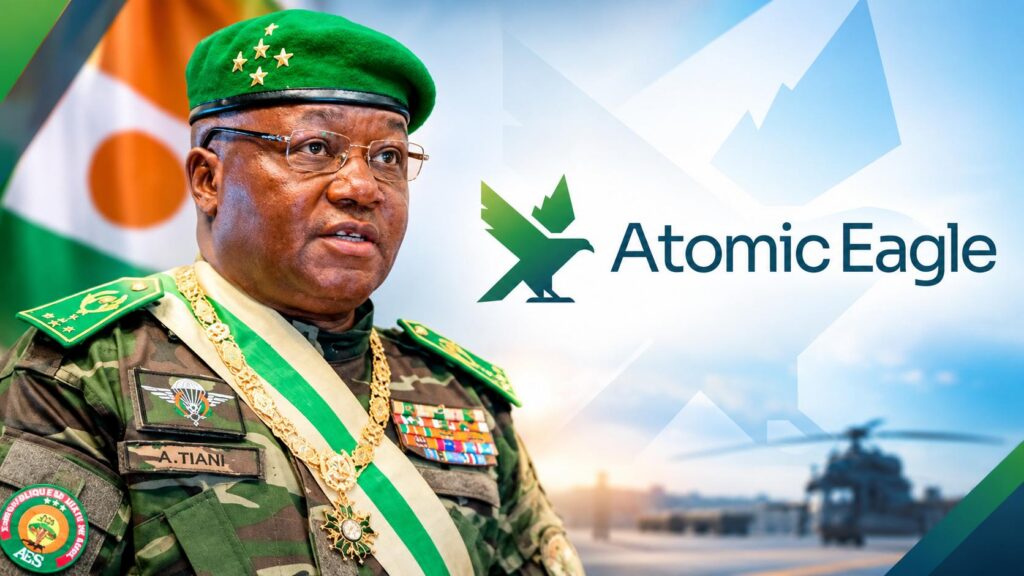
Niger’s transitional authorities have hailed the agreement signed on 23 September 2026 for the Madaouela uranium deposit as a major win for mining sovereignty. The convention with Atomic Eagle grants the state a 40% stake, a direct payment of $10 million, and a promise of 1,000 jobs. Yet behind this triumphant display, several uncertainties persist regarding the project’s actual feasibility and concrete benefits.
A partner with no proven industrial experience
The choice of Atomic Eagle raises eyebrows due to its glaring lack of technical guarantees. In a rush to show it had replaced Canadian company GoviEx, which was pushed out in 2024, Niamey turned to an operator that has never built or run an industrial-scale uranium mine. Its only notable project, in Zambia, remains stuck at the preparatory study stage.
Madaouela demands colossal investments, complex infrastructure, and cutting-edge expertise. Entrusting such a strategic deposit to an actor with no proof of productive capacity amounts to an irresponsible gamble. Without a binding timeline or financial penalties, this permit could easily become a financial asset for stock market speculation abroad, while the site remains abandoned.
The financial trap of the 40% stake
The announcement of a 40% public stake is political window dressing designed to dazzle public opinion. The central question, carefully avoided by the authorities, remains: what is the contributory share of these shares?
If the state must finance its share in development, equipment, and construction investments, this contract will quickly turn into a financial trap. Niger, already facing a precarious economic situation, would expose itself to massive cash calls to subsidize the operational risks of an inexperienced partner, paving the way for massive debt or inevitable dilution.
A paltry cheque and empty promises
The $10 million paid by Atomic Eagle looks like a symbolic payment compared to the real value of the reserves handed over and the development costs of a mine. Presenting this initial cheque as a commercial success is an illusion that masks the absence of guarantees on future tax revenues and profit repatriation.
As for the cosmetic announcement of 1,000 jobs, it rests on no precise data. Are these temporary construction jobs or permanent positions? Nothing is detailed about local recruitment targets, training plans, or national subcontracting. Without published regulatory constraints, these figures amount to mere propaganda.
A PR operation, not an industrial project
In reality, this agreement looks more like a political compromise aimed at moving past the dispute with GoviEx than a carefully considered industrial development strategy.
Sovereignty cannot be decreed by percentages on paper: it is exercised through the ability to regulate foreign capital, verify real costs, and guarantee direct benefits for the population. By refusing transparency and concealing the terms of the convention, the authorities are delivering the nation’s subsoil to uncertainty. Madaouela must not be sacrificed on the altar of political communication.
You may also like
Togo’s rulers turn to Chadian rebels for domestic repression
Niger journalist Moussa Kaka missing in Niamey as RSF demands official answers
Mali: Africa Corps loses 358 fighters in three years, a death toll that overshadows France’s decade-long campaign
Olympe Bhêly-Quenum reaches 100: a life carved into African literature
Niger: General Tiani’s fear at the palace after the August mutiny