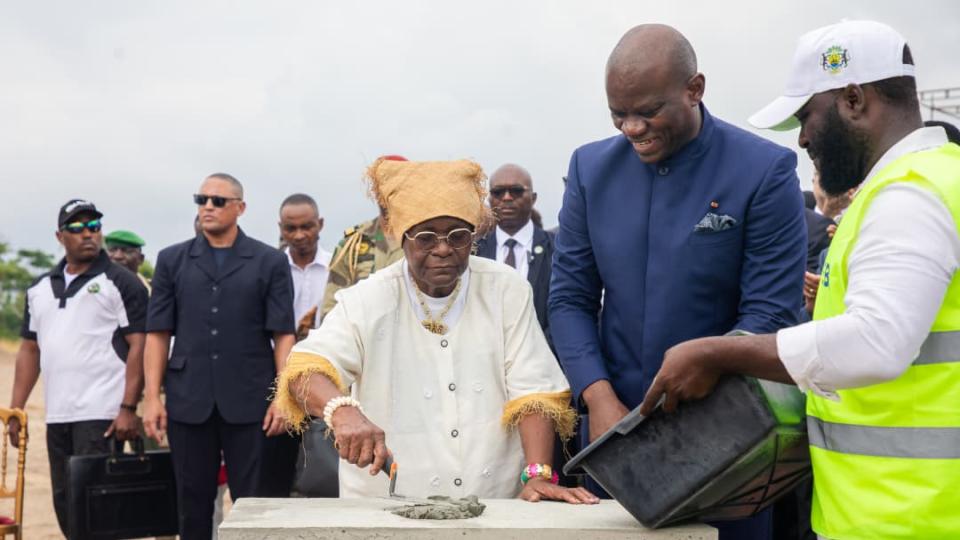
With the launch of construction on the future Kobé-Kobé deep-water port, Gabon has embarked on one of the most ambitious infrastructure projects in its recent history. Integrated with the Belinga iron ore deposit, a new railway line and the planned Booué hydroelectric dam, this industrial and logistics complex embodies the authorities’ determination to build an economy less reliant on oil and more focused on the local processing of natural resources.
Long dependent on oil revenues, Gabon is now seeking to diversify its growth drivers. Within this strategy, the Kobé-Kobé project emerges as a centerpiece of the new economic model envisioned by the government. More than just a port, it is a vast industrial ecosystem designed to connect the country’s mineral resources to international markets while maximizing local benefits.
Located on the Atlantic coast in Estuaire province, the future deep-water port will have a draft estimated between 14 and 16 meters, allowing it to accommodate very large vessels. This feature is expected to significantly boost Gabon’s logistical competitiveness in a context of growing rivalry among Central African port infrastructures.
A integrated project at the heart of economic transformation
Kobé-Kobé is part of a complete value chain built around several strategic infrastructures. At the center is the Belinga iron ore deposit, considered one of the largest still unexploited in the world.
To transport the ore to the coast, a new railway line will connect the interior to the future port. In addition, the Booué hydroelectric dam project will provide the energy needed to run the mining and industrial complex. This integrated approach aims to avoid the traditional model of raw material exports by encouraging local processing on national territory.
The strategic convention signed in April 2026 between the Gabonese state and Africa Global Logistics (AGL) represents a decisive step in the project’s realization. The stated goal is to create a reference logistics platform capable of supporting the country’s industrialization.
Up to 160,000 jobs expected
Beyond infrastructure, one of the main issues is the project’s social and economic impact. According to estimates, the complex could generate up to 160,000 direct and indirect jobs during its development.
This prospect sends a strong signal to Gabon’s youth, who face challenges in entering the job market. Needs will span construction trades as well as logistics, industry, rail transport, energy, and maintenance.
For the authorities, the goal is to create a ripple effect across the entire national economy by fostering the emergence of local companies capable of participating in the subcontracting chain.
The materialization of an economic sovereignty ambition
Beyond its economic dimension, Kobé-Kobé also carries strong symbolic weight. The project reflects President Brice Clotaire Oligui Nguema’s will to build an economy more rooted in the valorization of national resources and control over strategic infrastructure.
In a context where economic sovereignty is a major issue for African states, this future mining, energy, railway, and port complex stands as one of the most concrete illustrations of that ambition. If deadlines are met, Kobé-Kobé could, by 2030, become a key symbol of Gabon’s economic transformation and its entry into the post-oil era.