
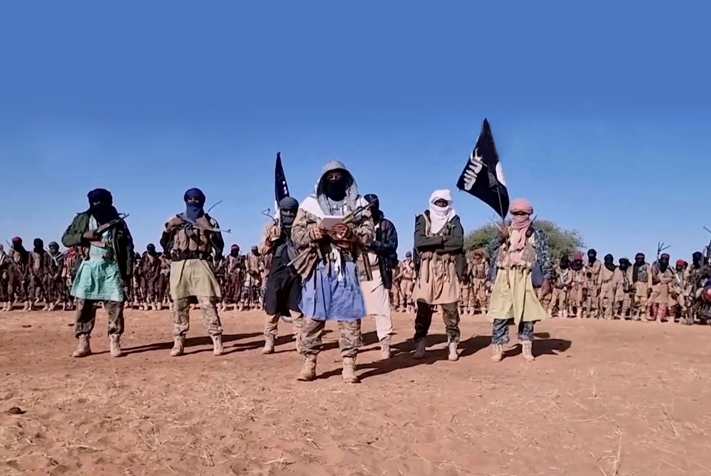
The Islamic State’s Sahel Province keeps a firm grip on Mali’s northeast despite the JNIM spotlight
The Islamic State’s Sahel Province (ISSP)—once known as the Islamic State in the Greater Sahara—maintains a persistent presence in Algeria’s Gao Region, particularly in Ansongo, and the Ménaka Region. Key areas like the so-called “3 T’s”—Talataye, Tin-Hama, and Tessit—along with Labbezanga, remain the group’s operational core, where it enforces territorial control and exerts relentless pressure on local communities.
Leadership dynamics
ADVERTISING
Led by Abou Al-Bara—a successor to the slain Adnan Abu Al-Walid Sahraoui—the ISSP’s command structure remains partly obscured. Since 2020, the group has shifted from large-scale public executions to a more calculated strategy focused on territorial dominance and local governance. By avoiding high-profile attacks that draw media attention, it has subtly embedded itself within communities, fostering acceptance among certain populations.
However, military operations against the ISSP show no signs of slowing. On May 14–15, 2026, Malian Armed Forces conducted an airstrike in Bara, Ansongo Circle, neutralizing a senior ISSP operative and several associates. This strike highlights Mali’s sustained pressure on Islamic State strongholds while underscoring the group’s resilience in border regions and its ability to rebuild logistical networks.
Operational reach and rivalries
The ISSP continues to assert control over strategic zones along the Mali-Niger corridor, including Talataye, Tin-Hama, Tessit, Labbezanga, and Ménaka. By regulating the movement of people and goods, it tightens its grip on these transit routes and influences local armed factions. Meanwhile, tensions with the JNIM shape the Sahel’s security landscape. While the JNIM has gained visibility through high-profile attacks—such as the coordinated strikes near Bamako on April 25, 2026—the ISSP has not faded into the background. The two groups operate under distinct strategies: the JNIM relies on dramatic, media-focused assaults, whereas the ISSP prioritizes quiet territorial expansion, community pressure, and securing vital supply lines.
Former JNIM members initially helped create a temporary “Sahel exception” that limited direct clashes, but this fragile truce has eroded since 2020. Recent military offensives by Malian forces have temporarily shifted both groups’ focus toward a common adversary, though no formal peace agreement has been reached.
Ongoing threats and regional impact
ACLED data from May 15, 2026, reveals that 86% of Islamic State activity in the first quarter of 2026 occurred in Africa, with a rise in drone strikes, motorized raids, and economic coercion targeting urban and rural hubs. The ISSP has struck civilian and military infrastructure along the Ménaka-Ansong-Tessit-Labbezanga axis, exploiting local weaknesses to impose de facto governance. A February 7, 2026 attack on a civilian convoy near Kobé, 35 km from Gao, exemplifies this strategy. While international security collaboration has removed key figures—such as Abu-Bilal Al-Minuki, killed in a May 16, 2026 operation involving Nigeria and the United States in the Lake Chad Basin—the ISSP’s threat persists in northeastern Mali, particularly in the “3 T’s” areas and Labbezanga, where territorial control and influence over local armed groups endure.
The ISSP remains a dominant force in Mali’s northeast, leveraging the JNIM’s media prominence and the FLA’s activities to consolidate its position, control populations, and maintain pressure on Malian forces. Its structured territorial organization and ongoing operations prove the threat is deeply entrenched—demanding intensified efforts in critical zones, especially along the Niger-Mali border.
You may also like
Gabon’s economic management hindered by unreliable public data
Niger: General Tiani faces growing unease within special forces after Russian involvement
Mali : 17 morts dans les rangs des dozos, le JNIM accentue sa pression
Sahel : le pari des juntes tourne-t-il à l’échec sécuritaire ?
MALI : Le JNIM diffuse les images de l’attaque de la base de San et contredit la version des FAMa