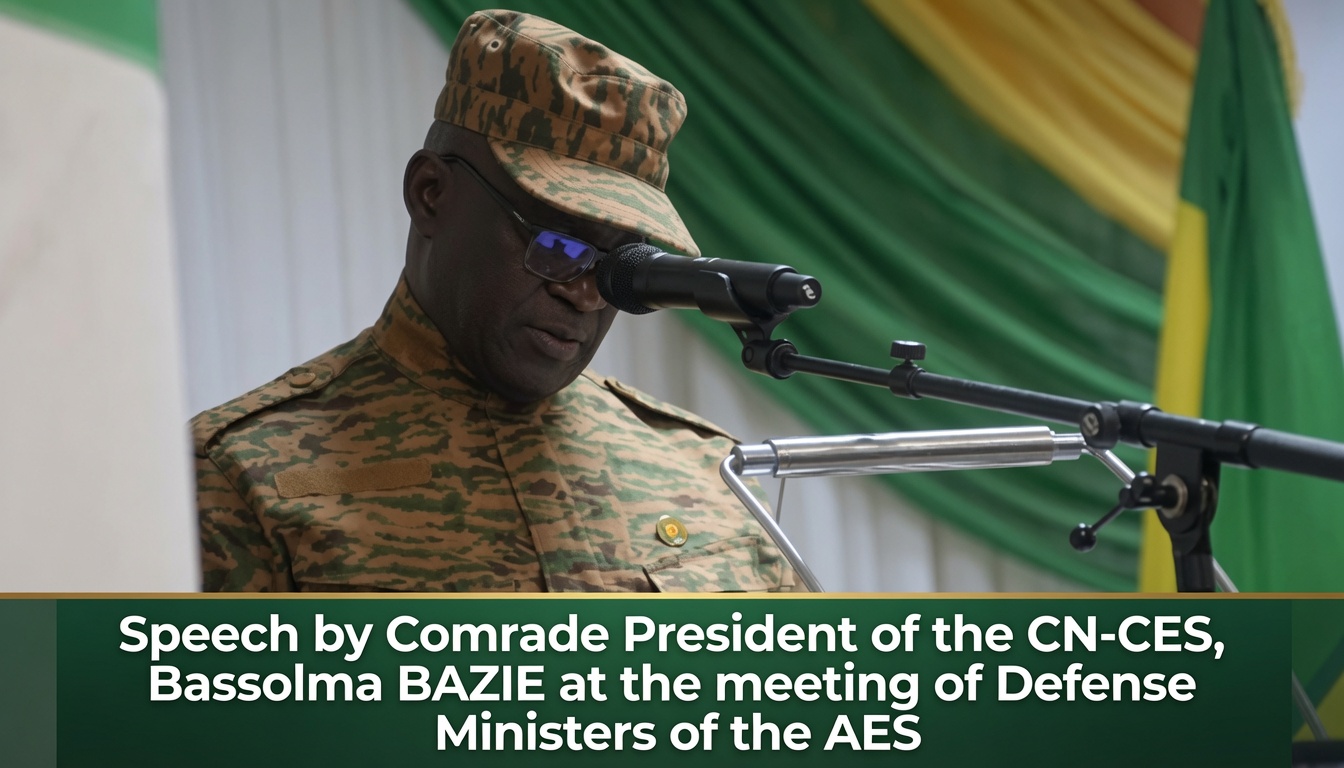
Following a recent gathering of defense ministers from the Alliance of Sahel States (AES), Bassolma Bazié, president of the CN-CES, extended heartfelt commendations to the valiant Forces of Defense and Security (FDS) from Mali, Burkina Faso, and Niger. His emphatic tribute underscored their unwavering commitment and profound sacrifices, framed within a broader discourse championing territorial integrity, the safeguarding of populations, and the pursuit of what was heralded as a historic sovereignty.
Yet, this official narrative prompts a critical inquiry that resonates increasingly within public opinion: do these declarations of satisfaction genuinely align with the daily realities experienced by the populace?
Since the inception of the AES, authorities across the three nations have consistently highlighted a narrative of regained sovereignty and enhanced strategic autonomy. However, on the ground, numerous communities continue to grapple with relentless armed attacks, widespread displacement, and a pervasive insecurity that remains an formidable challenge. In this context, the repeated accolades for the security forces, while undeniably legitimate given the immense sacrifices made by soldiers, appear insufficient to meet the expectations of citizens, who ultimately judge by concrete outcomes.
The chasm between official discourse and lived experience becomes starkly apparent when considering the human cost of this ongoing crisis. While armed forces courageously confront peril and make the ultimate sacrifice on the front lines, the daily existence for civilian populations is a harrowing struggle for survival. Thousands of families are compelled to abandon their homes and livelihoods, migrating en masse to neighboring countries in a desperate quest for the peace and security their own state can no longer guarantee. The sight of citizens transformed into refugees beyond their borders serves as the most tangible evidence that the sovereignty celebrated in ministerial chambers remains a distant, abstract concept for those directly affected.
Amidst this exodus and tragic loss of life, the posture adopted by leaders—limited to official tributes and posthumous speeches—raises a brutal question: can such conduct truly secure the populace or stem the rising death toll? Evidence suggests otherwise. Eulogies and medals offer no protection to front lines, cannot safeguard isolated villages, nor can they restore lost lives. By merely commemorating the sacrifice of soldiers instead of rectifying the strategic vulnerabilities that lead to their demise, political action risks dissolving into symbolism, leaving the underlying causes of insecurity unaddressed.
Fundamentally, the primary mission of any defense policy is to tangibly enhance the security of its people. When civilians continue to live under the constant threat of attacks, when certain regions remain largely inaccessible, and when humanitarian crises persist, official statements celebrating the triumphs of security strategies can appear profoundly disconnected from the realities on the ground.
The notion of a “real sovereignty” also warrants deeper scrutiny. For many observers, sovereignty is not solely measured by the assertion of political or diplomatic independence. It is equally assessed by the state’s capacity to guarantee security, ensure the free movement of its people, protect essential public services, and offer prospects of stability to its citizens. Across these vital indicators, the challenges confronting the Sahelian region remain substantial.
The military personnel engaged on the front lines often pay a heavy price, and their dedication is widely acknowledged. Nevertheless, honoring soldiers does not absolve political leaders of their duty to rigorously evaluate the effectiveness of implemented strategies. The sacrifices made by the armed forces should be accompanied by transparent reflection on the efficacy of military and political choices, to ascertain whether stated objectives are truly being achieved.
Ultimately, the most profound way to honor defense forces extends beyond mere official pronouncements. It lies, above all, in creating the conditions for a sustainable improvement in the security and daily lives of the population. As long as inhabitants continue to endure the consequences of insecurity, declarations celebrating a fully acquired sovereignty are likely to be met with considerable skepticism from a significant portion of the public.