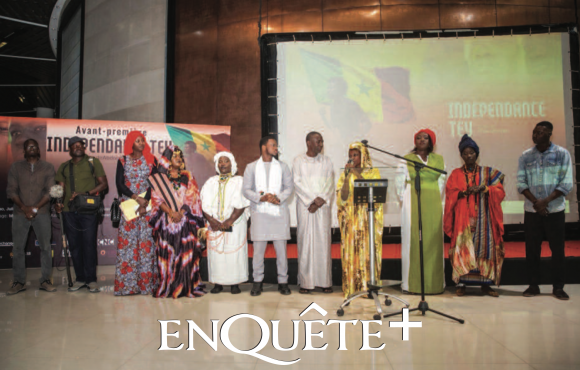
In the Museum of Black Civilizations in Dakar, the premiere of Indépendance Tey transformed an ordinary film screening into a powerful moment of collective memory, civic engagement, and political reflection on modern-day Senegal.
The evening at the Museum of Black Civilizations brought together film enthusiasts, artists, and activists to witness the debut of Indépendance Tey, the latest documentary by Senegalese filmmaker Abdou Lahat Fall. Hosted by Sine Films and Wawkumba Film, in collaboration with FRAPP, the National Film Directorate, and the Museum of Black Civilizations, the event was far more than just a premiere—it became a shared space for political, artistic, and generational dialogue.
In a packed theater, audiences experienced a film that had already captured attention in cultural and activist circles, particularly after its selection in the Front populaire category at the Cinéma du Réel festival. The evening began with a live performance by Leuz Diwan G, a prominent voice in conscious rap. His stage presence—blending political lyrics, urban beats, and messages of resistance—set the tone: Indépendance Tey was not just a political documentary, but a deeply emotional and human exploration of a nation in transformation.
four voices, one struggle: the heart of the documentary
With Indépendance Tey, Abdou Lahat Fall returns to the screen after his acclaimed 2018 documentary Migrants, migrer ; le retour impossible. This time, he immerses viewers in the heart of FRAPP, a vibrant social movement, following four key figures whose personal journeys reflect the hopes, contradictions, and fractures of a generation fighting for change. Among them are Abdoulaye, Bentaleb, Guy Marius Sagna, and Félix.
Convictions vs. reality: the cost of activism
The film weaves together four distinct trajectories—four generations, four visions of commitment. Through their stories, it traces the social upheavals that rocked Senegal between 2019 and 2024: oil scandals, mass protests, pre-election tensions, police repression, arrests of opposition figures, and the eventual 2024 presidential victory of the opposition. But at its core, Indépendance Tey is a deeply human story—one that asks what activism truly costs, what it destroys, and what it reveals.
Abdoulaye embodies the idealistic, fiery spirit of Senegalese youth, deeply devoted to his country. Yet behind the public speeches and marches lies a quieter truth: worried families, disrupted education, and uncertain futures. Under family pressure, he leaves Senegal to pursue his studies in Canada—a silent wound in the narrative. Bentaleb endures the harsh reality of repression, facing arrest and imprisonment. Meanwhile, Guy Marius Sagna evolves from a radical activist to a political figure within institutions, raising questions about the compromises required in political engagement. Félix, an aging union leader, represents the enduring memory of past struggles, his weary eyes reflecting decades of social activism.
filming resistance: artistry amid engagement
One of the film’s most compelling themes is the challenge of capturing a movement without slipping into propaganda. How does a filmmaker document a cause they believe in without distorting its message? Abdou Lahat Fall reflects on this tension openly. “Being both a militant and a filmmaker is not simple,” he admits. The documentary balances personal conviction with artistic distance, using voice-over to offer moments of critique—even questioning Guy Marius Sagna‘s entry into electoral politics. This balance gives the film depth, portraying activists not as heroes, but as complex individuals with doubts and flaws.
The film’s narrative begins in 2019, at the height of public outrage over a controversial oil contract. “My wife and I kept a camera at home,” the director recalls. “When we saw people gathering at Place de la Nation, we decided to film.” There, he met Abdoulaye Seck, a young activist whose boldness left a lasting impression. “I wondered who this young man was, speaking with such courage to thousands.” That moment sparked a years-long immersion into FRAPP, documenting meetings, protests, and intimate moments of doubt. The camera became a silent witness to a pivotal era in Senegalese history.
universal questions, local roots
Beyond Senegal, Indépendance Tey raises universal questions: What does civic engagement look like today? Can grassroots movements reshape societies? How do we resist without losing ourselves? What is the human price of political struggle? The film draws on the words of Frantz Fanon, the Martiniquan thinker: “Each generation must, in relative darkness, fulfill its mission: to see it through or betray it.” This idea runs through the documentary, portraying a generation tired of injustice, rejecting fatalism, and seeking its own form of independence—sixty years after Senegal‘s national independence.
The film’s cinematic approach is marked by restraint. There are no dramatic effects, no artificial staging. Instead, Abdou Lahat Fall favors patient observation, silence, and intimate moments. Protest scenes alternate with strategic discussions and solitary reflections, creating an authenticity that feels raw and immediate. He portrays his subjects without glorification, showing their contradictions, hesitations, and disagreements. It is this humanity that makes the documentary so compelling—a tool for collective memory and a bridge for intergenerational dialogue.
a rising star in African documentary cinema
Indépendance Tey has already earned its place in the landscape of African and international documentary filmmaking. Selected for Cinéma du Réel, it has received support from key institutions, including residencies at Sentoo 2022, Produire au Sud 2022, and DocA 2023, as well as selections at Durban FilmMart 2023. The project has been backed by organizations such as the National Center for Cinema (CNC), FOPICA, the Image Fund of La Francophonie, Procirep-Angoa, and Tenk, underscoring the growing recognition of Senegalese documentary filmmaking on the global stage.
The premiere in Dakar transcended the boundaries of cinema, evolving into a space for memory, dialogue, and reflection on the Senegal of yesterday, today, and tomorrow. With Indépendance Tey, Abdou Lahat Fall does more than document a political movement—he crafts a sensitive portrait of a people in motion. A people who, despite disillusionment and sacrifice, continue to believe in the possibility of a different future.