
Gabon has chosen Accra as the venue for one of its first major diplomatic sequences after its election, signaling a move that far exceeds bilateral frameworks. At a time when African economies are seeking to accelerate their integration, Libreville is opting for a diplomacy focused on continental partnerships, with the aim of transforming political relations into drivers of growth, investment, and industrialization.
The official visit to Ghana was received by President John Dramani Mahama at the Presidential Palace in Accra, where the Gabonese leader placed this meeting under the sign of complementary economics. The two countries have indeed complementing assets. The Ghana has established itself in recent years as one of Africa’s most diversified economies, while the Gabon is seeking to accelerate its local resource transformation and strengthen its economic attractiveness.
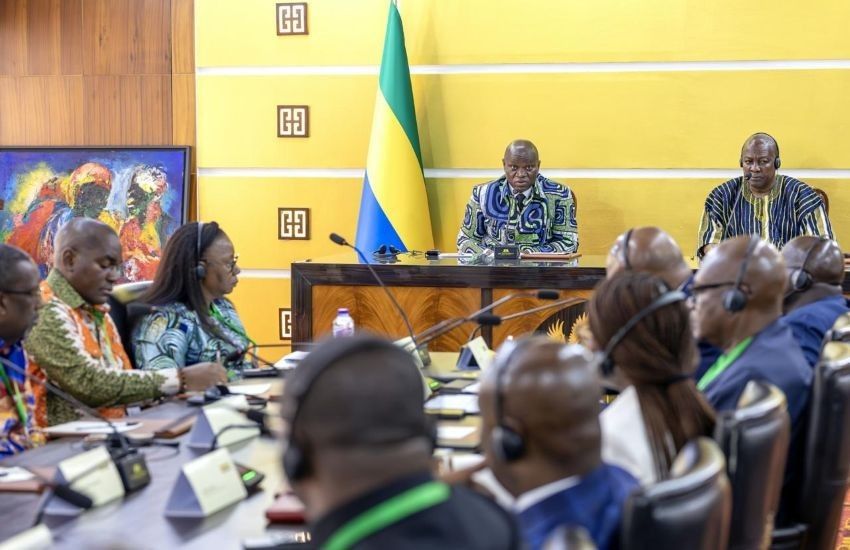
Beyond the exchange of diplomatic protocols, the head-to-head interviews between the two leaders defined the large orientations of a partnership destined to be lasting. The discussions rapidly led to an expanded working session bringing together the delegations of both countries around key sectors considered crucial for their development.
The areas retained testify to a productive vision of cooperation. Mines, agriculture, fishing, forests, digital technologies, education, and local material transformation are the main axes retenus by Libreville and Accra.
The objective is clear: no longer just to multiply cooperation agreements, but to favor cross-investments, develop African value chains, and create more jobs on the continent. This orientation aligns with President Oligui Nguema’s economic strategy, which places the diversification of the economy, the transfer of skills, and industrialization at its core. In this logic, diplomacy ceases to be solely political to become a genuine tool of national development.
Two major agreements were concluded as a result of these talks. The first establishes a reciprocal training program for diplomats from both countries to strengthen their institutional capacities. The second sets up a permanent consultation mechanism to coordinate the positions of Gabon and Ghana in regional and international organizations.
This visit also represents an evolution in African diplomacy. Long focused on traditional external partners, African diplomacy is now seeking to reinforce exchange between economies on the continent.
The rapprochement between Libreville and Accra fits into this dynamic. The two capitals demonstrate their willingness to build partnerships based on shared interests rather than logics of assistance. This approach could contribute to consolidating intra-African trade exchanges, which are still far inferior to those observed in other major regions of the world.
The symbol chosen to conclude this visit perfectly captures its ambition. The two leaders have proceeded with planting the tree of friendship, a gesture diplomatic that goes beyond protocol. For two countries strongly committed to preserving their natural resources, this act reminds us that African cooperation can also rely on environmental protection, climate change fighting, and green economy development.
The real impact of this visit depends now on the implementation of the commitments made. The agreements signed must translate into concrete projects, investments, university exchanges, industrial cooperations, and opportunities for businesses from both countries.
However, beyond the Gabon-Ghana partnership, this sequence reveals a significant evolution in African diplomacy. In the face of global economic uncertainties, more and more States are seeking to build their growth by relying on neighbors, complementarities, and their own markets.
For Gabon, this strategy marks an important inflection point. The country’s international opening is no longer limited to traditional partners but also includes the construction of African alliances capable of accompanying industrialization, innovation, and value creation on the continent.
If this dynamic confirms itself, the Accra visit could appear, with hindsight, as one of the first paves in an African diplomacy economically assumed, where States do not simply dialogue among themselves but choose to build their future together.
You may also like
-
BOAD backs Niger’s infrastructure with $105m loan amid governance challenges
-
Bénin: customs crack down on explosives trafficking in bold security move
-
Côte d’Ivoire climbs in global digital economy ranking with 4% rise
-
Niger: strategic partnership between CCR and IOM to boost national sovereignty
-
Gabon electricity crisis: 20% drop in Q1 2026 production fuels infrastructure concerns