Libreville, Monday 8 June 2026 – The opening of the second political dialogue between Gabon and the European Union on 8 June in Libreville goes far beyond a routine diplomatic meeting. Behind the ceremonial remarks and institutional consultations lies a much broader ambition.
It is the ambition of a Gabon seeking to turn its renewed political stability into a lever for economic transformation, and of a European Union aiming to reshape its presence in Africa through partnerships focused on investment, value creation, and shared sovereignty.
In a world marked by geopolitical rivalries, competition for strategic resources, and a reshaping of international alliances, this dialogue sends a strong signal. The Gabon of the Fifth Republic no longer presents itself solely as a diplomatic partner. It now intends to be recognised as an economic player capable of attracting capital, modernising its administration, and building growth based on local processing of its wealth.
Presiding over the opening session at the Palais des Congrès de la Cité de la Démocratie, Vice-President of the Government Hermann Immongault set the tone by stressing the shared will to consolidate cooperation founded on multilateralism, peace, security, and sustainable development. This direction reflects Gabon’s new doctrine of economic diplomacy focused on concrete results.
A partnership that changes dimension
For a long time, relations between Gabon and the European Union were based mainly on political exchanges, development aid, and technical cooperation. The session that opens today marks a significant evolution.
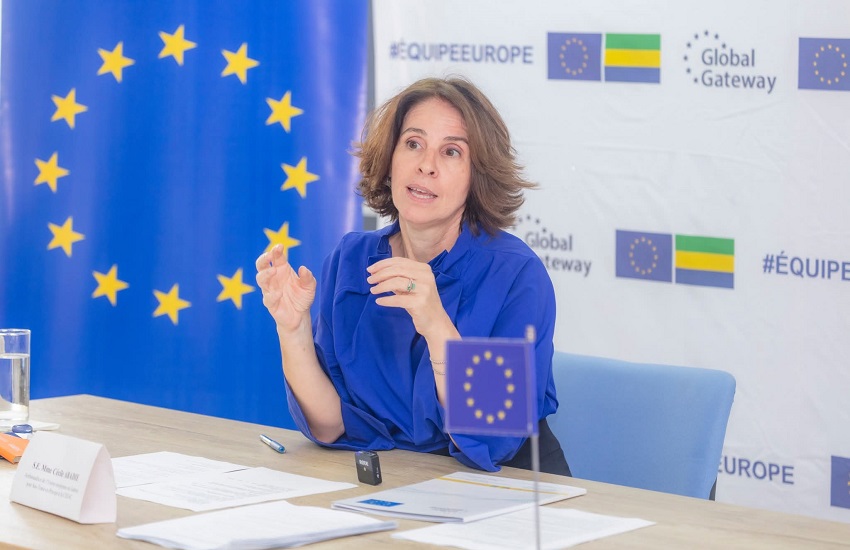
The head of the European Union delegation recalled that the proposed partnership follows a multilateral logic and aims to build a shared economic agenda. This formula reflects a deep shift in the European strategy on the African continent.
Faced with the emergence of new international partners, especially from Asia and the Middle East, Brussels now seeks to position itself as a catalyst for investment rather than a mere donor. For Gabon, this approach opens new prospects in infrastructure, industrial processing, energy, and economic diversification.
The stakes are high. The country aims to gradually move away from its historical dependence on raw commodities and develop higher-value-added sectors capable of creating more jobs and wealth on national soil.
The Fifth Republic tested by reforms
This meeting takes place in a particular context. Since the election of President Brice Clotaire Oligui Nguema and the establishment of the Fifth Republic, Gabon has embarked on a broad sequence of institutional and economic reforms.
Discussions with European representatives will notably cover political reforms, governance, the rule of law, the business environment, and administrative modernisation. These topics are considered essential to improving the country’s economic attractiveness.
Minister of Foreign Affairs and Cooperation Marie Edith Tassyla Doumbeneny recalled that the exchanges will also allow a review of all relations between Libreville and Brussels, both at the community level and through bilateral partnerships with member states.
The Samoa Agreement, which now serves as the framework for this cooperation, places good governance, sustainable development, energy transition, and economic resilience at the centre of priorities. These areas correspond directly to the goals set by Gabonese authorities.
With this perspective, the political dialogue becomes an instrument to support the national transformation strategy launched since 2023.
Gabon aims to become a regional investment hub
One of the most striking aspects of this meeting is the change in Gabon’s posture on the international stage.
The country no longer simply seeks financial support. It aims to attract productive investments that can accelerate its economic transformation. The forestry industry, mining processing, infrastructure, agriculture, digital technology, and renewable energy are among the priority sectors.
Sustainable management of natural resources also takes a central place in discussions. Gabon, internationally recognised for its role in preserving the forests of the Congo Basin, intends to turn its environmental heritage into a driver of sustainable growth while consolidating its position in international climate negotiations.
This direction fits into a broader vision of economic sovereignty. As Hermann Immongault emphasised, this dialogue constitutes a real exercise in economic diplomacy where Gabon intends to defend its strategic priorities coherently.
Beyond the declarations, the importance of this meeting lies in its ability to produce tangible results. The credibility of the partnership will now be measured by the investments mobilised, the reforms supported, and the projects implemented.
The Gabon–European Union Dialogue thus appears as one of the first major international appointments of the Fifth Republic. It symbolises Libreville’s will to turn its regained political capital into a lever for economic development. In an increasingly competitive global environment, Gabon chooses controlled openness, strategic partnership, and investment as the engines of its emergence. An ambition that could durably redefine its place within the African and international economy.