DRC government and ICRC deepen cooperation for detainee welfare and humanitarian support
DRC government and ICRC deepen cooperation for detainee welfare and humanitarian support
- Politics
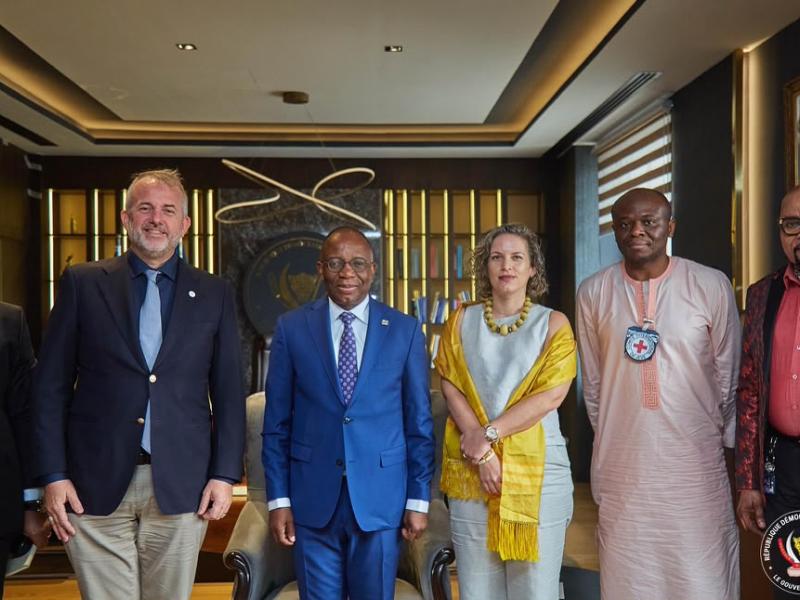
The International Committee of the Red Cross (ICRC) and the Democratic Republic of Congo’s government have agreed to strengthen their cooperation to enhance humanitarian action and improve detention conditions nationwide, particularly in eastern DRC. This commitment was reaffirmed today during a meeting between ICRC delegation head François Moreillon, concluding his three-year mission in the country, and Justice Minister and Keeper of the Seals Guillaume Ngefa Atondoko Andali.
This high-level meeting, which also served as a review of the partnership’s progress, highlighted positive evaluations of the cooperation between Congolese authorities and the ICRC. Both parties expressed their shared determination to deepen this collaboration for the benefit of humanitarian action and improved detention conditions in the DRC.
During the discussions, François Moreillon commended the quality of dialogue and cooperation maintained with the Ministry of Justice throughout his tenure. He emphasized that the ICRC works in close coordination with Congolese authorities on several priority issues, including improving detention conditions—especially in eastern provinces where humanitarian needs remain critical.
“My visit to the Ministry of Justice was primarily to thank Minister Ngefa for his collaboration with the ICRC over the past years. It was also an opportunity, after more than three years here, to take stock and identify areas where we can strengthen our partnerships with the Ministry of Justice to improve detention conditions and ensure proper monitoring of detainee treatment, particularly in eastern DRC where the ICRC focuses its activities. The topics discussed ranged from prison funding to food supply issues and various other matters we share with the Ministry of Justice. We maintain very close and high-quality relations,” Moreillon stated to the press following the meeting.
The two sides also reviewed key challenges faced by prison facilities, including funding constraints, detainee nutrition, and improving care standards. On this occasion, the ICRC delegation head reaffirmed his organization’s commitment to continue supporting the Congolese government in developing sustainable solutions to these challenges.
After three years in the DRC, François Moreillon presented a positive assessment of cooperation with Congolese authorities. He welcomed the progress achieved through this partnership and expressed hope that this momentum would continue to benefit the most vulnerable populations.
He also renewed the ICRC’s support for communities affected by crises in eastern DRC, while calling for sustained joint efforts to protect their dignity and uphold international humanitarian law.
“This brings a deep sense of satisfaction. It’s also a message of resilience and support I wish to convey to the Congolese people, who have endured over three decades of suffering, particularly in eastern DRC. Additionally, in our relationship with the Ministry of Justice, we’ve observed increased momentum in recent months with new ambitions that, we hope, will lead to sustainable solutions for detainees and better protection of judicial guarantees,” Moreillon added during his remarks.
The ICRC has been present in the DRC since 1978, supporting people affected by armed conflicts and violence. The organization also promotes respect for international humanitarian law and its integration into national legal frameworks amid deteriorating humanitarian and security conditions, particularly in eastern DRC.
As a neutral humanitarian intermediary, the ICRC regularly facilitates the release and transfer of detainees between conflict parties, including armed groups such as the AFC/M23—backed by Rwanda according to Congolese authorities—and the DRC government, in accordance with the Geneva Conventions. Between April 30 and May 15 of last year, the ICRC assisted in transferring over 1,300 disarmed members of government forces and their families from Goma to Kinshasa—a humanitarian operation covering nearly 2,000 kilometers through active frontline zones, conducted at the request of the DRC Ministry of Defense and Veterans, MONUSCO, and AFC/M23. The ICRC was chosen for its role as a neutral and impartial actor responsible for facilitating humanitarian exchanges between concerned parties.