Read aloud⏱ ~4 min
Économie
Agriculture : La Côte d’Ivoire et le Ghana réaffirment leur engagement pour un cacao durable
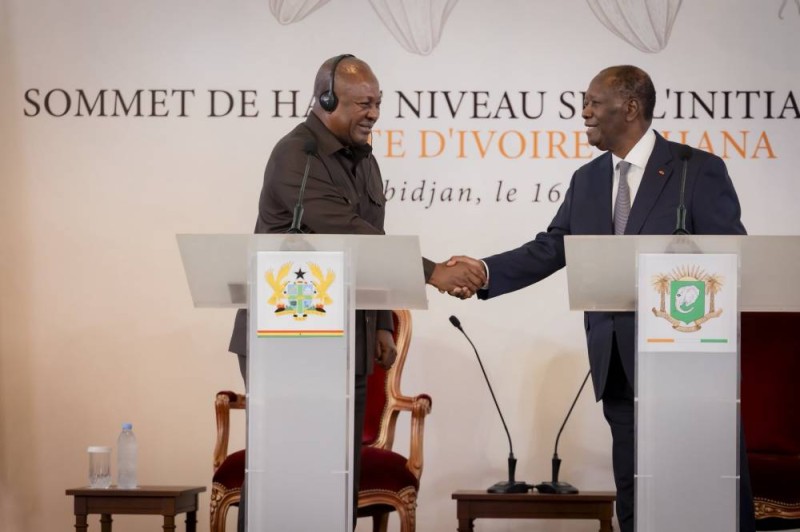
President Alassane Ouattara of Côte d’Ivoire and his Ghanaian counterpart, John Dramani Mahama, recently co-chaired a significant high-level summit on the “Cocoa Initiative” at the Presidential Palace in Abidjan-Plateau. This pivotal gathering served as a platform for both Heads of State to implement crucial decisions aimed at fostering a more equitable, robust, and sustainable cocoa economy. The objective is to benefit producers, bolster the economies of both nations, and advance the African continent as a whole.
Key strategies discussed included harmonizing farm-gate pricing policies, enhancing value creation within the sector, and extending this strategic initiative to other African cocoa-producing countries. Côte d’Ivoire and Ghana, the world’s foremost cocoa producers, unequivocally reiterated their collective resolve to champion the interests of their farmers and collaboratively forge a more prosperous and enduring future for the African cocoa industry.
President Ouattara conveyed his profound satisfaction with the summit’s outcomes, emphasizing the importance of the resolutions adopted by both parties. He underscored that the high-level summit on the Côte d’Ivoire-Ghana Cocoa Initiative, held in the presence of his esteemed colleague and friend, President Mahama, powerfully illustrates the deep-rooted bonds of friendship, fraternity, and cooperation uniting their two nations in service of Africa’s development.
During his opening address, President Ouattara highlighted that cocoa represents a vital stake for mobilizing the resources essential for implementing development policies in both countries. Beyond its economic significance, cocoa holds immense social importance and is a matter of national sovereignty. The sector, which sees Côte d’Ivoire and Ghana contribute 60% of global production and Africa 80%, sustains millions of livelihoods.
Setting the context, the Ivorian President affirmed, “At the heart of this sector lies an essential actor: the planter. It is through their daily labor that the global chocolate industry is nourished. It is they who imbue this sector with its strength, its legitimacy, and its future. Therefore, the planter must remain central to all our decisions.”
He also commended the considerable progress achieved since March 26, 2018, when Côte d’Ivoire and Ghana united their efforts through the Abidjan Declaration. This concerted action aimed to establish a unified voice to influence global cocoa prices. President Ouattara noted that “the implementation of a decent income differential has improved the remuneration of our planters and demonstrated that concerted action by our two states can favorably impact the formation of world prices.”
However, the Ivorian Head of State also acknowledged persistent challenges. These include price volatility, the adverse effects of climate change, aging cocoa orchards, prevalent cocoa diseases, and land pressures exacerbated by illegal gold panning. Furthermore, the emergence of substitute products and stringent international, particularly European, sustainability standards present additional hurdles.
Key strategies discussed included harmonizing farm-gate pricing policies, enhancing value creation within the sector, and extending this strategic initiative to other African cocoa-producing countries. Côte d’Ivoire and Ghana, the world’s foremost cocoa producers, unequivocally reiterated their collective resolve to champion the interests of their farmers and collaboratively forge a more prosperous and enduring future for the African cocoa industry.
President Ouattara conveyed his profound satisfaction with the summit’s outcomes, emphasizing the importance of the resolutions adopted by both parties. He underscored that the high-level summit on the Côte d’Ivoire-Ghana Cocoa Initiative, held in the presence of his esteemed colleague and friend, President Mahama, powerfully illustrates the deep-rooted bonds of friendship, fraternity, and cooperation uniting their two nations in service of Africa’s development.
During his opening address, President Ouattara highlighted that cocoa represents a vital stake for mobilizing the resources essential for implementing development policies in both countries. Beyond its economic significance, cocoa holds immense social importance and is a matter of national sovereignty. The sector, which sees Côte d’Ivoire and Ghana contribute 60% of global production and Africa 80%, sustains millions of livelihoods.
Setting the context, the Ivorian President affirmed, “At the heart of this sector lies an essential actor: the planter. It is through their daily labor that the global chocolate industry is nourished. It is they who imbue this sector with its strength, its legitimacy, and its future. Therefore, the planter must remain central to all our decisions.”
He also commended the considerable progress achieved since March 26, 2018, when Côte d’Ivoire and Ghana united their efforts through the Abidjan Declaration. This concerted action aimed to establish a unified voice to influence global cocoa prices. President Ouattara noted that “the implementation of a decent income differential has improved the remuneration of our planters and demonstrated that concerted action by our two states can favorably impact the formation of world prices.”
However, the Ivorian Head of State also acknowledged persistent challenges. These include price volatility, the adverse effects of climate change, aging cocoa orchards, prevalent cocoa diseases, and land pressures exacerbated by illegal gold panning. Furthermore, the emergence of substitute products and stringent international, particularly European, sustainability standards present additional hurdles.
For his part, President John Dramani Mahama expressed his delight at the successful Ivorian-Ghanaian collaboration on cocoa, conveying optimism for an even brighter future. He emphasized that the collective will of both nations is to “empower planters and provide them with all the necessary elements to continue production.”
The Ghanaian Head of State affirmed that both parties are committed to exchanging and implementing best practices, alongside injecting increased funding into the cocoa sector. Moreover, John Dramani Mahama stressed the imperative for Côte d’Ivoire and Ghana to guide other producing countries on the continent, fostering a policy of significant and sustained presence in the global market.
Follow this sectionFind our stories in Feedly, Inoreader…
You may also like
Can Togo’s mediation still deliver peace in eastern DRC after Tshisekedi’s latest letter to Gnassingbé?
Mali: did the JNIM ambush on Africa Corps near Niono expose a fatal gap in Russia’s Sahel strategy?
Will Mali’s 73.6 million dollar funding gap decide the fate of millions by 2027?
Guinea-Bissau’s December 2026 vote: can Embaló return legally, and can the result ever be trusted?
Can a $20 million bounty take down Ukraine’s drone war architect?