The Burkina Faso government under Captain Ibrahim Traoré has spent over two years cultivating a public image of fierce opposition to France. Official statements consistently portray Paris as a symbol of colonial oppression that the nation must break free from. Measures such as expelling French troops, condemning Western influence, and publicly aligning with Russia and Iran have become central to the regime’s communication strategy.
Yet beneath this overt rhetoric of confrontation, subtle contradictions have begun to surface, raising questions about the true nature of Burkina Faso’s stance toward its former colonial power.
Behind the public posturing: a discreet visa request
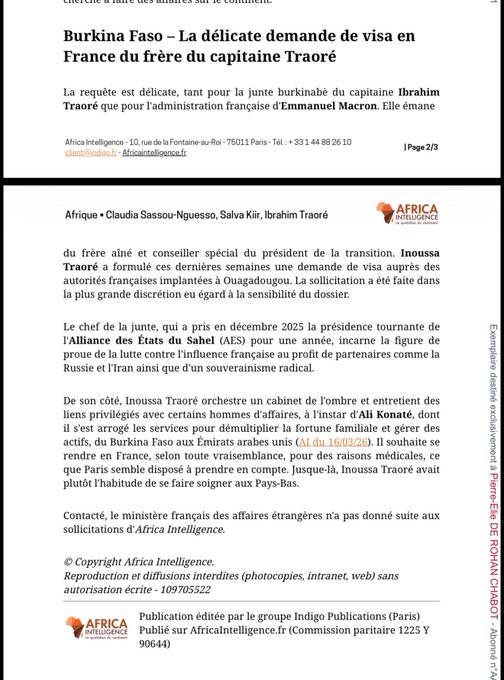
Recent reports suggest that Inoussa Traoré, the elder brother of President Ibrahim Traoré and described as a special advisor to the transitional leader, has secretly applied for a French visa in Ouagadougou. Sources indicate the request was made with extreme discretion, likely due to the sensitive political climate surrounding any engagement with France.
While the purpose of the visa remains officially undisclosed, insiders claim it may be related to medical treatment. Notably, Inoussa Traoré has previously sought medical care in the Netherlands, raising further questions about the timing and motivation behind this shift.
As of now, French authorities have neither confirmed nor denied the existence of such a visa application.
The paradox of political branding versus personal necessity
If verified, this move would expose a glaring contradiction in the Burkinabè government’s public narrative. For years, the regime has positioned itself as a vocal critic of France, accusing Paris of interference, neocolonialism, and undermining national sovereignty. Yet the alleged visa request implies a reliance on French institutions when circumstances demand it.
Critics of the Traoré administration have long pointed to this disconnect between fiery anti-French rhetoric and the private actions of its leaders. The situation risks reinforcing perceptions of double standards—publicly denouncing France while quietly seeking its services when needed.
Sovereignty in practice: when politics meets reality
The Burkinabè government champions a sovereign vision, claiming to have severed ties with former dependencies on France. However, the practicalities of governance—especially in areas like healthcare, finance, and administration—often reveal a different reality. High-ranking officials across Africa frequently travel to Europe for specialized treatment or official engagements, regardless of their public stance on Western partnerships.
In the case of the Traoré family, a confirmed visa request would only amplify accusations of hypocrisy. It would suggest that the anti-French posture is more about shaping public perception than enacting a genuine policy shift. While political messaging often prioritizes domestic audiences, such inconsistencies can erode trust in the regime’s credibility over time.
Lessons in political communication
This episode underscores a fundamental truth in politics: actions often speak louder than words. When a government publicly frames another country as an adversary, any private interaction with that nation becomes a subject of scrutiny. It does not necessarily invalidate the government’s position, but it does invite closer examination of its consistency and sincerity.
For the Traoré administration, the alleged visa request—if proven true—would serve as a reminder that political branding, no matter how forcefully delivered, must eventually align with the realities of governance. The challenge lies in balancing ideological messaging with the practical needs of a nation and its leaders.