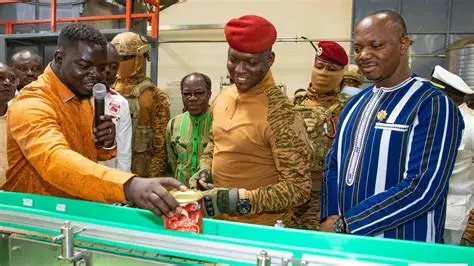
The recent months have witnessed a flurry of industrial inaugurations and site visits across Burkina Faso, orchestrated by Captain Ibrahim Traoré. From tomato processing plants to gold refining facilities, the transitional government’s communications machine is working overtime to project an image of progress and economic resurgence. Yet, beneath the polished veneer of state media broadcasts, the harsh realities of a nation grappling with severe security and economic crises continue to unravel, exposing the fragility of these carefully curated narratives.
Grandiose projects as a facade of progress
In a familiar playbook employed by governments seeking legitimacy, Burkina Faso has adopted the strategy of « high-profile development projects » to bolster public confidence. From the capital of Ouagadougou to the economic hub of Bobo-Dioulasso, Captain Traoré’s administration is positioning itself as a champion of national economic sovereignty. The messaging is clear: despite regional blockades, the exodus of Western partners, and mounting challenges, Burkina Faso is charting its own course toward prosperity.
The narrative centers on self-sufficiency, local job creation, and economic independence. Supporters of the regime present each groundbreaking ceremony as a triumph over foreign influence. However, independent economic analysts caution that these staged events may be more indicative of a desperate attempt to mask deeper systemic failures than a coherent development strategy.
Industrial ventures shrouded in opacity
Scrutiny of these so-called industrial « flagship projects » often uncovers troubling inconsistencies. While ribbon-cutting ceremonies draw media attention, critical details—such as actual funding sources, long-term production viability, and operational sustainability—remain conspicuously absent from public discourse.
Furthermore, allegations of financial impropriety have cast a pall over the management of patriotic funds. Questions persist about the destination of funds earmarked for both the war effort and industrial development. As traditional private enterprises struggle under the weight of heavy taxation and escalating insecurity, the emergence of new entities with close ties to power structures raises serious concerns about the integrity of procurement processes and the equitable allocation of resources.
The widening chasm between rhetoric and reality
The stark disparity between official narratives and the lived experiences of Burkinabè citizens has never been more pronounced.
Soaring living costs
Runaway inflation has pushed the prices of essential goods—such as rice, cooking oil, and millet—to unprecedented levels, pushing vulnerable households to the brink of survival.
A humanitarian catastrophe
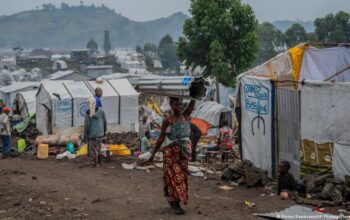
With over two million internally displaced persons, Burkina Faso is experiencing one of the most severe crises in its history. Entire villages remain under terrorist siege, relying on precarious humanitarian aid convoys for survival.
Economic paralysis
The informal sector, the backbone of the national economy, is in freefall. Recurrent power outages and the persistent insecurity along key trade routes have crippled commerce, stifling any meaningful economic recovery.
The limits of propaganda
The contrast is glaring: on one side, meticulously produced videos showcasing gleaming machinery and a resolute leader; on the other, parents struggling to afford school fees and soldiers battling under grueling conditions. The image of a « thriving Burkina Faso » is, at best, a media construct designed to foster false hope and suppress dissent. Yet propaganda has its limits—particularly when reality refuses to conform to the script.
It is impossible to sustain a population with lofty rhetoric on economic sovereignty if farmlands are inaccessible, roads are unsafe, and factories exist only as stage props for television broadcasts. Captain Ibrahim Traoré’s gamble on perception carries immense risks. In his pursuit of portraying progress at all costs, he risks severing the already tenuous connection between governance and the people it claims to serve. Industrialization is a worthy ambition, but it cannot be erected on shifting sands. Without transparent financial practices and genuine territorial security, these presidential photo opportunities will remain mere illusions in the Sahelian landscape.