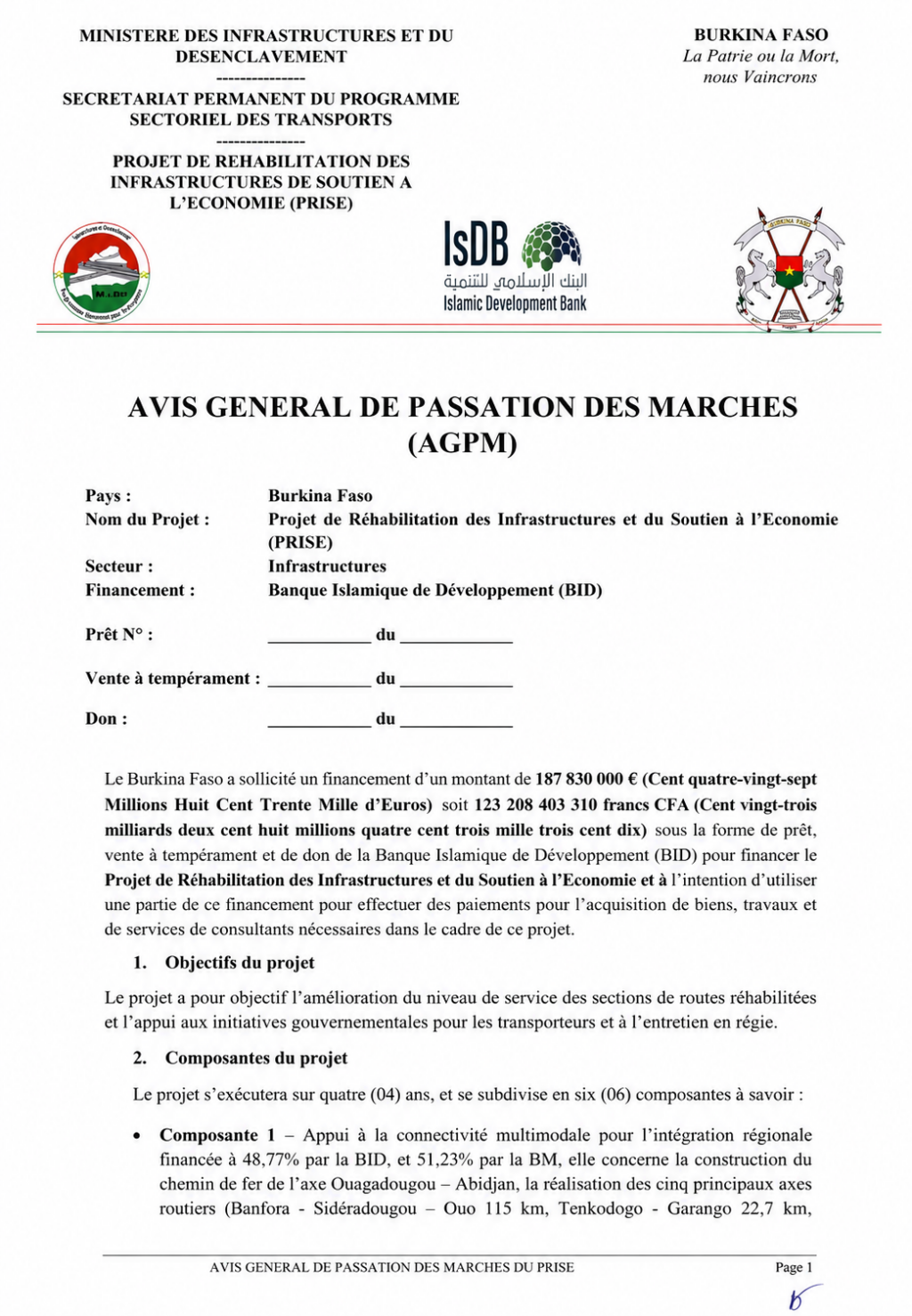
In Ouagadougou, the official narrative from Captain Ibrahim Traoré and the ruling military authorities has consistently championed a particular slogan as the emblem of their asserted economic sovereignty: « Y’a pas crédit dedans » (There’s no credit in it). This phrase, widely disseminated across social media and by government supporters, aims to convey that significant national projects—ranging from road rehabilitation and infrastructure construction to equipment acquisition and state modernization—are financed exclusively through domestic resources, without recourse to foreign borrowing.
The message is straightforward, impactful, and politically potent: Burkina Faso, it suggests, is now charting its own course, unshackled from reliance on international donors.
However, a discernible chasm emerges between this compelling slogan and the nation’s budgetary realities.
A captivating message, but a more intricate reality
Achieving economic sovereignty stands as a legitimate aspiration for any nation. The ambition to lessen external dependence, enhance internal revenue generation, and bolster national capabilities is universally acknowledged.
Nevertheless, presenting every public investment as entirely self-funded raises significant questions regarding transparency. This is particularly true when official financial documents, funding agreements, or public announcements clearly indicate the utilization of concessional loans or multilateral financing.
Recent agreements with the Islamic Development Bank (BID) for substantial road projects serve as a prime illustration of this dynamic. These initiatives undeniably mobilize external resources that will necessitate repayment according to agreed schedules, even if the financial terms are favorable.
Simply put, these are not gratuitous funds but rather financial commitments that become inscribed within the nation’s public accounts.
A contradiction fueling scrutiny
This situation prompts a fundamental query: why assert categorically that « il n’y a pas crédit dedans » when numerous projects are clearly benefiting from international financing agreements?
The practice of borrowing is not exceptional; it is a common tool employed by states globally to fund investments when their internal budgetary resources are insufficient.
What truly warrants closer examination is the disparity between:
- a discourse portraying near-total financial autonomy;
- and funding mechanisms that continue to involve international financial partners.
This inherent contradiction fuels critiques concerning the sincerity of the government’s public communication.
An economy under immense strain
Indeed, Burkina Faso’s prevailing economic climate renders the notion of extensive self-financing largely improbable.
The nation continues to grapple with a confluence of formidable challenges:
- a profoundly costly security crisis;
- a sharp escalation in military expenditures;
- significant pressure on public finances;
- extensive infrastructure requirements;
- mass displacement of populations;
- and tax revenues weakened by an economic slowdown across several regions.
Within such a demanding environment, the prospect of exclusively financing investments totaling hundreds of billions of CFA francs without engaging financial partners appears scarcely credible to many economic analysts.
Borrowing isn’t the problem… opacity can be
It is crucial to remember that public borrowing does not inherently constitute a poor decision.
When strategically deployed to finance productive infrastructure, improve transportation networks, stimulate growth, or strengthen public services, it can act as a powerful catalyst for development.
The core issue, rather, gravitates towards transparency.
Citizens rightfully expect to be informed about:
- the precise origin of funds;
- the total amount of loans contracted;
- the applicable interest rates;
- the repayment schedules;
- any guarantees provided;
- and the true cost of the projects.
Responsible financial governance is built upon clear, accessible information, not merely on compelling slogans.
A communication strategy primarily political
The slogan « Y’a pas crédit dedans » appears to fulfill a distinct political function.
It serves to bolster the image of a government capable of breaking from past practices, presenting each achievement as tangible proof of newfound independence.
This communication also cultivates a sense of national pride among a segment of the public, particularly in a context where questions of sovereignty hold a central position in political discourse.
However, when communication overshadows sound budgetary education, there is a distinct risk of fostering unrealistic expectations regarding the state’s actual capacity to finance its development autonomously.
Future generations will bear the weight of current decisions
Any public debt incurred today will invariably be repaid tomorrow through future tax revenues.
While the infrastructure constructed today may benefit future generations, these generations will also inherit the accompanying financial commitments.
This is precisely why transparency concerning public indebtedness represents a critical democratic imperative.
It empowers citizens to assess whether borrowed funds are indeed channeled into productive investments capable of generating sufficient wealth to ensure their eventual repayment.
Sovereignty is not measured by the absence of credit
True economic sovereignty does not equate to proclaiming an absolute avoidance of debt.
Instead, it resides more profoundly in a state’s capacity to:
- sustainably manage its public finances;
- invest effectively;
- publish transparent accounts;
- be accountable to its citizens;
- utilize borrowing responsibly;
- and progressively reduce its dependence through a more competitive economy.
A resilient nation is not one that denies its financial obligations, but rather one that embraces them with transparency and leverages them for the pursuit of sustainable development.
Conclusion
The slogan « Y’a pas crédit dedans » has undoubtedly resonated widely. Yet, the long-term management of public finances cannot credibly rest solely on communicative formulas.
The financing agreements forged with international partners serve as a potent reminder that Burkina Faso, much like many developing nations, continues to mobilize external resources to fund a portion of its investments.
The pertinent debate should therefore not pit borrowing against sovereignty, but rather focus on the caliber of governance, the transparency of financial commitments, and the efficacy of the investments undertaken. For, beyond the rhetoric, it is the taxpayers of both today and tomorrow who will ultimately bear the consequences of the budgetary choices made by current leadership.
You may also like
Benin’s DGI sets September 21 as launch date for online tax services in Parakou
Sevilla vs Barcelona: kick-off time, tv channel and odds for the Sánchez-Pizjuán clash
Mali prison overcrowding: Bamako jail holds 10,000 in space built for 600 as mass arrests surge
General Moussa Salaou Barmou: US military doctrine driving Niger’s special forces
World Bank brings education, jobs and entrepreneurship open days to Abidjan on 21-22 September 2026