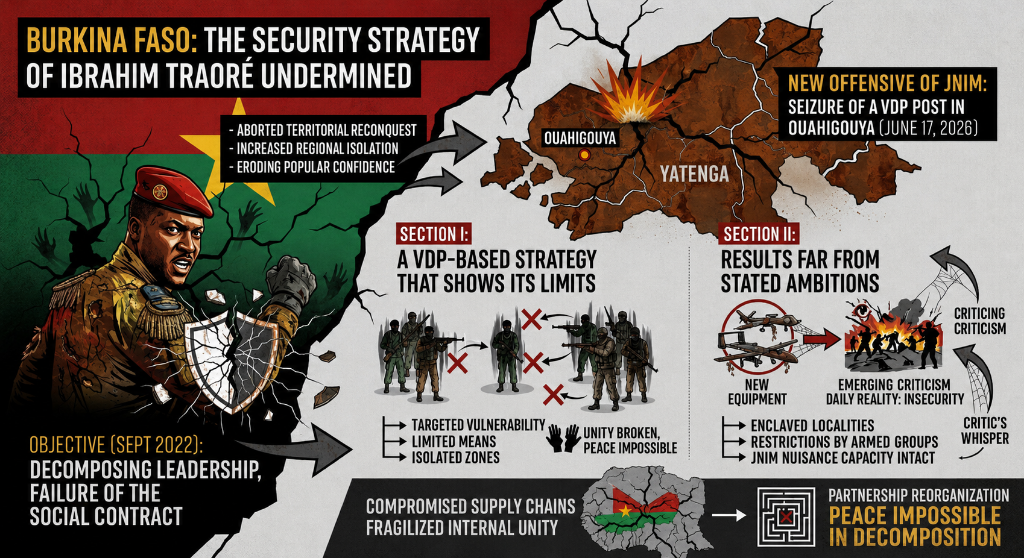
The security landscape across Burkina Faso continues to worsen. The Group for the Support of Islam and Muslims (JNIM), an organization allied with Al-Qaeda in the Sahel, has claimed responsibility for seizing a position held by the Volunteers for the Defense of the Homeland (VDP). This assault occurred on June 17, 2026, within the Ouahigouya region, which serves as the administrative center for Yatenga province in the nation’s northern reaches.
This recent incursion represents another significant setback for the territorial reconquest strategy championed by the transitional authorities. Captain Ibrahim Traoré, who assumed leadership in September 2022 with a firm commitment to restoring the nation’s integrity, now confronts escalating scrutiny regarding the efficacy of his current security approach.
A VDP-centric strategy revealing its limitations
In an effort to address the personnel deficits within the regular armed forces, the administration has heavily relied upon the Volunteers for the Defense of the Homeland. However, these civilian units, frequently stationed in remote locales and equipped with finite resources, have increasingly become prime targets for armed factions.
The Ouahigouya attack is merely one incident in a succession of reverses experienced over recent months. Despite ongoing military operations across the territory, numerous strategic locations prove challenging to secure on a sustained basis. Many regional experts observe that JNIM maintains a considerable capacity for disruption and enjoys extensive operational freedom throughout the northern and eastern sectors.
Outcomes falling short of declared aspirations
The transitional government frequently highlights advancements and the procurement of modern equipment, specifically surveillance and combat drones. Nevertheless, for a significant segment of the populace, pervasive insecurity remains a constant daily concern. Numerous communities endure isolation, and certain territories continue to operate under restrictions enforced by armed groups.
Against this backdrop, criticisms are surfacing regarding the efficacy of the prevailing security policy. The fundamental justification for the 2022 overthrow of civilian rule — the perceived failure to safeguard the populace — has now re-emerged as a central topic in public discourse.
As Ouagadougou continues to restructure its alliances within the Confédération des États du Sahel (AES) and anticipates an escalation of operations throughout 2026, the Yatenga assault serves as a stark reminder of the inherent complexities in overcoming an asymmetric conflict through military means alone.
You may also like
Can Lomé’s quiet diplomacy finally deliver peace to eastern DRC?
Can Nigeria’s security forces ever shut down the kidnapping economy in the north?
Will Benin’s UCESIF gambit in Bucharest pay off for francophone social dialogue?
Can Benin’s defense strategy survive on diversification alone?
Can the CEMAC capital market finally bankroll Cameroon’s real economy?