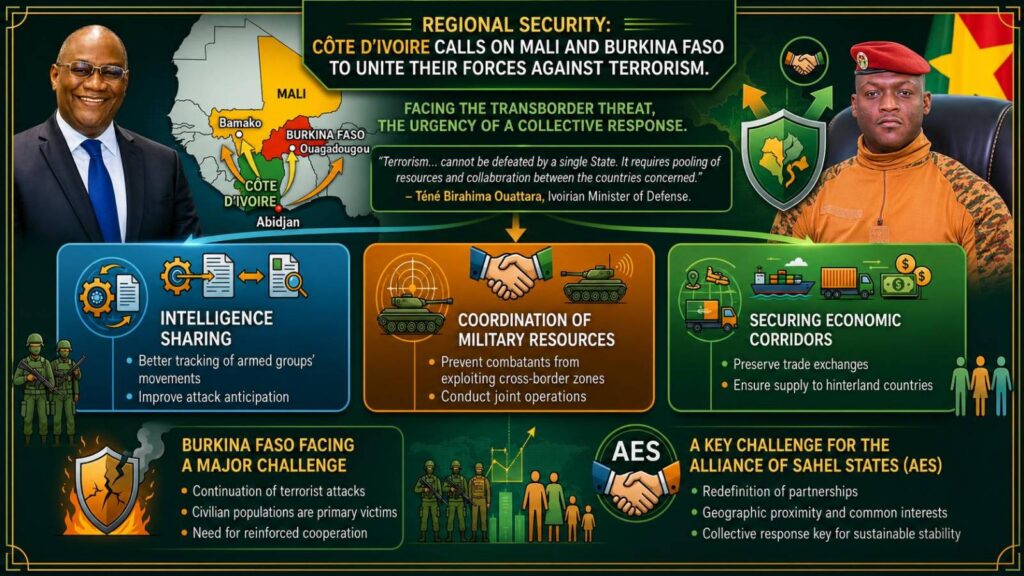
As terrorist incursions intensify across the Sahel region, Abidjan has underscored the critical need for a unified regional front. Faced with an urgent security imperative, Captain Ibrahim Traoré is compelled to prioritize pragmatic collaboration with the Ivorian state to contain a threat that unequivocally transcends national borders.
In the West African landscape, the era of diplomatic discord and ideological posturing has given way to the paramount concern of collective survival. Confronted by the relentless advance of armed terrorist groups, which continue to inflict devastation across the Sahel and now imperil coastal nations, Côte d’Ivoire has issued a clear appeal to its neighboring states, Mali and Burkina Faso.
The Ivorian Minister of Defense, Téné Birahima Ouattara, articulated a stark assessment of the situation:
« The current manifestation of terrorism cannot be overcome by any single nation. It mandates a pooling of resources and concerted collaboration among all affected countries. »
This gesture of extended partnership resonates as a profound call to reality for Ouagadougou.
Burkina Faso at a critical juncture
Despite fervent declarations of national sovereignty and significant mobilization efforts, Burkina Faso demonstrably struggles to contain the pervasive terrorist threat. Attacks are proliferating, territorial control remains precarious, and civilian populations continue to bear a heavy cost. For Captain Ibrahim Traoré, who presides over Burkina Faso’s transitional government, the prevailing circumstances necessitate a crucial strategic decision.
Regional analysts suggest that the persistent nature of this menace will inevitably compel the young leader to set aside political tensions and personal considerations, engaging fully in this proposed community dynamic. The security of his populace now hinges upon a departure from strategic isolation.
Pillars of cooperation proposed by Abidjan
Côte d’Ivoire, leveraging its relative stability and substantial logistical capabilities, proposes a framework for collaboration founded upon three principal axes:
- Intelligence Sharing: To meticulously track the movements of jihadist groups along porous border regions.
- Resource Mutualization: To coordinate trans-border military operations, thereby preventing terrorists from finding sanctuary on either side of the frontier.
- Securing Economic Corridors: To guarantee the uninterrupted flow of essential goods vital to the economies of landlocked nations.
A test of political maturity for the AES
This proactive gesture from Côte d’Ivoire represents a pivotal moment for the Alliance of Sahel States (AES). While Mali and Burkina Faso have opted to recalibrate their international partnerships, geographical realities remain immutable. Côte d’Ivoire stands as an inherent and indispensable regional partner.
For Captain Ibrahim Traoré, accepting collaboration with the Ivorian state would not signify an admission of weakness, but rather an act of profound political maturity and responsibility towards his citizenry. Against an asymmetric and highly mobile adversary, division proves a fatal strategy; only a concerted and unified response will restore peace to the sub-region.
You may also like
Can Tinubu’s Lagos homecoming before Nigeria’s 66th independence day reshape his 2027 path?
Can Benin turn a €500 million loan into lasting social change?
Burkina Faso: what does Ibrahim Traoré’s four-year record truly mean for the displaced and the silenced?
Cameroon’s Vision 4 suspension: does silencing a broadcaster protect the Martinez Zogo trial or undermine press freedom?
Thali oil permit: can Prime Global Energies’ $15 million rescue finally unlock Cameroon’s stalled Njom-3 well?