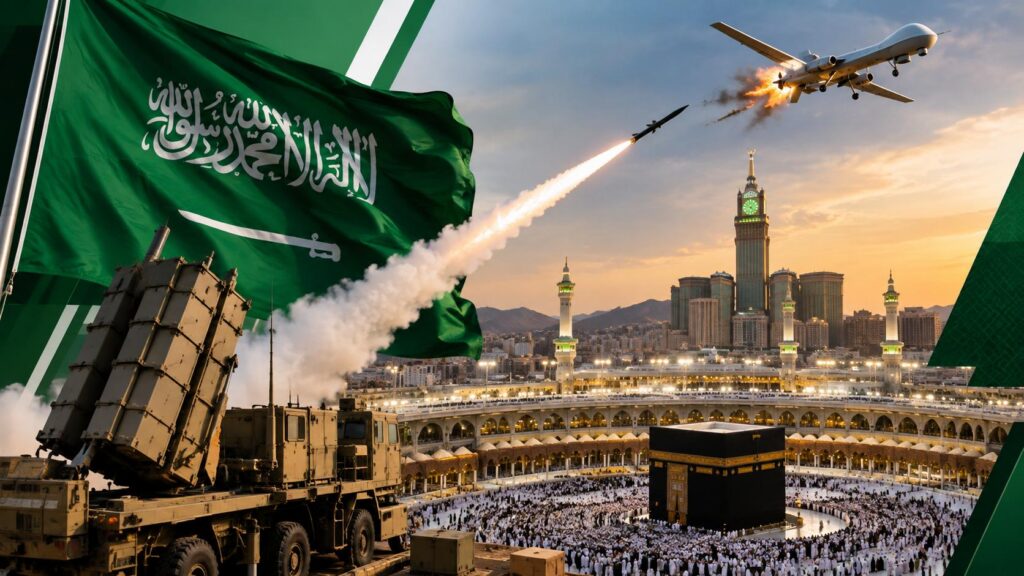
An armed drone attributed to Yemen’s Houthi rebels was destroyed by Saudi air defenses in the sky south of Mecca on Tuesday, 15 September — an interception that Riyadh is framing as the moment its posture shifted from routine vigilance to open deterrence. The aircraft never reached the sacred perimeter. According to the Riyadh-led military coalition, it was neutralized before it could slip into the heavily shielded airspace surrounding Islam’s holiest city.
The coalition went public with the operation the next day, Wednesday 16 September. Its statement recorded neither casualties nor material damage. Even so, the trajectory itself is what gives the episode its weight: Mecca is home to the Grand Mosque and draws a constant tide of worshippers and residents, so any device pointed at the area carries a symbolic and political charge that far exceeds a standard defensive maneuver.
The instant the flight path broke
The engagement unfolded over the southern approaches to the holy city, where the Royal Saudi Air Defense Forces picked up the track of a weaponized drone and brought it down short of the strictly guarded zone. That containment, the coalition stressed, is precisely what its air shield is built to deliver.
The absence of victims or wreckage on the ground does not dilute the significance of where the drone was heading. For the kingdom’s command, the target selection alone turned a technical interception into a strategic statement.
A red line drawn around the sanctuary
Coalition spokesman General Turki Al-Maliki was quick to respond, condemning the attempt in unambiguous terms. He laid responsibility squarely on Yemen’s Houthi rebels and their backers, accusing them of seeking to “disrupt the security and stability” of the kingdom and of deliberately putting at risk the lives of residents and the faithful gathered at the Grand Mosque.
Why Riyadh calls this a threshold moment
In the Saudi reading of the event, aiming at a place of worship of such standing amounts to crossing yet another line. The coalition restated its commitment to deploy every means at its disposal to shield Saudi territory, its civilian population and its sacred sites — language that signals a lower tolerance threshold for future launches aimed at the same direction.
A war whose clock runs in years, not weeks
This episode does not stand alone. It slots into a long-running confrontation between the international coalition led by Saudi Arabia and the Houthi insurgency in Yemen. Drone and ballistic missile strikes against oil facilities, airports and frontier zones have become a recurring feature of the conflict, but anything whose course bends toward the Mecca region invariably triggers diplomatic and security reactions of a sharper intensity.
Mediation attempts and fragile truces brokered under United Nations auspices have come and gone. Each new launch of this kind exposes the same hard truth: the Houthis retain real military reach, and stabilizing the kingdom’s southern border remains an unresolved problem.
What this turning point actually shifts
Attention returns to a familiar vulnerability — the exposure of the Arabian Peninsula’s strategic and religious infrastructure to asymmetric strikes. The performance of Saudi air defenses on this occasion offers tactical reassurance, yet it simultaneously sharpens the case for a durable political settlement to the Yemeni war rather than an endless cycle of interception.
Tactical confidence, political pressure
Foreign ministries are tracking the trajectory of the situation closely. The message carried by this interception is double-edged: the kingdom can stop what is fired at it, but the latent risk of escalation has not gone away, and it remains capable at any moment of undermining peace efforts and the region’s fragile equilibrium.
The momentum now points in one direction. Either the diplomatic track gains enough traction to reduce the frequency of these launches, or the pattern repeats — and each repetition pushes the confrontation closer to a threshold neither side can easily walk back from.
You may also like
International concern grows over Sahel states’ ICC withdrawal
Azerbaijan and Morocco bolster parliamentary cooperation
Morocco and philippines: building on 50 years of diplomatic ties
Benin Niger strengthen bilateral ties after high-level talks in Niamey
Niger’s interior minister embroiled in visa trafficking allegations