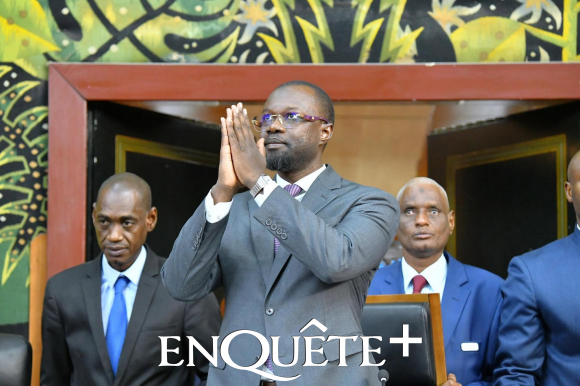
In a decisive legal setback, the Supreme Court has dismissed the emergency motion filed by the National Union for Integrity and Sovereignty (UNIS) seeking to suspend the installation of Ousmane Sonko as President of the National Assembly. The ruling, delivered on June 25, 2026, by the emergency judge of the highest court, has drawn sharp criticism from the opposition movement, which vows to pursue its challenge on the merits.
The dispute centers on the administrative act formalizing Ousmane Sonko’s appointment, a decision UNIS argues is legally flawed and threatens constitutional order. In a strongly worded statement released by its president, Amadou Gueye, the organization condemned the Supreme Court’s refusal to intervene, describing it as a “negative jurisdictional conflict” and a “denial of justice.”
a procedural clash rooted in constitutional ambiguity
The controversy stems from a June 17, 2026 decision by the Constitutional Council, which declared itself incompetent to rule on the matter, classifying the contested act as an administrative—not legislative—measure. UNIS, however, contends that the Council’s ruling implicitly recognized the Supreme Court as the competent jurisdiction to hear the case, given its characterization of the act as an “administrative act of integration.”
The Supreme Court’s emergency judge rejected UNIS’s suspension request, invoking the principle of separation of powers and asserting that the judiciary should not interfere in internal affairs of the National Assembly. The opposition coalition dismisses this reasoning as legally unsustainable. It argues that judicial oversight over administrative acts—even those emanating from the legislature—remains a cornerstone of the rule of law, pointing to recent Constitutional Council rulings that have struck down provisions of constitutional reforms on grounds of illegality.
fear of a legal vacuum fuels further legal action
UNIS warns that the Supreme Court’s refusal to act could create a “legal no-man’s-land” within the Bureau of the National Assembly, allowing unchecked administrative decisions to go unchallenged. Despite the setback, the movement has reaffirmed its commitment to pursuing an annulment appeal on the merits before the full bench of the Supreme Court. It has formally requested that the plenary session of the court rule on its jurisdiction and resolve what it describes as a “prejudicial uncertainty” threatening legal security across Senegal’s institutional landscape.The organization calls on magistrates to fully exercise their constitutional mandate in this matter, framing it as a pivotal test for the balance of power between Senegal’s executive, legislative, and judicial branches.