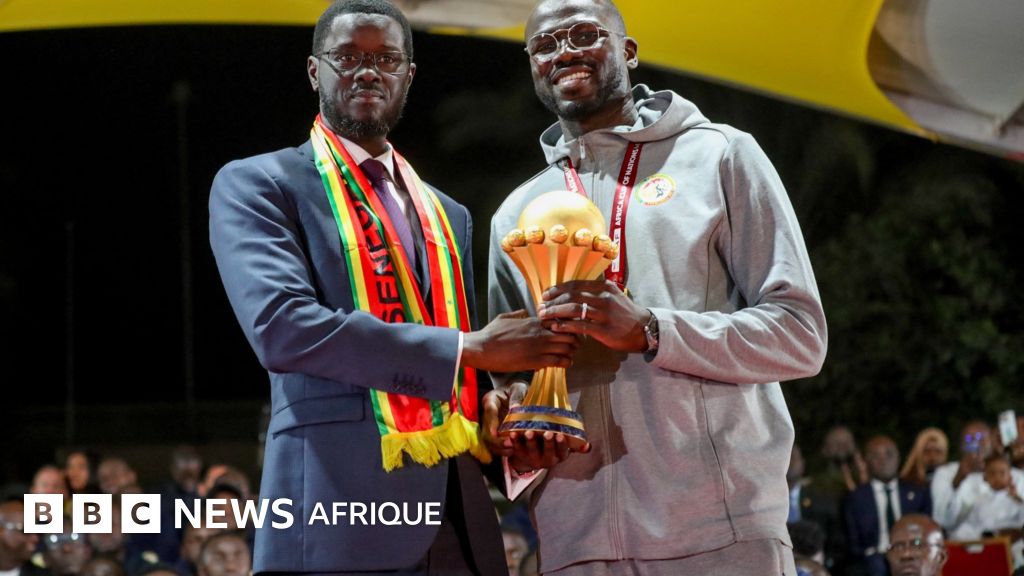
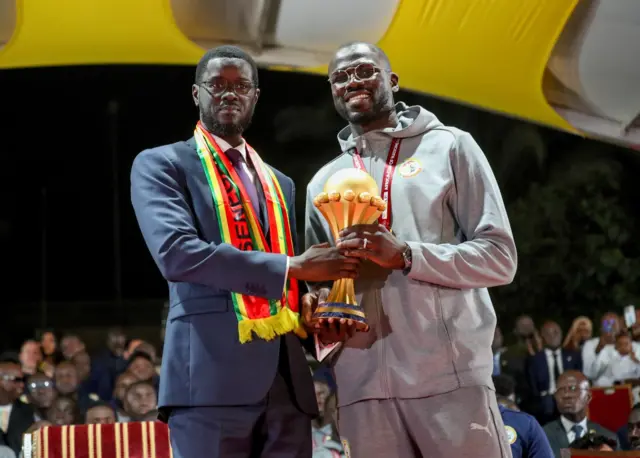
Crédit photo, Président de la République du Sénégal/Facebook
The Senegalese government has swiftly responded to a contentious ruling by the Confederation of African Football (CAF) Appeals Jury. This decision declared Senegal to have forfeited the TotalEnergies CAF Africa Cup of Nations Morocco 2025 final, played on January 18th, and named Morocco as the tournament champions.
In an official statement released this Wednesday, the government described the ruling as an “unprecedented decision of exceptional gravity, directly conflicting with fundamental principles of sports ethics, notably fairness, integrity, and respect for on-field truth.”
Categorically rejecting this “unjustified attempt at dispossession,” the Senegalese government has called for an independent international investigation into “suspicions of corruption within CAF’s governing bodies.” This development adds a significant twist to the CAN 2025 Senegal controversy.
Furthermore, the government stated its ongoing efforts to monitor the situation of Senegalese supporters detained in Morocco following incidents during the CAN 2025 final, aiming for a positive resolution. They reiterated their unwavering vigilance and commitment to “defending the rights of the Senegalese national team and restoring the honour of African sport.” This is a significant piece of West Africa Sahel news.
CAF’s controversial ruling
Morocco was awarded the Africa Cup of Nations 2025 title after the Confederation of African Football (CAF) overturned the original final result due to Senegal’s controversial walk-off.
Senegal had initially defeated Morocco 1-0 in the final on January 18th. The match was marred by a dramatic refusal from Senegalese players to continue playing after a penalty was awarded to Morocco in injury time, with the score still level at 0-0.
Following an approximate 17-minute suspension, the players eventually returned to the field. Brahim Diaz’s subsequent penalty attempt was saved, and Pape Gueye later scored the winning goal in extra time.
However, this on-field outcome was annulled by a decision from African football’s governing body’s appeals committee.
In a statement, CAF declared that Senegal was “declared to have forfeited the final” and the “match result was recorded as 3-0 in favour” of Morocco. The Senegalese Football Federation has announced its intention to appeal CAF’s decision to the Court of Arbitration for Sport (CAS), branding it an “unjust, unprecedented, and unacceptable decision that casts discredit upon African football.”
This ruling followed an appeal lodged by the Royal Moroccan Football Federation (FRMF), which CAF deemed “admissible in form” and subsequently accepted.
CAF further stated that, “by the behaviour of its team,” Senegal had violated Article 82 of the Africa Cup of Nations regulations, thereby making Article 84 applicable.
Article 82 stipulates that if a team refuses to play or leaves the field before the end of regular time without the referee’s permission, it is declared the loser and eliminated from the competition.
Article 84 complements this provision, specifying that any team infringing Article 82 is permanently eliminated and loses the match 3-0. In its statement, the FRMF asserted that its decision to appeal the final result was “never intended to question the sporting performance of the teams,” but rather constituted a request for the “application of the competition regulations.”
“The federation reaffirms its commitment to respecting the rules, ensuring clarity in the competitive framework, and maintaining the stability of African competitions,” the FRMF added in its communication.
“It also extends its congratulations to all nations that participated in this edition of the CAN, which marked a major turning point for African football.”
Earlier, a video shared on the Senegalese men’s national team’s X account showcased players celebrating their victory in a bus parade, holding the CAN trophy aloft and accompanied by an “OK” emoji.
Maher Mezahi, a North African sports journalist, conveyed to BBC Radio 5 Live that the decision to annul the result would not diminish the profound emotions experienced by those who witnessed the match.
“You cannot erase the last 16 minutes of that match and what we saw,” he asserted.
“You cannot erase the emotion of seeing Senegal lift the trophy, the players returning home with the medal, and parading.”
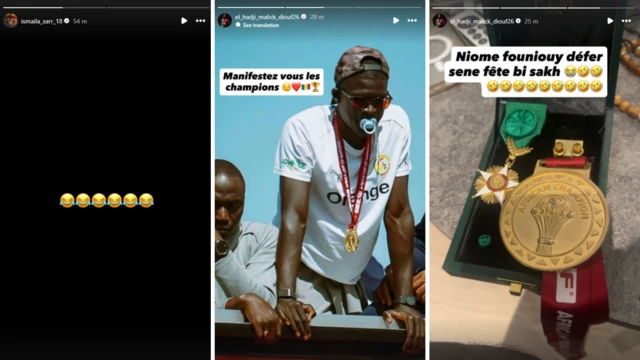
Crédit photo, Instagram
What unfolded during the CAN final?
With the score tied at 0-0, referee Jean-Jacques Ndala awarded a penalty in the eighth minute of added time.
Ndala was advised by the Video Assistant Referee (VAR) to review the challenge by defender El Hadji Malick Diouf on Diaz at the pitch-side monitor.
Senegal’s coach, Pape Thiaw, still incensed by Ndala’s earlier decision to disallow an Ismaïla Sarr goal, instructed his team to leave the pitch.
Former Liverpool forward, Sadio Mané, remained on the field, attempting to persuade his Senegalese teammates to complete the match.
After a 17-minute stoppage, the Senegalese players eventually returned.
Real Madrid attacker, Diaz, stepped up to take the penalty, but his softly-struck ‘Panenka’ attempt was easily caught by Senegalese goalkeeper Édouard Mendy, who barely had to move. Ndala immediately blew the final whistle.
Villarreal midfielder, Gueye, then scored the winning goal in the fourth minute of extra time, securing Senegal’s second triumph in five years.
During his post-match press conference, Moroccan coach Walid Regragui labeled Senegal’s actions as “shameful” and asserted that they “do not honour Africa.”
FIFA President, Gianni Infantino, strongly condemned these “deplorable scenes” in an Instagram post.
Thiaw’s press conference, however, was cancelled following an altercation in the media room.
Yet, in a post-match interview, he acknowledged that he should not have ordered his team off the pitch and offered his “apologies to football.”
Morocco subsequently parted ways with their coach, Walid Regragui, on March 5th, four months prior to the World Cup finals.