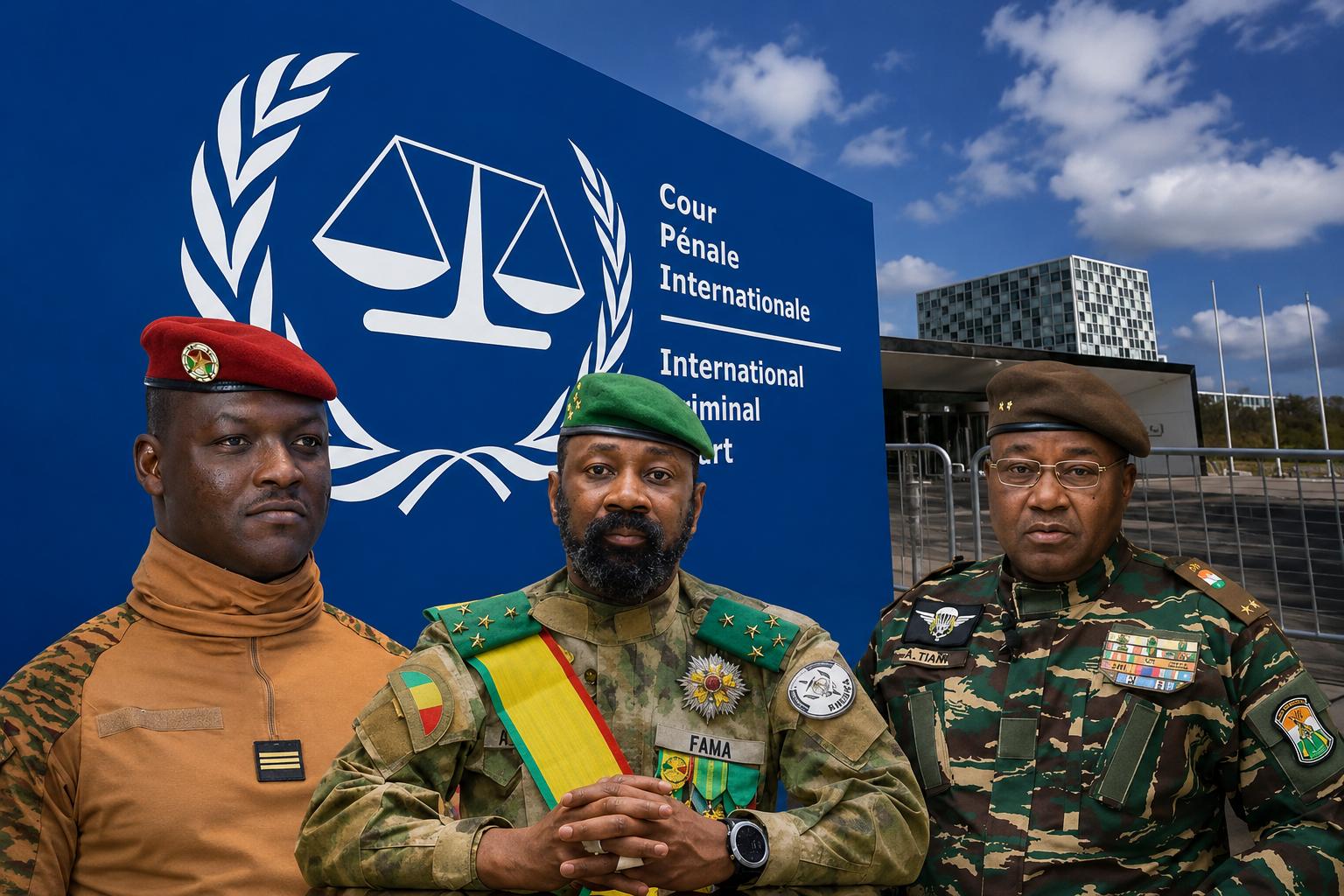
Following Niger’s precedent, both Mali and Burkina Faso have formally announced their departure from the International Criminal Court (ICC). While the military juntas forming the Alliance of Sahel States (AES) cite claims of “souveraineté” and a “politicized” judicial system, this significant move primarily unmasks a familiar tactic employed by authoritarian governments: distancing themselves from international law to safeguard their leaders from accountability. This underscores a critical development in Sahel politics today.
This triple withdrawal resonates as a tacit admission. Within a span of mere weeks, the three military administrations across the Sahel region finalized their disengagement from the global legal framework. Subsequent to Niamey’s notification, the capitals of Bamako and Ouagadougou formally informed the United Nations of their intent to withdraw from the Rome Statute, the foundational treaty establishing the International Criminal Court.
The official narrative propagated by these juntas is well-rehearsed: they portray the ICC as merely a “neo-colonial” tool, a system of selective justice manipulated by Western powers. Yet, beneath this veneer of sovereign and populist rhetoric lies a far more pragmatic and cynical truth. By severing ties with The Hague, these regimes are endorsing a classic dictatorial strategy: to embed impunity as a means to solidify and perpetuate their hold on power. This is a crucial Sahel breaking news development.
The autocrats’ legal shield
The ICC was established with a singular purpose: to intervene when national justice systems prove unwilling, unable, or fail to prosecute the most egregious offenses – specifically war crimes, crimes against humanity, and genocide. By pulling out of this jurisdiction, the military leaders in Mali, Burkina Faso, and Niger are overtly attempting to secure a form of legal immunity for themselves.
Within a West Africa Sahel region grappling with devastating asymmetric conflicts, human rights organizations consistently release reports detailing not only the horrific abuses perpetrated by jihadist groups but also the escalating atrocities committed against civilian populations by regular armies and their allied forces, such as the Russian mercenaries from the former Wagner Group operating in Mali. By effectively shutting the door on the ICC, the leaders of these juntas aim to guarantee that neither they nor their subordinates will ever face judgment before an international tribunal.
Populist rhetoric masking fear of justice
The assertion of “selective justice,” claiming the ICC exclusively targets Africa, has long been a resonant theme across the continent. While this argument may have held some historical validity, it is now entirely distorted by these dictatorial regimes. The ICC actively prosecutes war criminals in Ukraine and the Middle East, clearly demonstrating that its reach extends far beyond African borders.
In reality, contemporary history reveals that a state’s withdrawal from the ICC is almost invariably linked to an authoritarian shift or a desperate fear of its leaders facing indictment. Pierre Nkurunziza’s Burundi pioneered this path in 2017 amidst accusations of widespread violence by the regime. Today, the Sahelian juntas are employing an identical strategy: criminalizing internal dissent, suppressing the press, stifling civil society, and severing connections with international observers to operate without scrutiny. This is a significant aspect of Mali Niger Burkina news English.
The primary victims: civilian populations
This asserted surge of “souveraineté” by the AES regimes comes at the direct expense of Sahelian citizens. Local populations, trapped between the terror of extremist groups and the violence of states operating without checks and balances, find themselves deprived of their final recourse to justice.
While exiting the ICC, these regimes do not erase past transgressions, as ongoing proceedings or crimes committed while the treaty was active theoretically remain within the Court’s jurisdiction. Nevertheless, their actions send a calamitous message for the region’s future: a blank check for state-sanctioned violence. History has consistently shown that impunity has never secured the stability of a dictatorship; it merely postpones its inevitable collapse, making the ultimate cost for the populace far heavier.