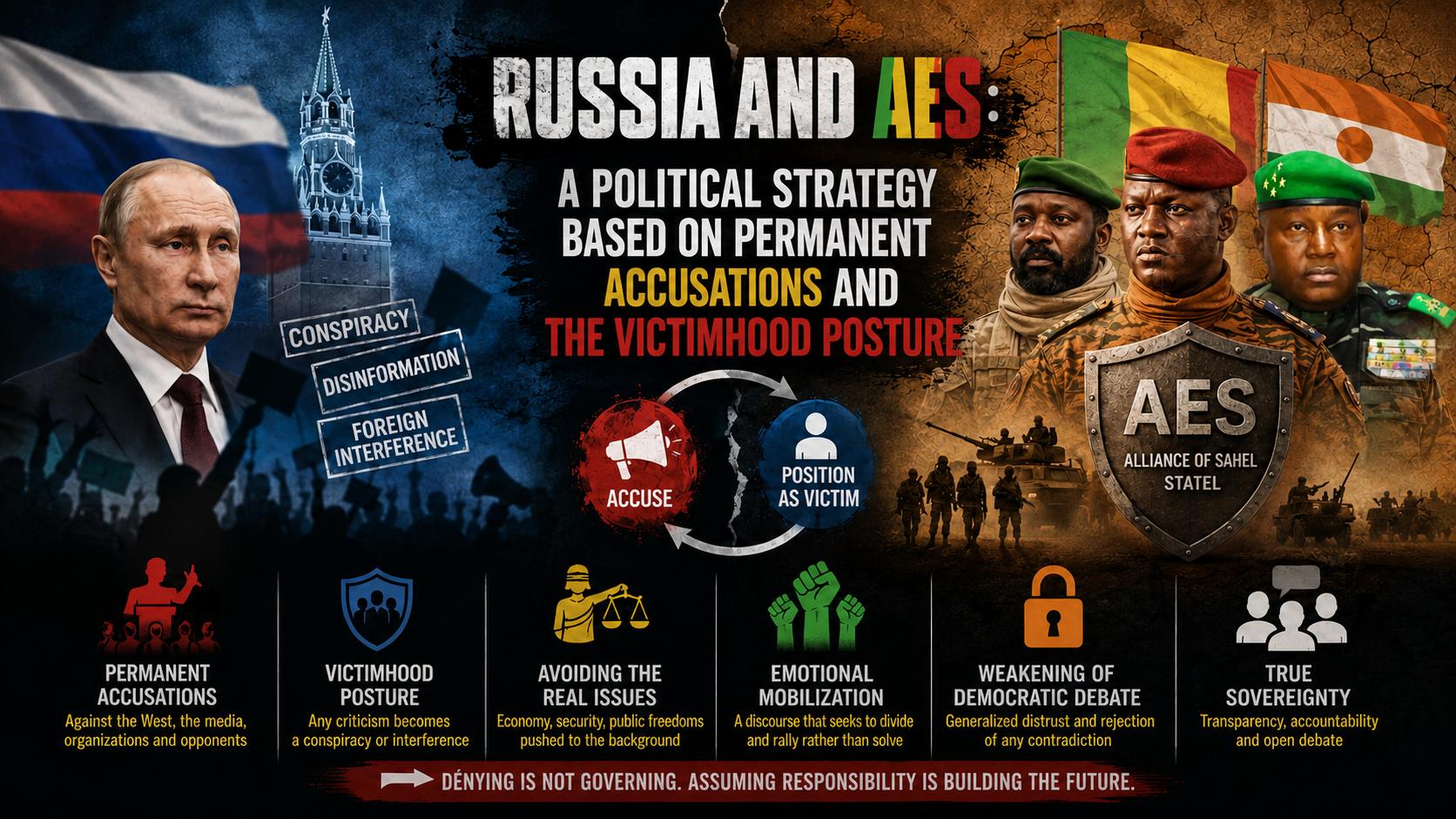
Over the past few years, a recurring pattern has emerged in the political communication strategies of both Russia and the governments within the Alliance of Sahel States (AES). Central to this approach is the practice of relentless denunciation of adversaries, whether they be Western powers, international media outlets, regional bodies, or domestic opposition forces. Criticism, however justified, is met with a barrage of counter-accusations, creating a cycle where those who frequently cast themselves as accusers swiftly revert to portraying themselves as victims when subjected to scrutiny.
a systematic pattern of deflection
This strategy has become entrenched in their political playbook. Whenever decisions or actions are questioned, the response is predictable: allegations of conspiracy, accusations of disinformation campaigns, or claims of foreign interference are swiftly invoked. Any form of critique is framed not as an opportunity for reflection but as a coordinated assault designed to undermine sovereignty or impede progress toward self-determination.
The underlying political advantage of this approach is clear. By casting themselves as targets of external aggression, leaders sidestep accountability for pressing domestic issues. Economic hardships, ongoing insecurity, restrictions on civil liberties, and the uneven outcomes of certain policies are overshadowed by a narrative steeped in emotional appeal. The focus shifts from addressing tangible challenges to rallying support through a discourse that prioritizes mobilization over substance.
the AES and the weaponization of victimhood
Within the AES, this tactic is particularly pronounced. Authorities routinely attribute setbacks to sanctions, colonial legacies, or external actors. Yet, when citizens, journalists, or human rights organizations raise concerns about internal governance failures, their critiques are dismissed outright. Often, they are dismissed as part of a broader campaign of destabilization orchestrated from abroad—a claim that serves to invalidate legitimate concerns without examination.
Russia, too, employs a similar logic on the global stage. In response to international criticism regarding its foreign policy, military interventions, or human rights records, the official narrative consistently portrays the country as the perpetual victim of Western hostility. This framing not only diverts attention from the substance of the critiques but also reframes dissent as evidence of an orchestrated smear campaign.
the unsustainable nature of perpetual victimhood
While this strategy offers short-term political benefits, its long-term sustainability is questionable. A government’s credibility hinges on its willingness to engage with dissent, respond to criticisms with reasoned arguments, and remain accountable to its citizens. By framing every challenge as a conspiracy, the foundations of democratic discourse are weakened, and a culture of mistrust is perpetuated.
Accusation is a convenient tool, but it pales in comparison to the demands of responsibility. Through the frequent recourse to victimhood, Russia and several AES member states risk conveying an image of evasion rather than engagement. Criticism, no matter how harsh, should not automatically be equated with conspiracy. In any functional society, it can serve as a catalyst for policy improvements, error correction, and the strengthening of public trust.
True sovereignty is not merely about denouncing perceived enemies—real or imagined. It is forged through transparency, accountability, and the acceptance of open debate. Without these pillars, the narrative of perpetual victimhood loses its persuasive power, revealing itself less as a genuine response to challenges and more as a calculated political maneuver.