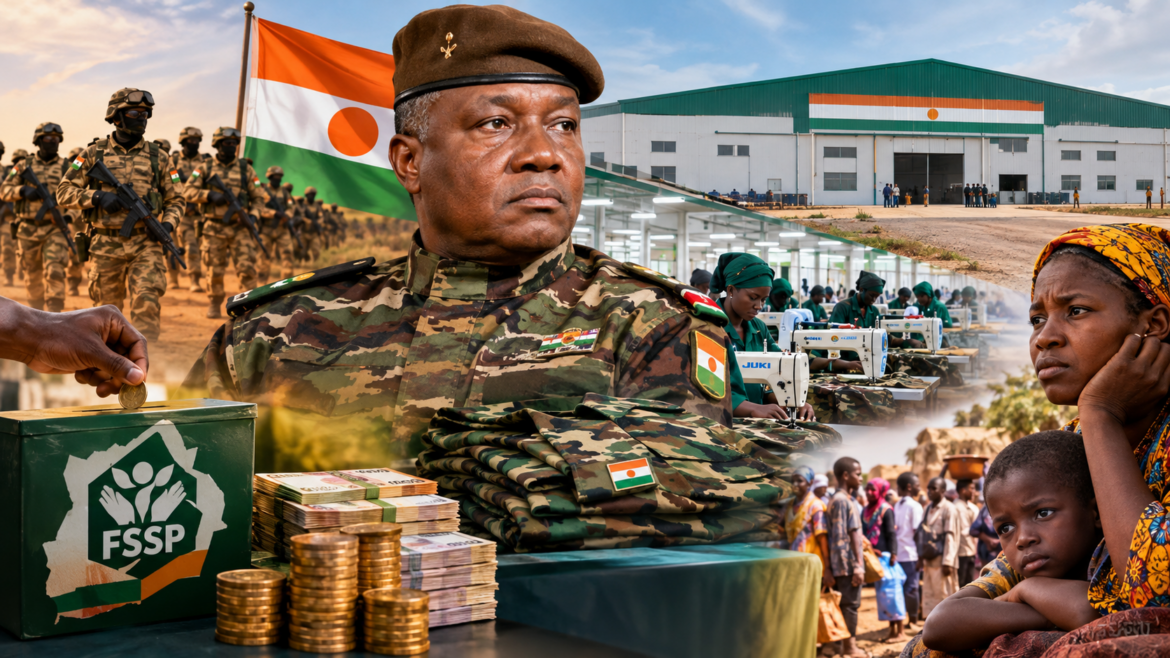
The ceremonial laying of the foundation stone for a military uniform production unit in Niger has reignited a critical debate about national priorities. With an announced capacity of 1,000 uniforms per day and financed entirely by the National Solidarity Fund for the Safeguard of the Homeland (FSSP), the project raises a pivotal question: does this new infrastructure address the most pressing needs of the population?
Local production and its strategic implications for national security
Producing military equipment domestically could, in theory, reduce reliance on imports and streamline supply for the armed forces. However, the objectives, total cost, financing arrangements, and expected outcomes of the project remain unclear. In a country grappling with persistent insecurity and widespread economic hardship, citizens are justified in asking what tangible benefits this initiative will bring to their daily lives.
With a stated capacity of 1,000 uniforms per day, the unit could produce up to 365,000 uniforms annually if operating at full capacity every day. This substantial figure prompts several questions: what specific needs will this production meet? How many uniforms do Niger’s armed forces require? Where will the equipment be deployed, and how will distribution be organized?
Beyond these questions, a fundamental issue persists: will the mere availability of uniforms improve the security situation on the ground? While clothing and equipment are essential for soldiers, they represent only one component in the fight against armed groups. Security also depends on operational capabilities, intelligence, logistics, training, and the ability to protect populations sustainably.
If authorities present this unit as a response to the army’s needs, they must also demonstrate how it will concretely improve security conditions in areas affected by violence.
The FSSP and the allocation of popular contributions
The financing of the project through the National Solidarity Fund for the Safeguard of the Homeland raises another critical question: how are resources mobilized in the name of national solidarity distributed among the country’s various urgent priorities?
In a context where households struggle to meet their food needs, economic difficulties weigh on purchasing power, and insecurity disrupts the activities of many communities, the population has a right to expect transparent and justified use of collected funds.
This is not to deny the importance of the army’s needs or to reject any industrial initiative on principle. Rather, it is to demand that authorities demonstrate that expenditures address clearly established needs and will yield measurable results.
If contributions are levied from citizens, directly or indirectly, their use must be explainable. How much will the project cost? What portion of the financing actually comes from FSSP resources? How many jobs will be created? What revenues will this unit generate, and within what timeframe? These are questions to which officials should provide precise answers.
The AES and the proliferation of industrial projects: is there a common strategy?
This initiative also invites scrutiny of the growing number of local production projects announced in the countries of the Alliance of Sahel States (AES). Niger, Mali, and Burkina Faso all express a desire to strengthen their autonomy and reduce external dependence.
This ambition may be legitimate. However, a question remains: are these projects part of a coordinated industrial strategy based on each country’s real needs, or do they follow a pattern of replicating similar initiatives without sufficient public evaluation of their profitability?
Industrialization is not measured solely by the number of factories inaugurated or the announced production capacity. It is also measured by the creation of sustainable jobs, cost control, availability of raw materials, existence of markets, and the economic and social benefits generated.
Without precise data on these elements, it would be premature to conclude that the announced unit will be an economic success. Authorities must explain how the project will be operated, maintained, and financed over time, and how they will prevent operating expenses from becoming an additional burden on public finances.
A capacity of 365,000 uniforms per year: what economic justification?
The calculation is straightforward: at 1,000 uniforms per day, continuous production over 365 days would yield 365,000 uniforms annually. But this theoretical capacity does not mean the factory will actually produce that volume. Results will depend on the pace of operations, orders, supplies, and available resources.
The real question is therefore the alignment between production capacity and actual needs. If orders are insufficient, some capacity may remain unused. Conversely, if military needs are significant, this production could help alleviate supply difficulties. Only data on needs, costs, and contracts will determine the project’s economic relevance.
It would also be essential to know the manufacturing cost per uniform, its production cost compared to imported uniforms, and the expected savings for the state budget.
Producing locally is not automatically synonymous with savings. Everything depends on how the project is designed, financed, and managed.
Citizens also expect answers to their daily struggles
Beyond military and industrial considerations, citizens’ concerns remain numerous. Access to adequate food, decent incomes, healthcare, and essential services is a priority for families facing rising expenses and the consequences of insecurity.
Authorities must therefore explain how their investments align with policies aimed at improving living conditions. What resources are allocated to food security? What measures support vulnerable households? What investments will strengthen public services and preserve purchasing power?
These questions are not incompatible with national defense. On the contrary, security and economic development are closely linked. A population with better living conditions, economic activities, and future prospects is also better equipped to withstand the consequences of crises.
Ultimately, the creation of a military uniform production unit should not be evaluated solely on its announced capacity. It must be assessed based on its real usefulness, profitability, contribution to security, and benefits for the Nigerien economy.
Authorities have the responsibility to present verifiable figures, justify the use of FSSP resources, and demonstrate that this project meets a clearly identified need. For citizens who contribute to the national effort, the multiplication of announced infrastructures cannot replace concrete results in security, employment, and improved living conditions.