The attack on Niamey’s airport: a rare escalation in the Sahel
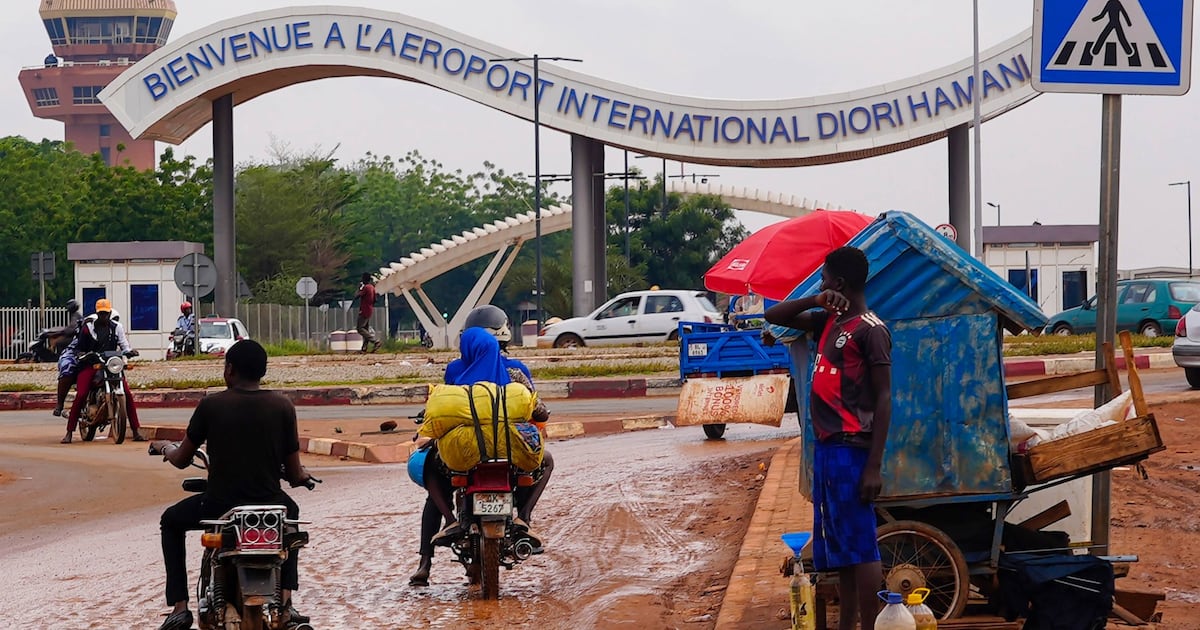
In the early hours of January 29, gunfire and explosions rocked Niamey, targeting the Diori Hamani International Airport. The assault, which lasted about an hour, was later claimed by the Islamic State in the Sahel (EIS) through its AMAQ propaganda outlet. While official figures remain unverified, authorities reported 20 attackers killed, 11 captured, and four Nigerien soldiers injured.
Following the incident, the Russian Ministry of Foreign Affairs confirmed that Africa Corps—a unit under Russia’s Defense Ministry—had assisted in securing the airport alongside Nigerien forces. This collaboration underscores Niger’s pivot toward Moscow amid shifting security alliances.
EIS propaganda footage exposes the attack’s scale
The Islamic State in the Sahel escalated its propaganda by releasing a video allegedly filmed during the assault. The footage, branded with the AMAQ logo, shows dozens of armed militants moving through the airport’s military zone, opening fire, and setting fires. Damaged aircraft, including two small planes and a helicopter, were visible, along with burning munitions stockpiles.
The attack extended to the civilian side of the airport, where attackers filmed commercial planes belonging to Asky Airlines and Air Côte d’Ivoire. Authorities confirmed damage to three civilian aircraft, though specifics about the extent of destruction remain unclear.
Niger’s shifting security landscape
While Niger has battled jihadist groups like the Group for the Support of Islam and Muslims (JNIM)—affiliated with Al-Qaeda—for over a decade, direct strikes on the capital are unprecedented. Just days before the airport attack, the JNIM claimed responsibility for destroying a military vehicle near Niamey, signaling growing threats to the central government.
Since the 2023 military coup, Niger has distanced itself from Western partners, including the departure of French forces in late 2023 and the withdrawal of most U.S. military personnel in 2024. Concurrently, Niamey has deepened ties with Russia, embedding Africa Corps personnel within its security framework, particularly at the airport’s Air Base 101.
Diplomatic fallout amid accusations
General Abdourahamane Tiani, leader of Niger’s military junta, accused France, Benin, and Côte d’Ivoire of sponsoring the attack—a claim swiftly rejected by Abidjan and Cotonou. The Côte d’Ivoire government summoned Niger’s ambassador, condemning the remarks as a threat to bilateral relations.
Meanwhile, Italy’s MISIN mission, with around 300 troops stationed near the airport, denied involvement in the clashes. Italian Defense Minister Guido Crosetto emphasized that his forces prioritized their own security above all else.
A strategic target with regional implications
The airport holds critical significance beyond its symbolic value. It serves as:
- The headquarters for the G5 Sahel joint force (comprising Niger, Mali, and Burkina Faso);
- A storage site for uranium concentrates, a point of contention with French firm Orano;
- A potential asset for Russia, as Niger explores alternative partnerships amid its uranium sector’s diversification.
Despite the attack, air traffic resumed the next day, and life in surrounding areas quickly returned to normal. However, the incident marks a pivotal moment: the EIS has demonstrated its operational reach, while Russia’s growing footprint in Niger’s security raises concerns about regional destabilization.