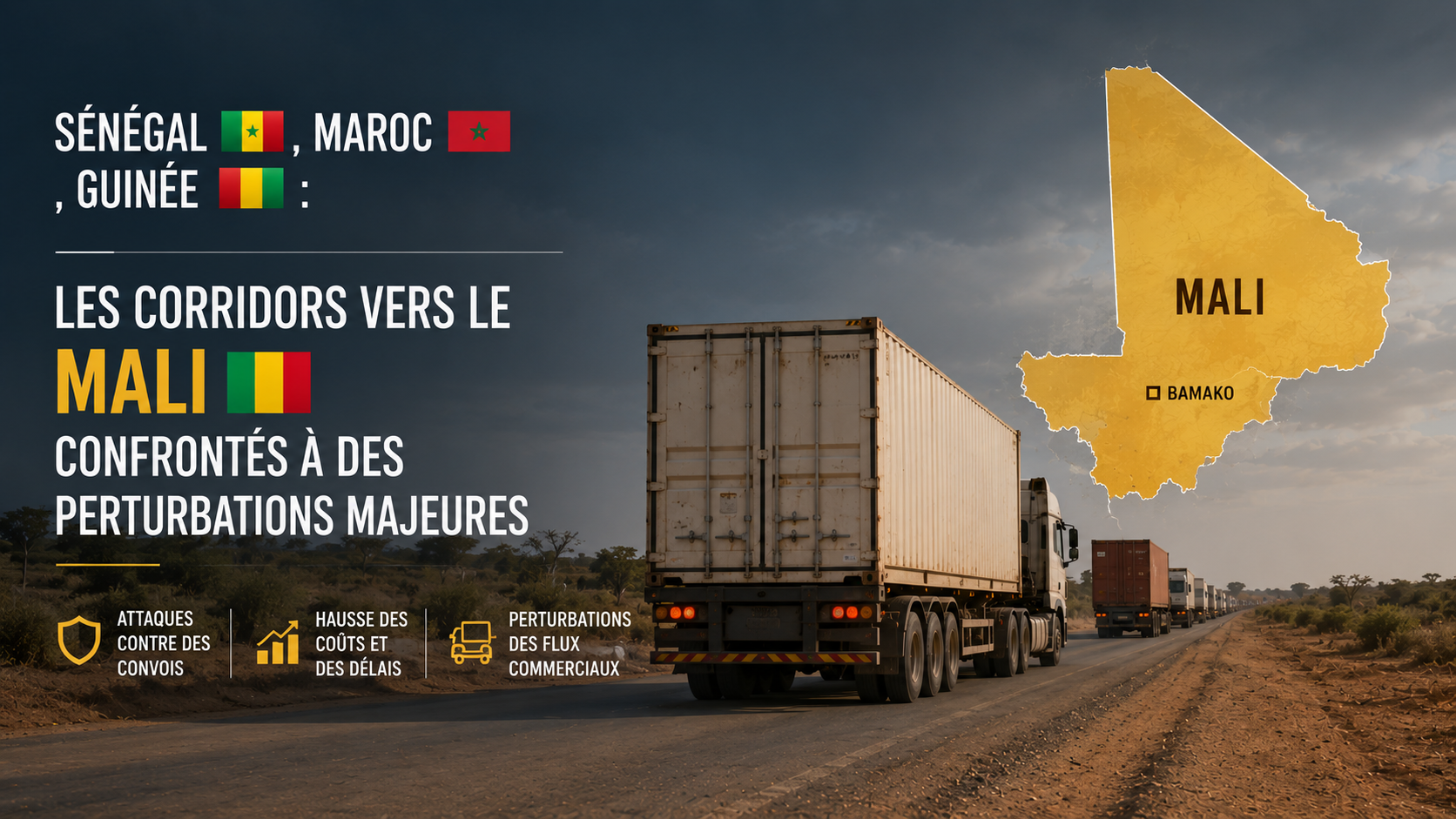
Senegalese carriers calling for a halt to trips toward Bamako, Moroccan operators exercising greater caution, and disruptions along the Guinea-Mali corridor — several vital road arteries for Mali’s supplies have faced major difficulties in recent weeks.
Rising insecurity disrupts key trade corridors
The challenges affecting multiple corridors serving Mali are beginning to reshape regional transporter habits. Behind calls to suspend certain routes and worries voiced by professional organisations, the disruptions on trade axes are now raising freight costs, delivery times, and the logistics chains linking Bamako with its main commercial partners.
As a landlocked nation, Mali relies heavily on regional road transport. The Dakar-Bamako corridor remains one of the main entry points for Malian imports. In 2024, roughly 2.6 million tonnes of goods destined for Mali transited through the port of Dakar, underlining the economic weight of this axis in the country’s supply. Security concerns are now translating into concrete actions by transporters. In Senegal, the Union of Road Haulers reports that at least eleven Senegalese trucks operating on Mali routes have been set ablaze in recent weeks. Professional organisations have urged drivers to reduce or suspend certain trips, arguing that the risks are becoming economically unsustainable.
Attacks on convoys heighten fears
The incident of May 6 deepened these worries. Several commercial convoys were attacked on the road linking the Mauritanian border to Bamako. According to Moroccan union officials, more than fifteen trucks from Morocco, Senegal, and Mauritania were targeted by armed groups. At least six Moroccan heavy goods vehicles were burned.
This event also had repercussions in Morocco, where many road transport operators are now showing greater caution regarding Mali-bound routes. For transport companies, the calculations are shifting rapidly: rising insurance premiums, vehicle immobilisation, increased security costs, and more detours are eating into margins on journeys that are already long and expensive.
Guinea-Mali corridor also affected
The Guinea-Mali corridor is not escaping the disruptions. Since attacks reported in late April on this major commercial route, the movement of goods and passengers has slowed significantly. Yet this itinerary plays an important role in Mali’s logistical diversification, notably via the port of Conakry. The difficulties on this road limit the available alternatives when other corridors face tension.
The consequences now extend beyond transport companies alone. On several axes, drivers are prolonging waiting times before departure, some convoys travel in groups, and families remain without news of relatives who left on the roads for days. For economic operators, each interruption increases storage costs, delays deliveries, and slows cross-border trade. When several corridors are disrupted simultaneously, the supply of the Malian market, regional logistics times, and cross-border economic activity all feel the direct effects of these difficulties.
Three years after the security reorientation undertaken by Mali, Burkina Faso, and Niger — marked by a distancing from several Western partners and a closer alignment with Russia — security challenges continue to weigh on the Sahel. These security difficulties are now increasingly affecting regional trade and circulation on major commercial routes. The repercussions are felt well beyond the borders of the Alliance of Sahel States: transporter organisations in Senegal, Moroccan operators, and Mauritanian haulers all express major concerns about the risks on certain Malian roads.