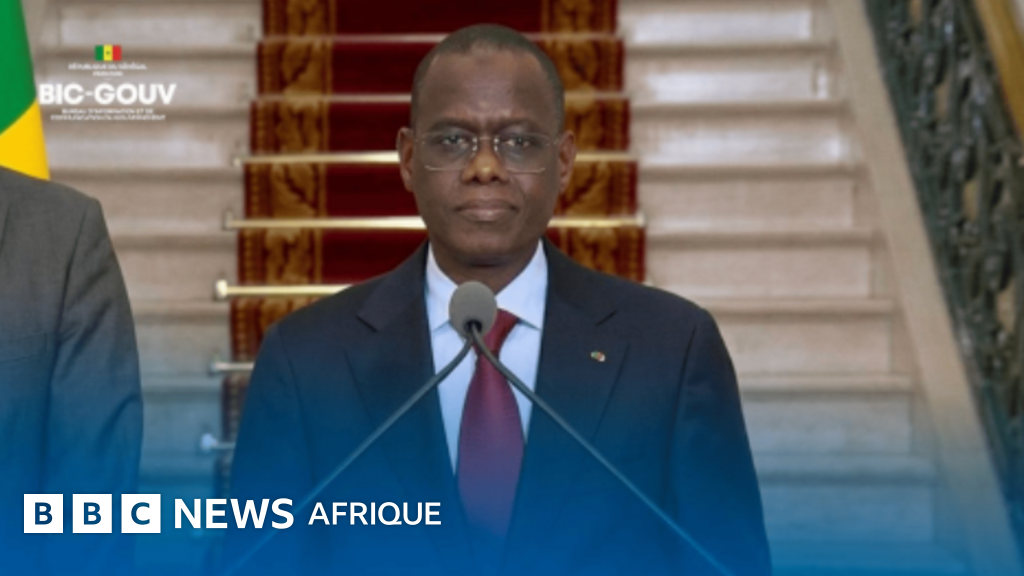
President Bassirou Diomaye Faye unveiled the new cabinet lineup late Monday evening, just ten days after dismissing former Prime Minister Ousmane Sonko. The reshuffled team now faces the urgent task of steering Senegal out of its deepening debt crisis while resisting calls for restructuring.
Led by newly appointed Prime Minister Ahmadou Al Amine Mohamed Lo, the 30-member team includes 26 full ministers and four deputy ministers. The cabinet features four women, none of whom hold key sovereignty portfolios.
The formation comes as the PASTEF party, led by former Prime Minister Sonko, announced its refusal to participate due to profound disagreements with the administration’s policy direction. This move leaves the government without a parliamentary majority, complicating its ability to push through reforms.
a cabinet without parliamentary backing
Hours before the official announcement, PASTEF released a statement declaring its decision to stay out of government, citing irreconcilable differences with President Faye’s leadership. Several high-profile PASTEF figures, including Birame Souley Diop (Energy), Yacine Fall (Justice), Amadou Ba (Culture), and Maïmouna Gueye (Family and Social Solidarity), have exited the government in solidarity with the party’s stance.
Despite the boycott, a few former PASTEF members remain in the cabinet, such as Balla Moussa Fofana (Urban Planning), Yancoba Diémé (Defense), Ibrahima Sy (Health), and Cheikh Diba (Finance, Economy, and Planning). New faces from PASTEF, including Cheikh Tidiane Dieye (Sanitation), Déthie Fall (Infrastructure), Moustapha Guirassy (National Education), and Mamadou Lamine Dianté (Civil Service), have also been included.
Meanwhile, allies of Sonko occupy key roles like Boubacar Camara (Higher Education, Research, and Innovation), while the Coalition Diomaye secures six ministerial positions, with El Hadj Abdourahmane Diouf taking charge of Energy and Petroleum. Veteran Dakar lawyer Me Moussa Sarr now leads the Ministry of Justice.
women significantly underrepresented
The cabinet’s gender balance remains skewed, with only four women among 30 members—down from five in the previous 31-member lineup. Three hold full ministerial posts, while one serves as a deputy minister.
The female ministers are:
- Marie Angélique Mame Selbé Diouf – Minister of Family, Social Action, and Solidarity
- Djirèye Clotilde Coly – Minister of Sports and Youth
- Ami Mara – Minister of Fisheries and Maritime Economy
- Mame Coumba Diop – Deputy Minister of Culture, Crafts, and Tourism (Culture, Creative Industries, and Historical Heritage)
Women’s rights advocates have criticized the lack of representation, arguing it fails to reflect women’s demographic weight and expertise. Dr. Coumba Mar Gadio of the African Women Leaders Network (AWLN) Senegal chapter stated, “This configuration neither mirrors women’s role in Senegalese society nor leverages their strategic expertise.” She urged the government to adopt corrective measures to strengthen women’s presence in decision-making spheres.
Since May 2010, Senegal has had a law mandating gender parity in elective institutions, but its application remains limited to political roles, leaving cabinet appointments largely unaffected.
debt crisis and IMF negotiations loom large
Senegal is grappling with a staggering debt burden, including a hidden debt estimated at over $7 billion inherited from the previous administration. The issue has been a point of contention between President Faye and former Prime Minister Sonko during coalition talks.
Amath Ndiaye, an economist at Cheikh Anta Diop University, suggests the new government may adopt a more flexible approach toward debt restructuring. “The economic downturn, rising unemployment, and growth projections of just 2.2% to 2.5% for 2026 demand urgent action,” he noted. “Negotiations with the IMF will likely shift toward a more pragmatic stance, moving away from the previous administration’s restrictive interpretation of sovereignty.”
However, the government faces a dilemma: securing an IMF agreement to reprofile debt could require cutting subsidies and public spending, while rising living costs, unemployment, and social unrest demand immediate relief. “Balancing these two imperatives will be the administration’s greatest challenge,” Ndiaye warned.
an unprecedented political standoff
Moussa Diaw, a political science professor at the University of Gaston Berger, describes the current situation as “unprecedented in Senegal.” The 2024 legislative elections produced a majority for PASTEF, but President Faye’s party lacks a parliamentary foothold, creating a rare cohabitation scenario.
Diaw attributes the divide to fundamental disagreements over governance, debt resolution, and justice for victims of the 2021–2024 protests that left over 80 young Senegalese dead. “The lack of alignment on political direction has led to a standoff,” he explained. “The government struggles to govern without allies, while the opposition-dominated parliament can block initiatives at any time.”
He cautioned that Prime Minister Lo’s administration has “limited room for maneuver” and must avoid confrontation to prevent institutional paralysis. “Both the presidency and parliament must prioritize Senegal’s stability, set aside partisan ambitions, and ensure institutions function smoothly.”
constitutional roles must be respected
Diaw emphasizes that the presidency and parliament each have defined constitutional roles that must be exercised responsibly. “The president and the speaker of parliament must rise above political considerations and focus on the nation’s interests,” he stressed. “Only through dialogue, courage, and patriotism can they prevent a crisis in these economically turbulent times.”
The success of this administration hinges on collaboration between President Bassirou Diomaye Faye and Speaker Ousmane Sonko, two leaders who must demonstrate statesmanship to uphold Senegal’s democratic stability.